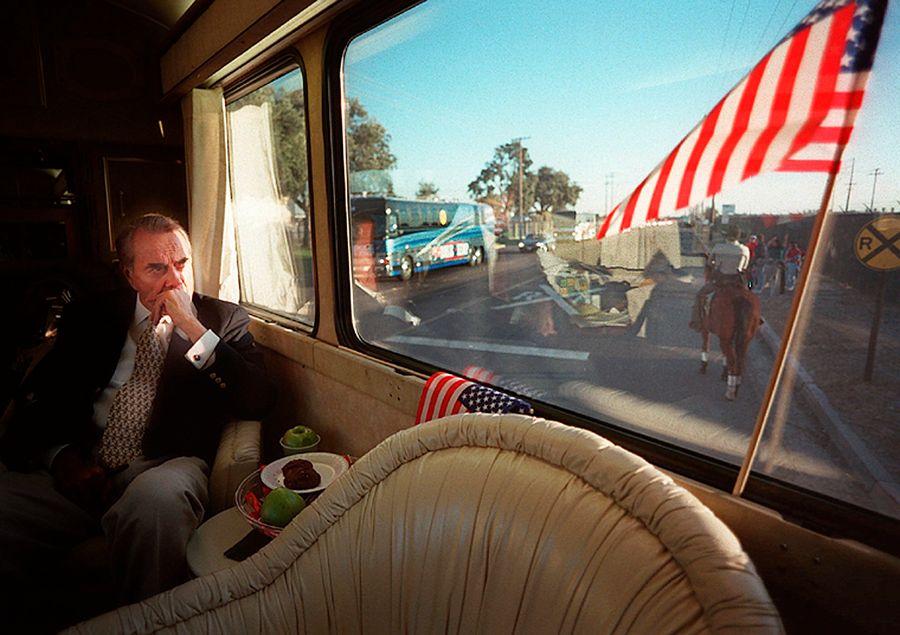
Dole A Closer Look
The Many Bob Doles, All of Them Honorable
COMMENTARY
Published Dec. 6, 2021 • Read time: 11m
Join the Conversation
0Notwithstanding the tenor of our times, it was a jolt to see segments of the liberal Twitterati trolling Bob Dole just hours after his death Sunday at 98. What were the sins of a war hero who devoted his career to public service — a man who, successfully, championed sweeping government programs to help the poor and disabled? Supporting Donald Trump, of course.
To some people, a guy could cure cancer and fix global warming, but if he ever spoke in support of Trump, nothing else would matter. Dole was a lifelong Republican who served in Congress for decades, once led the Republican National Committee, and was his party’s nominee for vice president (1976) and president (1996), yet some progressives are apparently dumbfounded by his support for the GOP’s most recent nominee.
It’s an odd perspective, even in these hyper-partisan times, but let’s get it over with: Yes, Dole endorsed Trump twice — and pronounced himself “a Trumper” as recently as this summer in an interview with Susan Page of USA Today. But he also scoffed publicly at the 45th president’s claims of voting fraud, telling the Kansas City Star six weeks after the election, “It’s a pretty bitter pill for Trump, but it’s a fact he lost.” He also told Page in July that he was “sort of Trumped out.” So yes, along with 74.2 million other Americans, Bob Dole voted for the GOP ticket last year. It’s barely a footnote in a lifetime of national service by a highly driven man.
At Russell High School in western Kansas, he arose at 5 a.m. to go running before delivering the morning newspaper. He was a three-sport athlete good enough in basketball to play for legendary University of Kansas coach Phog Allen. A pre-med student who hoped to become a doctor, Dole also was on the Jayhawks’ football and track teams.
Cruz's Path to Nomination
Trump Stands by His Manager
With Tweets on Heidi Cruz, Trump Sinks to New Depths
A Vote for Kasich Is a Vote for Trump
In December 1942, though, he signed up for the U.S. Army Enlisted Reserve Corps. He’d hoped to play one more basketball season after the current one. Instead he was called to active duty on June 1, 1943, and commissioned as a second lieutenant a year later. He was at Camp Breckenridge in Kentucky, receiving artillery training on D-Day and was shipped to Europe days before Christmas. In February 1945, he was assigned to lead platoon in the elite 10th Mountain Division. His company, made up mostly of Olympic skiers and expert mountain climbers, was tasked with rooting out Nazis who had escaped into the Alps.
“I thought it was mighty odd that a kid from Kansas who had seen a mountain up close only once in his life would be assigned to lead a platoon of mountain troops,” Dole wrote in his 2005 account. “We Kansans didn’t ski much.”
On April 14, 1945, the orders called for a small squad to take out a German machine-gun nest. Dole was supposed to remain behind. He changed the orders and led the squad, which was raked by enemy fire. Dole took cover in a foxhole, then crawled out to retrieve his wounded radio man. He was hit by a shell that exploded on his right shoulder, crushing his collarbone, puncturing his lung, paralyzing him from the neck down. His men pulled him to safety but were unable to evacuate him for nine hours while he lay in a bloody heap. Sent to Europe as a Division I athlete, he returned to Kansas in a body cast — “boxed up,” he recalled later, “like a piece of furniture.”
He’d been a popular kid growing up. His peers liked him, as did his teachers. When their high school journalism teacher announced a pop quiz one day, young Dole puckishly suggested an alternative: an ice cream social. The teacher, apparently charmed, agreed. Although his female classmates voted him the “best-looking” boy in school, he was too busy with sports, studies, and his job as a soda jerk at the Main Street drugstore to be much of a ladies’ man. The girls called him “Bashful Bob.”
After the war, athletic competition was a thing of the past. His dreams of being a doctor evaporated. But Kansas helped bring him back to life. He returned home to an Army hospital in Topeka, where he couldn’t walk, eat, or go to the bathroom unassisted. The muscular 6-foot-2-inch, 194-pound soldier weighed 122 pounds. His friend Bub Dawson told journalist Sheryl Stolberg that he looked “like he’d come out of Dachau.” Slowly, he recovered. From traction, he went to a wheelchair, then to a walker, and finally he could walk unassisted. The right arm was now shorter than the left — and useless. Working so hard at physical therapy that his family feared he would overdo it, Dole underwent countless surgeries while in and out of the hospital for three more years.
“I think,” Bub Dawson’s brother Chet recalled, “that wound kind of motivated him. By golly, he wasn’t going to be a cripple. He wasn’t going to be dependent on anybody.”
Military health care wasn’t enough then, as it isn’t now, however, and despite the two Purple Hearts and the Bronze Star, there were medical bills to pay. The Dawson brothers placed cigar boxes in the local VFW hall and other places around town — the mid-20th century version of GoFundMe — and $1,800 was raised.
For much of Dole’s career in the Senate, these details were unknown outside of Kansas. His second wife, Elizabeth Hanford Dole, said that in the early years of their marriage, she didn’t even know much about it. But Dole’s crucible was not forgotten back home. In 1976, during his first appearance with Gerald Ford after being named the president’s running mate, a crowd of 10,000 — nearly twice the city’s population — assembled in downtown Russell. Dole began to thank them for their support after the war but was overcome by emotion and had to stop speaking. The audience remained respectfully quiet until Ford rose to his feet and led them in applause. Wiping tears from his eyes, Dole said, “That was a long time ago.”
During his 1996 presidential campaign, his team finally prevailed on the candidate to share the story, or at least, let them share it. Until then, his notion of discussing his war record usually amounted to murmuring asides such as “I’ve been tested.”
Dole first ran for president in 1980, a year in which Ronald Reagan so dominated the Republican field (not to mention the general election) that few people even remember the Kansas senator was a candidate. Four years earlier, he had been tapped as Gerald Ford’s running mate, pitted against the Democratic ticket of Jimmy Carter and Walter Mondale. Ford chose him after narrowly defeating Reagan, presumably because Dole was palatable to the conservative wing of the GOP.
In those days, veep candidates were expected to play the role of “attack dog” on the campaign trial, and Dole had already shown he was up to the task. The man could never resist a zinger. Some of the funniest concerned Richard Nixon. Dole defended Nixon until very late in the game, but while running for reelection in Kansas in 1974, he was asked if he wanted the Watergate-enmeshed president to campaign for him. “I’d settle for a flyover by Air Force One,” he deadpanned.
It was the kind of caustic quip he was known for, but Dole could take it too far. He certainly did during his 1976 debate with Mondale in which he complained about the 1.6 million American military personnel who had lost their lives in “Democrat wars.” Astonished at this example of hyper-partisanship — it was a gaffe, really — Mondale replied: “Senator Dole has richly earned his reputation as a hatchet man tonight. Does he really mean to suggest that there was a partisan difference over our involvement in the war to fight Nazi Germany?”
Dole tried running for president four years later in a campaign remembered among political aficionados for two things: the media’s hysteria over Dole’s express desire that George H.W. Bush “stop lying about my record” — a comment somehow ruled out of bounds — and Dole’s emergence as the unlikely protagonist of Richard Ben Cramer’s campaign classic, “What It Takes.”
Writing for Esquire magazine in September 1996 while researching the book, Cramer caught the essence of a principled politician who managed to come across as disingenuous simply because he craved the presidency too damned much.
Dole had launched the campaign by resigning his Senate seat, which also meant relinquishing his post as Republican leader of the chamber and giving a poignant speech on the Senate floor, probably the best of his career. “I will then stand before you without office or authority, a private citizen, a Kansan, an American,” he said. “Just a man.”
The eloquence didn’t survive the heat of the campaign. Dole was always more comfortable saying whatever came into his head as a candidate (often referring to himself in the third person), which in practice meant turning himself into a rhetorical pretzel.
“For those of us odd and old enough to have acquired early our taste for Doles,” Richard Cramer wrote, “there is still, touching down on our personal tarmacs, the Horatio Bobster of ’88 (I’m one of you!), the right-winger-without-hair-dye of ’80 (Y’lookin for a younger Ronna Reagan? Here I am!), and (my personal favorite) from ’76, the long-sideburned, lapels-like-aircraft-carrier-decks, squinty-eyed, hard-assed Bobster-as-Veep, who flung himself about the heartland, rasping out the message (Whip Inflation Now!) for God, country, and Jerry Ford.”
Or as the equally talented, but pithier, political journalist Michael Kelly wrote in the New Yorker, “Watching Bob Dole campaign for the presidency is a curious and dislocating experience, like showering clothed or eating naked.”
Why wasn’t he a better candidate? Who knows? It’s not such a disgrace, really. In a country of 300 million, only one citizen can hold that job at a time. It hardly means the rest are losers (even if the 45th U.S. president can’t grasp that concept). Luck plays a role, too, but in Dole’s case perhaps the problem was simply as basic as this: His skill set translated poorly to the campaign trail — and perfectly to the U.S. Senate (at least when Congress still functioned).
Dole didn’t hold grudges, for one thing. And his self-deprecating wit coupled with a desire to achieve lasting legislative legacies made it hard for Democrats to hold grudges against him. After losing the 1972 presidential campaign to Nixon in a landslide, Sen. George McGovern recalled how Dole “took a bite out of me every morning for breakfast.” Yet, just six years later, Dole teamed up with McGovern to greatly expand the nation’s food stamp program.
During Reagan’s second term, Dole led the efforts on Capitol Hill to restore fiscal sanity in the wake of GOP budget cuts and increased congressional spending by shepherding through a difficult tax bill. More importantly, he teamed up with Democratic Sens. Tom Harkin and Edward M. Kennedy to enact the Americans With Disabilities Act, which was signed into law by Dole’s longtime rival George H.W. Bush in 1990.
In the last decade or so, Dole would journey on weekends from his home in the Watergate Hotel to the World War II Memorial on the National Mall and greet the aged warriors who fought in that “Democrat war” — a noble war — and who had come, usually for the last time, to the city that epitomizes freedom to the world. Dole had helped raise the money for that memorial and spoke at its dedication in 2004.
“What we dedicate today is not a memorial to war, rather it's a tribute to the physical and moral courage that makes heroes out of farm and city boys and that inspires Americans in every generation to lay down their lives for people they will never meet, for ideals that make life itself worth living,” he said that day. “This is also a memorial to the American people who in the crucible of war forged a unity that became our ultimate weapon.”
In an interview the following year, Dole called the ADA his proudest achievement in the Senate. And how, he was asked, would he like to be remembered? “As somebody who had a sense of humor, who got along well with people and who kept his word.”

Newsom Defies Voters, Juries and Lawmakers To Spare Murderers While Defending Abortion
Curtis Hill • RealClearPolitics
The Algorithmic Tilt
Frank Filingeri • RealClearPolitics
A RealClear Thanksgiving: Investing in a Better Future
David DesRosiers • RealClearPolitics
Trump’s Newsom Problem: Antagonist-in-Chief
Carolina Lumetta • RealClearPolitics
America’s Free Spirit
John Maxwell Hamilton • RealClearPolitics
The GOP Majority Should Go Out in Glory
Daniel McCarthy • RealClearPolitics
RCP Today
Top stories on RealClearPolitics
The Takeaway
Polling intelligence and analysis delivered to your inbox
World News
Featuring the latest world news
Policy
Featuring the latest policy news
Support Our Mission
As part of RealClearPolitics, authors aim to provide balanced, non-partisan analysis by presenting top reporting and commentary from all sides of the political spectrum.
Trusted by policymakers and citizens alike since 2000