
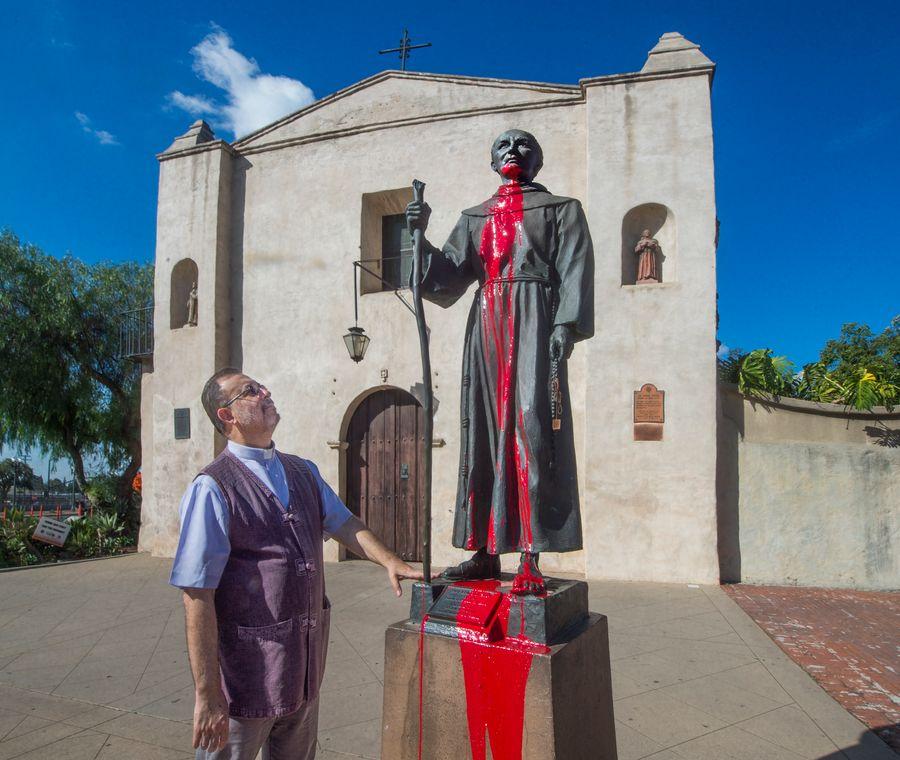
Saints Statue Vandalized
California and the Erasure of Junipero Serra's Legacy
Published Oct. 19, 2021 • Read time: 15m
House Speaker Nancy Pelosi and other top California political figures are notably silent on a big cultural issue roiling Hispanics, Native Americans, and the Catholic Church, even last week when it was commanding the media spotlight in the state.
Los Angeles Mayor Eric Garcetti, President Biden’s stalled choice for ambassador to India, announced the renaming of Father Serra Park, located across the street from Union Station in the heart of the city. Garcetti timed the event to what is now officially known in the city as Indigenous Peoples’ Day, but still Columbus Day to the federal government.
The move followed California Gov. Gavin Newsom’s decision to sign a bill permanently removing St. Junipero Serra’s statue from Capitol Park in Sacramento where it has stood since the 1960s. The eight-foot bronze figure and several others like it were defaced and toppled last summer during the nationwide protests denouncing racial injustice. Under the new law, a monument commemorating California’s native peoples will replace it.
Two of California’s Catholic archbishops, Salvatore Cordileone of San Francisco and Jose Gomez of Los Angeles ardently opposed the bill and refuted its characterization that “enslavement of both adults and children, mutilation, genocide and assault on women were all part of the mission period initiated and overseen by Father Serra.”
“While there is much to criticize from this period, no serious historian has ever made such outrageous claims about Serra or the mission system,” the two prelates wrote in a Sept. 12 Wall Street Journal op-ed.
Black and White, Left and Right
Liberals Exploit Race & Gender
Selma Snub vs. Eastwood Eclipse -- Who's the Victim of Discrimination?
The "NAACP Bombing" ... or The Barbershop Bang?
RealClearPolitics reached out to Pelosi’s office several times over the past week seeking her opinion about the Serra controversy. Her office didn’t respond, and neither did press secretaries for Vice President (and former California senator) Kamala Harris, as well as Democratic Sens. Dianne Feinstein and Alexa Padilla.
Nancy Pelosi greets Pope Francis at the U.S. Capitol in 2015.
Nikki Kahn/The Washington Post via AP
It was tough timing for Pelosi, a self-described devout Roman Catholic. On Oct. 9, two days before Garcetti’s announcement, she met with Pope Francis at the Vatican. (President Biden, who is also a practicing Catholic, plans a Vatican visit and a meeting with the pope later this month.) After the visit, Pelosi and Francis touted their shared vision for combating climate change. There was no public mention of their divergent opinions on abortion – or her views on the Serra controversy.
Pelosi’s silence shows just how thoroughly the dogma of “post-colonialism” has taken root in the Democratic Party, as well as the secular public sphere. In 2015, both Pelosi and Biden were front and center for the ceremony in which the pope celebrated the canonization of Serra inside the U.S. Capitol. Pelosi is also mum on whether she believes the Serra statue representing California (along with another depicting Ronald Reagan) in the U.S. Capitol’s Statuary Hall should remain. Pelosi’s party won’t allow the ambivalence forever.
California’s Banished Founding Father
Although most Americans may not be familiar with Junipero Serra, in California his name and legacy are enshrined in the state’s history just as the Spanish-style missions he founded still influence the state’s iconic orange and red-tiled stucco architecture. Long venerated as a state founding father, the Franciscan priest is the architect of California’s 21 Spanish missions, nine of which were built during his lifetime. The missions, which still dot the California landscape from Sonoma to San Diego, were devoted to converting Native Americans to Catholicism. They were also the first European outposts established between 1769 and 1833 in what is now the state of California but back then was known as Alta California or New Spain.
The Spanish colonization across Central and South America brought devastating disease and was undeniably brutal, with conquistadors wiping out the Aztec and Mayan cultures. When it came to settling California, the Spanish military worked alongside the church. While nothing like the slaughters that took place to the South, the Spanish soldiers in California were still known for their cruelty, and the two institutions — the church and the military — were often at odds with one another. Whether Serra embodies that colonialism or served as an imperfect type of buffer for its harsher elements is a matter of fierce debate.
Serra, as the man behind the missions, was responsible for baptizing thousands of Native Americans. Historians in recent years have discovered that many, if not all, of the missions Serra founded recruited indigenous people, then forced them to convert and remain there, subject to corporal punishment if they tried to flee or engaged in behavior the missions had outlawed. In exchange, the missions offered food and stability along with a pious, regimented life and what Catholics and other Christians value most: eternal salvation.
Through the lens of secular modernity, Serra’s role has shifted from historical hero to cultural villain. But the truth is somewhere in-between — and dependent on the personal values of each interpreter. The pope’s decision to canonize Serra in 2015 still divides liberals and historians as well as Native Americans, roughly a quarter of whom are Catholic, according to Crux Now, an online newspaper focusing on news related to the Catholic Church.
For the better part of a century, elementary school children in California were taught to revere Serra. Building a model mission – usually out of clay and cardboard – was often an obligatory fourth-grade project. School lessons devoted to him were usually one-dimensional: Serra was a devoted and pious figurehead beloved by all, the man responsible for the “gift of modern California,” as one essayist put it. Over the last several years, as more negative information surfaced, many Native Americans have denounced those teachings.
A portrait of Franciscan missionary Junipero Serra, who was once revered in California culture but is now being renounced.
AP Photo/Gregory Bull, File
“Serra did not just bring us Christianity,” Deborah Miranda, a Native American and professor of literature at Washington & Lee, told the New York Times in 2015. “He imposed it, giving us no choice in the matter. He did incalculable damage to a whole culture.”
But such absolutist portrayals are one-dimensional and strip Father Serra not only of his humanity, but also his historical context, counters Franciscan priest Joseph Chinnici, the president emeritus of the Franciscan School of Theology at the University of San Diego, a Catholic institution. “Serra was not simply a colonizer or promoter of Spanish-ization,” he told RCP. “He stood as a mediator between different cultures — the Native American culture and the Spanish culture.”
Instead of trying to launch a genocide against the native Californians, Serra was focused on what the church considers the opposite: protecting them from the vicissitudes of the Spanish military and the evils of the world. Chinnici believes Serra himself would have no problem with public officials replacing his statues with those celebrating Native Americans.
“He was too much of a student of history and too reliant on the providence of God not to try to discover God’s presence even in the present actions … and argue for a path forward,” he said.
For some tribal leaders who are Catholic, Serra’s sins — forced conversions, indentured servitude and corporal punishment inflicted on natives — cannot be rationalized away even though they still value the Catholic heritage Serra provided.
Jesus Tarango, chairman of the Rancheria Tribe in Elk Grove, Calif., who is Catholic, agrees with Gov. Newsom’s decision to sign the bill permanently removing the Serra statue from Capitol Park. He penned an op-ed outlining his views for the Sacramento Bee last month.
“I'm a Catholic man, but my views are simple,” Tarango told RCP. “There's no Catholic person around today who I know who would suggest that we would accept his behavior and what he did here today in our day.” Still, Tarango said, he doesn’t condemn Catholicism or even Serra himself for actions of more than 200 years ago. He simply doesn’t believe the state should publicly celebrate him.
Other Native Americans active in the Catholic Church tell a different, more complicated story.
Deacon Andrew Orosco is a Kumeyaay tribal member from the San Pasqual Band of Mission Indians in North County San Diego. That band of Kumeyaay readily embraced Catholicism during Serra’s time, unlike their neighbors to the South who fought it. Orosco, whose grandfather was baptized into the Catholic faith in mission San Diego, opposes the removal of the Serra statues and argues that the vitriol aimed at him would be better directed at Peter Burnett, California’s first governor before it became a state.
California Gov. Peter Burnett waged a war of extermination against Native Americans but his likeness remains on view at the Capitol.
Wikipedia
“[Burnett] is the one that caused a lot of death and destruction within the native tribes of California – and his likeness is still in the state Capitol,” Orosco told RCP. “… In the state history, these things did happen [to natives], but if you pin them down in a timeline, most of it took place during the 1850s. I think Junipero Serra gets the blame because he was the first one who brought Western civilization to California, but that’s just turning a blind eye to those who are truly responsible.”
The controversy over Serra’s treatment of Native Americans isn’t manufactured, however. There are documented examples of Serra directing the Spanish military to round up and punish deserters with whippings and ordering Spanish military commanders to use shackles on them. The late author Elias Castillo chronicled what he cast as a mission system of indentured servitude and corporal punishment, “A Cross of Thorns: The Enslavement of California’s Indians by the Spanish Missions,” published in 2015.
Serra’s Complexities
But even Castillo acknowledges that one of Serra’s likely motivations for keeping natives inside the missions, in addition to shielding them away from sinful elements of society, was to protect them from the Spanish military, which ran the nearby towns. Spanish soldiers were known for raping women and even children, and spreading the deadly diseases they carried. Serra repeatedly clashed with military leaders, especially Felipe Neve, a Spanish solider turned governor who prevented him from establishing any new missions for five years.
While Serra treated mission deserters harshly, he also demonstrated mercy in the wake of assaults by natives on him and fellow priests. When natives attacked and burned the San Diego mission in 1775, they tortured and executed Serra’s friend, a fellow missionary priest, Father Luis Jayme. Nevertheless, Serra pleaded with colonial authorities to show the attackers mercy. “Let the murderer live so he can be saved, which is the purpose of us coming here and the reason for forgiving him,” Serra wrote in a letter to the viceroy of New Spain.
Other historians have noted that Serra allowed the natives to preserve some cultural elements of their pre-mission lives and defended their property rights when disputes with settlers arose. Once at the missions, native peoples continued traditional songs and dances and most dressed the same way they did before they entered the Catholic communities, according to Steven Hackel, a professor of history at the University of California, Riverside. Hackel is the author of “Junipero Serra: California’s Founding Father.”
In November 1777, when California’s first civilian settlement was founded in San Jose, disputes arose immediately over the takeover of native land. “The laws state distinctly that all of that territory, and the water right too, are the property of the Indians living in this mission,” Serra wrote to another priest in 1778.
With the flood of white settlers came diseases that decimated natives. Castillo cites mission records for some years during Serra’s rule showing more deaths than births.
That pattern accelerated over the course of the 75 years following Serra’s death in 1784. By the end of the Gold Rush, 80% of the native population in California had perished. The Spanish soldiers and ranchers took over Native American land, and Peter Burnett, who became California’s governor 67 years after Serra’s death, was directly responsible for launching a deliberate genocide against the indigenous people.
Extermination Strategy
Burnett, who also tried to keep blacks and Chinese out of the state, called for the extermination of the Native American race. The legislature responded by paying to raise militias and fund bounties for killing native people. Between 9,000 and 16,000 natives were murdered in cold blood by white settlers.
Even though his ignominious history has forever tainted Burnett’s legacy (so much so that most Californians don’t know who he is), his portrait still hangs on the first floor of the state Capitol. In his first months as governor, Newsom denounced Burnett’s racist “war of extermination” but did not remove it. Garcetti, during last week’s renaming of the park, was careful to spread the blame even as the event focused on erasing Serra’s name.
“We’re sorry for all the things that were done as a Spanish city, a Mexic[an] city, an American city to erase the peoples whose land this is and always will be,” Garcetti told several tribal leaders gathered alongside him for the announcement in the same park where critics of Serra toppled his statue last year.
Church leaders also have tried to grapple with Serra’s mixed legacy while still honoring him for his role in spreading the Gospel in the New World. In a speech at Catholic University in Washington, D.C., where Serra was canonized, Chinnici pointed out that Serra died 15 years before the Spanish colonial system responsible for so many natives’ deaths really took hold in California. Even so, Chinnici added, Serra “participated in the mechanism of colonization while at the same time fighting with the public authorities for the protection of native rights, the amelioration of their sufferings, the softening of their punishments, the forgiveness of their violence and the preservation of their land.”
In post-colonialist academia and broader secular society, few scholars value Serra’s complexities, and, for a very basic reason: They place no premium whatsoever on saving souls. That is not Pope Francis’ worldview, however. In his first major apostolic letter, Evangelii Gaudium, Francis repeatedly extols the virtues and even “comforting joy” he has found in proclaiming the Gospel.
Mission San Luis Obispo, one of nine missions Serra established during his lifetime.
Wikimedia Commons
When this endeavor is discounted by secularists, Serra’s mission work is inevitably boiled down to his role as a colonizer who helped wipe out another culture – even if his life’s work of saving souls was often at odds with the Spanish crown’s bigger goals of profiting off the land and transforming the natives into subjects.
“There’s no doubt that Serra belonged to a system that was oriented to colonization and Spanish-ization [of California],” Chinnici said. “But he was coming from a place from within that system … from the space of his religious convictions — his commitment to the Gospel and his desire to spread the good news that included the formation of a community of people.”
Before canonizing Serra, Pope Francis made a point of acknowledging the churches’ failings, especially with its missionary efforts. During a visit to Bolivia, he said, “Many grave sins were committed against the native peoples of America in the name of God.” In a speech before 1,500 delegates, he asked forgiveness “not only for the offenses of the Church herself, but also for crimes committed against the native peoples during the so-called conquest of America.” Francis pointedly noted, however, that many missionary priests had helped protect native peoples from violence at the hand of the Spanish military.
While critics, even fans of Francis — the first pope from Latin America — question his decision to honor Serra’s work, others say he has many practical, as well as theological, reasons to do so.
“At a time when the Catholic church is becoming more and more Hispanic and Latino, they’re trying to say, you know, Catholicism in America needs to be understood as always having had this kind of Hispanic element to it,” Robert Senkewicz, a professor of history at Santa Clara University, a Jesuit college and the oldest institution of higher learning in California, told the Atlantic in 2015. Its campus surrounds Mission Santa Clara de Asis, the first one named for a woman (Saint Claire of Assisi), which Serra founded.
Over the last year, the university itself has struggled to confront its origins and put Serra’s role in the larger historical context. The Serra statue has been placed in storage “until a more comprehensive history that appropriately acknowledges Serra’s legacy at Santa Clara can be devised,” according to a university web page devoted to the controversy.
Pelosi’s Choice
After visiting with Pope Francis, Nancy Pelosi issued a statement linking the pontiff to the Bay Area district she represents. “In San Francisco, we take special pride in Pope Francis, who shares the namesake of our city and whose song of St. Francis is our anthem, ‘Lord, make me a channel of thy peace. Where there is darkness, may we bring light. Where there is hatred, may we bring love. Where there is despair, may we bring hope.’”
Pelosi failed to mention that the city of San Francisco and the anthem are both derived from the eponymous mission that Serra, a member of the Franciscan order, built there. In fact, many of California’s major cities are named after either the first nine missions Serra established or the 12 others built after his death, including San Diego, San Francisco, San Jose, Santa Cruz, San Luis Obispo, and Santa Barbara.
It’s a fact and part of California’s rich but deeply flawed history that could have stirred up controversy for Pelosi, so she avoided it. But trying to sidestep the issue or worse — erase Serra from the California landscape — is not only impossible but a mistake that discounts its citizens’ ability to both recognize and correct the injustices Native Americans suffered but also to understand and appreciate the complex heritage they share, blemishes and all.

The GOP Majority Should Go Out in Glory
Daniel McCarthy • RealClearPolitics
Republican Majorities Could Return Sooner Than Expected
J.T. Young • RealClearPolitics
The Danger Before the Attack
Leslie J. Sullivan • RealClearPolitics
Jon Finer’s Old and Dangerous ‘New Approach’ to Israel
Peter Berkowitz • RealClearPolitics
The President Deserves Better
John Ullyot • RealClearPolitics
Congress Doesn’t Need Another Blame Game. It Needs To Find What’s Broken
Jarrod Bernstein • RealClearPolitics
RCP Today
Top stories on RealClearPolitics
The Takeaway
Polling intelligence and analysis delivered to your inbox
World News
Featuring the latest world news
Policy
Featuring the latest policy news
Support Our Mission
As part of RealClearPolitics, authors aim to provide balanced, non-partisan analysis by presenting top reporting and commentary from all sides of the political spectrum.
Trusted by policymakers and citizens alike since 2000