Election 2020-Pennsylvania-House
Infrastructure Vote Puts Vulnerable Progressives in a Bind
Published Sept. 30, 2021 • Read time: 7m
With the fate of President Biden’s domestic agenda hanging in the balance, Democratic leaders face their biggest test yet on whether they can corral the competing factions of their party together to pass at least a down payment on the social spending they’ve promised.
Thursday’s vote on the bipartisan infrastructure bill also will challenge Democratic members facing tough reelection fights to remain true to their professed liberal policy beliefs.
There are six House Democrats who are members of both the Congressional Progressive Caucus and their party’s Frontline program, which provides members in competitive seats additional resources to assist their reelection chances. They are Rep. Katie Porter, the deputy chair of the caucus, as well as Reps. Matt Cartwright, Peter DeFazio, Steven Horsford, Andy Kim and Mike Levin. Porter, an outspoken liberal, is the only one of the six who has publicly committed to voting against the bill on Thursday if the Democratic leadership doesn’t first negotiate an agreement on a much larger reconciliation package that includes trillions of dollars to expand education, health care and child-care support, as well as funds to advance Democrats’ climate change agenda.
With Sen. Bernie Sanders’ help, Rep. Pramila Jayapal is leading an effort to sink the $1.2 trillion bipartisan bill if the much larger reconciliation measure is not finished and ready for a tandem vote — as House Speaker Nancy Pelosi originally promised. Jayapal is whipping the Progressive Caucus, and at least 24 members have publicly stated their commitment to vote against the bipartisan bill unless it is passed with the reconciliation measure or a detailed version is negotiated first, according to a public whip count.
BART Is Not a Homeless Shelter
Thank Gridlock for Economic Turnaround
Infrastructure Is Not the Problem
Take the Public-Private Road to Efficiency
During a meeting Tuesday afternoon, 10 other members (possibly more) also reportedly voiced support for the strategy and pledged to join forces with the no votes if the bipartisan legislation comes to the floor without a tangible agreement on the broader bill. Just how many progressive Democrats will be needed to torpedo the measure will depend on how many centrist Republicans vote in favor of it. House GOP leaders are working to persuade their members to hold the line and oppose the smaller $1.2 trillion infrastructure bill. So far, there are at least four GOP defections.
Earlier this week, Republicans launched a campaign to keep the pressure on vulnerable House Democrats by not backing either of the infrastructure bills. They ran ads tying 17 House Democrats in competitive districts, including Cartwright and DeFazio, to President Biden, rising inflation and what they deemed as the “biggest tax increase in decades.”
“House Democrats are helping Joe Biden and Nancy Pelosi pass the biggest tax hike in decades,” said Rep. Tom Emmer, who chairs the National Republican Congressional Committee, the body in charge of electing GOP members. “With costs already through the roof, the last thing middle-class Americans need is the government taking more money form their paychecks. Voters will hold every Democrat who votes for this reckless tax and spending spree accountable.”
Biden and congressional Democrats have said they plan to pay for the massive new spending by increasing taxes on people making more than $400,000 a year. But the bipartisan Joint Committee on Taxation has estimated that anyone with income of more than $200,000 would see their taxes rise slightly in 2023, and by 2027 — after an expanded child tax credit expires — those earning between $30,000 and $200,000 would start to see slightly higher tax bills.
Rep. Kevin Brady, a Texas Republican and the ranking member of the House Ways and Means Committee, on Thursday said Biden’s claim that the sweeping $3.5 trillion spending bill will have a zero-net cost after the tax increases “is now rivaling President Obama’s [false] claim that ‘If you like your doctor[s], you can keep them.”
“The president is telling a whopper, to say the least,” he told reporters on a conference call. “It has been roundly and justifiably criticized.”
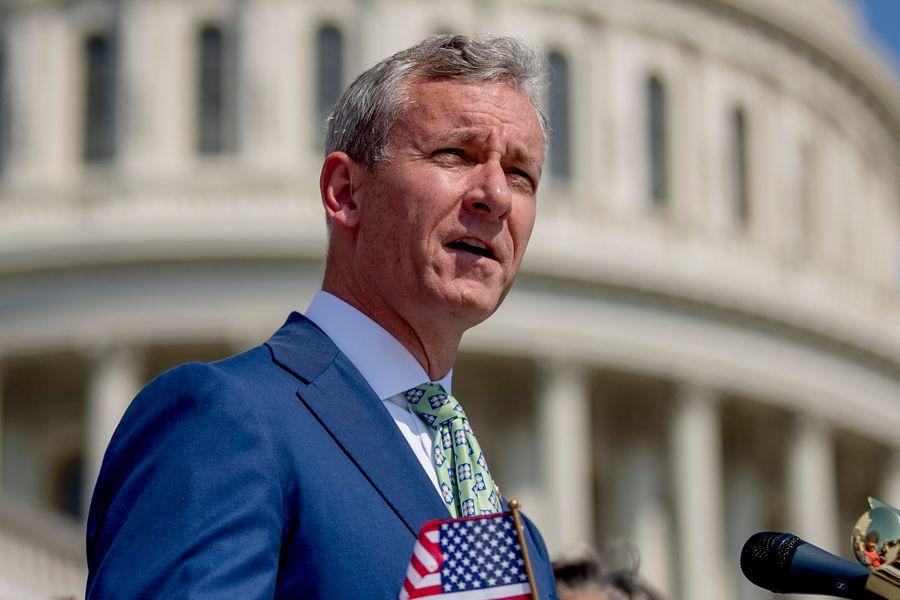
Of all the targeted House Democrats who are also members of the Progressive Caucus, Cartwright (pictured) appears to be the most vulnerable. His northeastern Pennsylvania district is the second most Republican-leaning one held by a Democrat, according to the Cook Partisan Voting Index. Cartwright won it last year with 51.8% of the vote, ahead of Republican challenger Jim Bognet’s 48.2%.
Cartwright has been a vocal advocate of the bipartisan infrastructure bill, calling it “a big shot in the arm for PA” on Twitter – a signal he’s not backing the Progressive Caucus’s efforts to vote it down without an agreement on the reconciliation bill.
“It’ll create thousands of good paying jobs across our commonwealth, and the money for roads & bridges alone will grow our economy by $3.5 billion/year,” he tweeted Tuesday. “Let’s get this done.”
In early July, the two-term lawmaker said he would “probably” vote for both infrastructure packages, and in August he voted to approve the $3.5 trillion budget bill and the $1 trillion bipartisan package. At the time, an NRCC spokeswoman said voters would hold him and two other Pennsylvania Democrats – Chrissy Houlahan and Susan Wild — “accountable for raising taxes and driving up the costs of everyday goods.” In mid-September, the conservative National Taxpayers Union released polling it conducted in Cartwright’s district, finding that 60% of voters oppose the $3.5 trillion package, 80% are worried about inflation and only 40% approve of the job Biden is doing, compared to 57% who disapprove.
Democrats are pointing to surveys commissioned by liberal groups showing that voters in 10 battleground states and 48 competitive congressional districts support key components of the social spending plan, including tuition-free community college, universal pre-K, investments in public housing and efforts to combat climate change.
On the other side of the equation, at least one self-described centrist Democrat in a competitive district is facing heat for agreeing to vote in favor of the larger measure, as well as approving its hefty price tag. Rep. Vincente Gonzalez, who represents a purple-trending South Texas district, was one of nine moderate Democrats whose tough stand back in August helped secure this week’s vote on the bipartisan measure.
“We cannot afford to delay passage of this critical bipartisan legislation promised to the American people. It must be brought to the House floor immediately — before the reconciliation package, to ensure its passage,” he said in a statement.
On Sunday, however, he was one of two of those nine centrist Democrats to back down and agree to package the two measures. The other was Rep. Filemon Vela, also of Texas. Vela announced his retirement earlier this year.
The capitulation earned Gonzalez a swift rebuke from the NRCC. The group’s spokeswoman called him “the ultimate Pelosi doormat” and predicted his vote “to raise taxes on working families and crush small businesses will cost him reelection.”
Meanwhile, Republican moderates are also getting the squeeze. Third Way, a think tank that champions center-left policies, sent letters to 25 Republican members of the Problem Solvers Caucus who haven’t publicly committed to voting for the bipartisan bill. The letter states that Republican members of the caucus who side with GOP leaders’ efforts to sink the bipartisan measure will show that their pledge to solve problems is “entirely hollow.”
“[N]aked partisanship — choosing gridlock over progress for purely tactical reasons — is exactly what you pledged to fight in becoming a ‘problem solver,” the letter states. “Your time to take up that fight has arrived.”

Newsom Defies Voters, Juries and Lawmakers To Spare Murderers While Defending Abortion
Curtis Hill • RealClearPolitics
The Algorithmic Tilt
Frank Filingeri • RealClearPolitics
A RealClear Thanksgiving: Investing in a Better Future
David DesRosiers • RealClearPolitics
Trump’s Newsom Problem: Antagonist-in-Chief
Carolina Lumetta • RealClearPolitics
America’s Free Spirit
John Maxwell Hamilton • RealClearPolitics
The GOP Majority Should Go Out in Glory
Daniel McCarthy • RealClearPolitics
RCP Today
Top stories on RealClearPolitics
The Takeaway
Polling intelligence and analysis delivered to your inbox
World News
Featuring the latest world news
Policy
Featuring the latest policy news
Support Our Mission
As part of RealClearPolitics, authors aim to provide balanced, non-partisan analysis by presenting top reporting and commentary from all sides of the political spectrum.
Trusted by policymakers and citizens alike since 2000