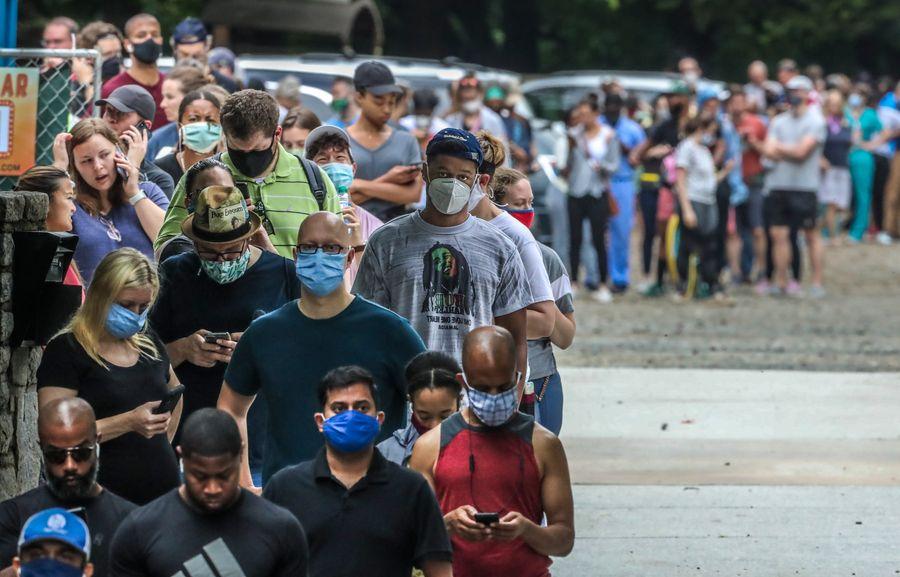
Election 2020 Atlanta
Underfunded Polling Places Add to Voting Access Concerns
COMMENTARY
Published July 16, 2021 • Read time: 7m
Last month, with some acrimony and confusion, the Committee on House Administration commenced its inspection into polling-place closures during the 2020 election. The partisan conflict over poll closures amounted to questions over who makes the decisions to shutter polling places, and why? Democrats tend to blame active electoral manipulation on the part of Republicans. Republicans, in turn, blame mismanagement and corruption in Democrat-run cities.
Addressing the problem is a pressing issue, given embarrassingly long lines arising from overwhelmed polling places, but the questions are more complex than many partisans realize. Part of the answer has to do with resource inequalities at the municipal level and reliance upon non-professional election workers. These inequalities force the costs of poll closures onto impoverished voters and people of color, even without active manipulation on the part of state governments and partisan elected officials. Republican state governments are trying to reduce voter access in Democratic areas, but merely blocking these laws would not solve the structural inequities giving rise to polling-place closures.
To understand why polling places close, it’s necessary to understand how they work. Efficient operation of polling places makes use of “queuing theory,” the science of preventing bottlenecks in services with limited capacity. The ability to estimate how many people will arrive at any given time is imperfect. As political scientist Stephen Pettigrew mentioned during the House hearing on June 11, queuing theory is widely applied to contexts ranging from hospital emergency rooms to grocery-store cashier lines to polling places. Voting is complex, with three check-in points to process voters: checking in to verify identity, marking a ballot, and finally submitting a ballot for tabulation. If voters outnumber processors for a queue at any point, lines build up, leading to longer wait times. Political scientists Charles Stewart III and Stephen Ansolabehere note that the best ways to improve voting on the supply side would be to increase the number of polling locations, along with more poll workers and voting machines at these locations. On the demand side, increasing the number of voters making use of mail ballots would ease potential crowding at polling locations.
Gavin Newsom's Misguided Redistricting Initiative
A Warning Against the Overuse of Sanctions
Open The Books on the California State Checkbook
Senate Passes Bill Addressing Heroin, Opioid Crisis
While solving the queuing problem seems like a matter of simply purchasing more voting equipment and hiring more staff, the problem of scarce resources remains. Local governments bear the most election administration costs, with minimal aid from the state and federal government. Worse yet, most local government revenue draws primarily from property taxes, among the least stable sources of tax revenue. State legislatures inadequately funded local election administration even before the COVID-19 pandemic, which, in turn, increased costs by $4 billion. Most local governmental expenditures go toward welfare, education, hospitals, and other services; local election administration is low on the list of priority spending, and funds are lacking to solve the queuing problem at polling places. From a financial perspective, it is wiser to consolidate as many polling places as possible and minimize expenditures on personnel by relying on volunteers. Local governments feel little incentive to invest in election machines and tabulators when such equipment is used only once or twice a year. As a result of all these factors, local election administration runs with a lean staff and thin infrastructure.
If the frustrations of polling places were equally distributed and affected everyone equally, pressure might exist to reform the funding and administration of polling places. However, these costs are not distributed equally; local governments draw their revenue from property taxes, and therefore entirely depend on local wealth. For this reason, localities with increased proportions of impoverished people suffered the longest voting wait times during the 2020 general election, as is normal. Worse yet, America’s practice of redlining until the 1970s led African Americans and other people of color to suffer from a lack of generational wealth, which now severely limits revenue for local governments. As a 2019 Federal Reserve survey found, whereas median wealth (not income) for whites amounts to nearly $190,000, for African Americans it totals only $24,400. Pettigrew finds that for these associated reasons, voters living in predominantly racial-minority precincts wait twice as long to vote.
Scarce resources limit where administrators can open polling places, and unintended closures occur even after plans are set. Polling places open only if poll workers show up, which is not always the case. Most poll workers are part-time and underpaid, if paid at all. Most states don’t have the time or money to train poll workers, and attrition rates can run up to 50%. Political scientist Michael Alvarez found in studying Ohio’s 2004 elections that most problems on Election Day arose from poll workers showing up late or not at all. The same problem plagued the city and county of Milwaukee during the April 7 presidential primary and spring election, where only 50 out of the 300 expected workers showed up.
I found in my own research that, unsurprisingly, these problems overwhelmingly afflicted African American precincts. Insofar as municipalities did avoid the long lines and poll closures seen in Milwaukee, they had to expend greater funds and take out bonds to minimize the number of polling-place closures. Wealthier and whiter Madison, Wis., for example, expended an additional $108,000 – 21% greater than normal. While it is praiseworthy that Madison’s election officers took preemptive action to fund and hire more poll workers, Milwaukee’s closures were not the result of any single person. Rather, the system of funding elections as a whole amid a pandemic led to a reliance on a part-time/volunteer staff that already exhibited attrition problems, even in good years. Likewise, the same trends and factors afflict local election administrators across the country. The question is not whether they suffer these same problems, but how severely.
Given the fragile foundation of election administration and racial-wealth disparities, the ensuing poll closures arising from the pandemic are not surprising. Many state legislatures’ refusal to fund local election administration effectively made poll closures and longer wait times inevitable. For this reason, as Republican legislatures in states such as Georgia and Texas seek to reduce voter turnout by Democrats, the environment is set up to do so easily. By limiting the number of drop boxes and shortening time periods when mail ballots can be accepted, state legislatures can weaken the faith that one’s ballot will be counted by mail, thus spurring more people to vote in person. Republican state legislatures appear to be in no hurry to substantively increase state-level election funding, either, while seeking to ban private donations for local election administration.
Failing to replace these funds with state or national money would undoubtedly lead to more poll closures and longer wait times. Columbia Law school professor Elora Mukherjee found that approximately 18% of average-age voting machines break down during Election Day, which is sufficient to effectively shutter 10% of polling places within predominantly racial-minority areas. Even without state laws limiting ballot drop boxes or Southern election officials actively shuttering over 1,200 polling places for various reasons, those who seek to suppress voter turnout through poll closures need only wait out local election officials.
Every one of the approximately 200,000 polling places across the nation faces similar obstacles. Scarce resources, aging equipment, and reliance on part-time and volunteer staff all contribute to poll closures. States and the federal government should address these issues with increased funds and more centralized training. The Committee on House Administration has taken on a formidable task, and it will not meet with success unless it tackles these foundational and structural inequalities.

Newsom Defies Voters, Juries and Lawmakers To Spare Murderers While Defending Abortion
Curtis Hill • RealClearPolitics
The Algorithmic Tilt
Frank Filingeri • RealClearPolitics
A RealClear Thanksgiving: Investing in a Better Future
David DesRosiers • RealClearPolitics
Trump’s Newsom Problem: Antagonist-in-Chief
Carolina Lumetta • RealClearPolitics
America’s Free Spirit
John Maxwell Hamilton • RealClearPolitics
The GOP Majority Should Go Out in Glory
Daniel McCarthy • RealClearPolitics
RCP Today
Top stories on RealClearPolitics
The Takeaway
Polling intelligence and analysis delivered to your inbox
World News
Featuring the latest world news
Policy
Featuring the latest policy news
Support Our Mission
As part of RealClearPolitics, authors aim to provide balanced, non-partisan analysis by presenting top reporting and commentary from all sides of the political spectrum.
Trusted by policymakers and citizens alike since 2000