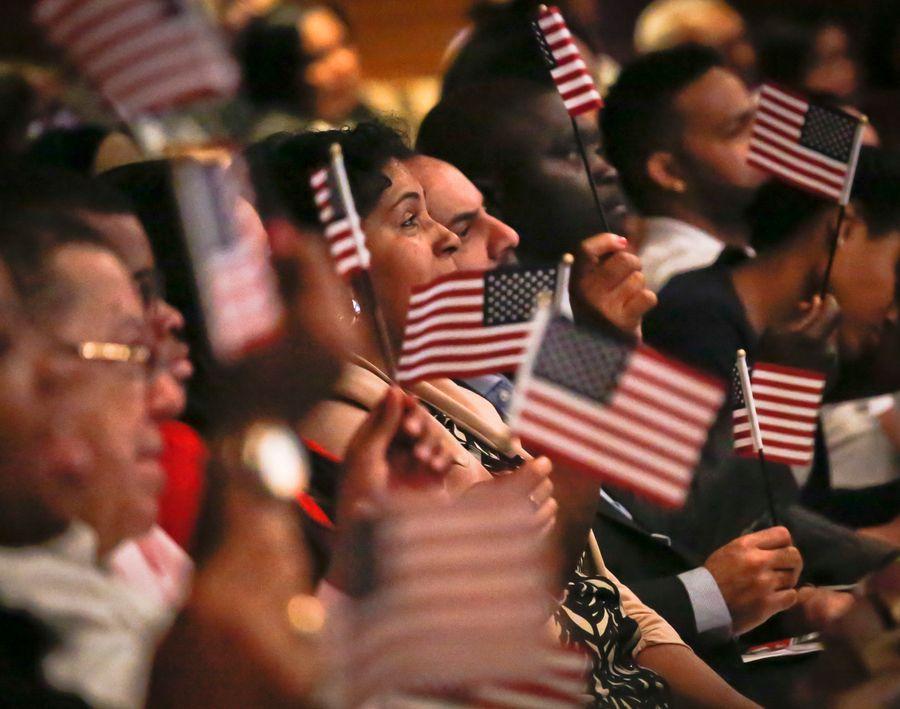
naturalization ceremony
RCP's Patriotism Poll: What Applying Controls Tells Us
ANALYSIS
Published July 2, 2021 • Read time: 4m
Join the Conversation
0The advent of publicly available scientific polling in 1936 is one of the great accomplishments of modern social science. Through it, we can obtain good general information on the state of public opinion, as well as the views of subgroups through what we call crosstabs. These effectively break down larger samples into smaller parts; by looking only at, say, black voters, we can discern their views and, if significant, compare them to those of white voters and other subgroups.
But one problem with this approach is the lack of controls. At the end of the analysis, we can’t tell if black voters vote differently than whites because of some feature of African American experience in our society, or if, for example, black voters are overall of a different socio-economic status than whites.
One solution is to conduct a regression analysis, which allows us to find the average relationship between two variables after controlling for other factors. So, for example, we could conduct a regression analysis that looks to determine whether African Americans are more likely to vote for Republicans than whites after you control for income (they aren’t) or whether they are more likely to vote in the first place with that control in place (they are).
When we apply a regression analysis to the results of the new RealClear Opinion Research poll, which explored Americans’ feelings about patriotism, we find similarly interesting results. For my regressions, I used the same controls for each aspect I examined: gender, age, race/ethnicity, and income.
Culture Wars, Old and New
The Better Option
Trust -- Society Depends On It
Family Fragmentation: Can Anything Be Done?
With controls in place, Hispanic voters, for example, are less likely to consider themselves highly patriotic than white voters, but not nearly to the extent of black or Asian voters. Being Hispanic increases your odds, all other things being equal, of giving a less patriotic response than whites by 17%, compared to 48% for blacks and 89% for Asians.
Likewise, with controls in place, Hispanics were more likely to be Democrats than similarly situated whites, but not overwhelmingly so. With controls in place, the odds that a voter who was Hispanic would be a Democrat were 11% higher than that he or she would be Republican, compared to 62% for blacks. This is encouraging for Republicans, as it suggests that as Hispanic voters continue to climb the socioeconomic ladder, they may continue to pick up GOP voting habits.
Interestingly, and perhaps counterintuitively, with controls in place the racial groups in the survey exhibited no statistically significant divergence from whites on the question of whether illegal immigration is a major problem, a minor problem, or no problem at all. Likewise, with controls in place, Hispanics are no more likely than whites to say that immigration has done more good than harm. Blacks, however, are more likely than whites to say that immigration has done more harm than good, with controls in place.
While there is more Hispanic support for the DREAM Act than there is among whites, things like a pathway to citizenship show no significant differences between racial groups, once controls are in place.
The survey also asked about Hispanic subgroups. While the number of respondents is low, the regression analysis finds no significant differences between subgroups in levels of Republicanism. This is surprising, but is consistent with interpretations of Cuban American levels of Republicanism being attributable largely to socioeconomic status. Cuban Americans were, however, significantly more likely than other subgroups to respond that immigration did more harm than good. This could reflect the unique status of Cuban Americans with respect to immigration laws, or intra-Hispanic attitudes toward other groups. Cuban Americans were also more likely to support fining employers who employ illegal immigrants.
Overall, we should remember when analyzing ethnic and racial groups that they are not monoliths, and that, as with non-Hispanic whites, their views and experiences are filtered through other lenses, including gender, age and class.

Newsom Defies Voters, Juries and Lawmakers To Spare Murderers While Defending Abortion
Curtis Hill • RealClearPolitics
The Algorithmic Tilt
Frank Filingeri • RealClearPolitics
A RealClear Thanksgiving: Investing in a Better Future
David DesRosiers • RealClearPolitics
Trump’s Newsom Problem: Antagonist-in-Chief
Carolina Lumetta • RealClearPolitics
America’s Free Spirit
John Maxwell Hamilton • RealClearPolitics
The GOP Majority Should Go Out in Glory
Daniel McCarthy • RealClearPolitics
RCP Today
Top stories on RealClearPolitics
The Takeaway
Polling intelligence and analysis delivered to your inbox
World News
Featuring the latest world news
Policy
Featuring the latest policy news
Support Our Mission
As part of RealClearPolitics, authors aim to provide balanced, non-partisan analysis by presenting top reporting and commentary from all sides of the political spectrum.
Trusted by policymakers and citizens alike since 2000