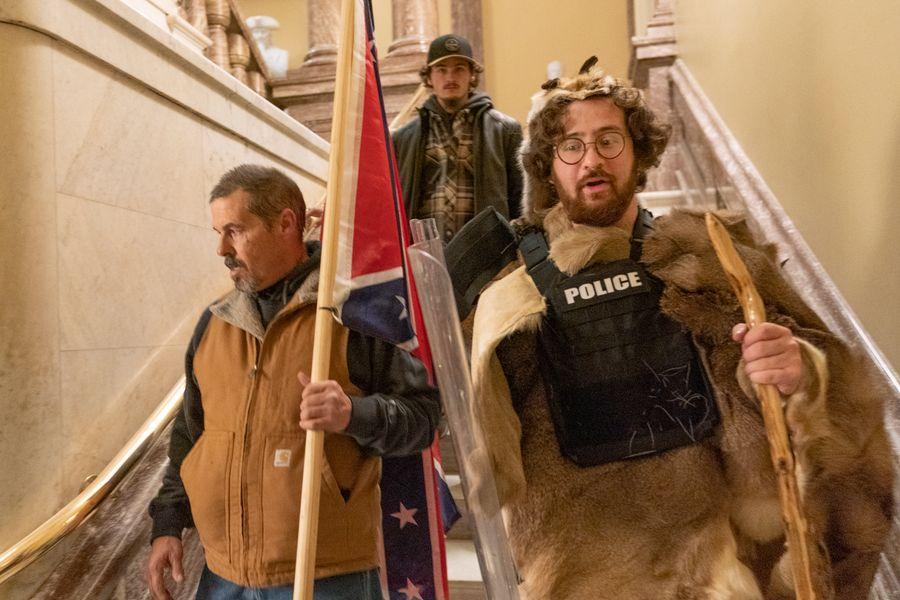
Supporters of President Donald Trump walk down the stairs outside the Senate Chamber as violence erupted at the Capitol after demonstrators breached the security and stormed the U.S. Capitol, Wednesday, Jan. 6, 2021 in Washington. (AP Photo/Manuel Balce Ceneta)
Abe Lincoln's Warning About the Perils of Mob Rule
COMMENTARY
Published Jan. 13, 2021 • Read time: 6m
Join the Conversation
0In January 1838, 28-year-old Abraham Lincoln delivered an address in Springfield, Ill., condemning a series of vigilante attacks that had recently taken place across the young republic. Just weeks before, Elijah Parish Lovejoy, ardent abolitionist and editor of the St. Louis Observer, was shot to death outside his warehouse in Alton, Ill., by a pro-slavery mob.
“Whenever the vicious portion of population shall be permitted to gather in bands of hundreds and thousands,” Lincoln said, “and burn churches, ravage and rob provision-stores, throw printing presses into rivers, shoot editors, and hang and burn obnoxious persons at pleasure, and with impunity; depend on it, this government cannot last.”
Lincoln’s warning about the mob’s threat to the nation is suddenly -- and unfortunately -- relevant again. In the last year we’ve witnessed months of rioting and looting sparked by Black Lives Matter protests over the deaths of George Floyd and others, the destruction of a federal courthouse in Portland, Ore., the illegal occupation of a portion of downtown Seattle, and finally the invasion of the U.S. Capitol last week by violent supporters of Donald Trump.
It’s now all too common to read stories of activists showing up at the homes of elected officials at night, and either implicitly or explicitly threatening them and their families. It is still disturbing, but no longer surprising, to see videos clips of private citizens and innocent bystanders being bullied, and in some cases assaulted, by “protesters” in the streets of America’s cities.
Rethinking the Pledge; Trump and Women; One Last Egg Roll; Eulogizing Ike
2016: A Repeat of the 1960s
An Apology, Fashioned for Nancy Reagan
Nancy Reagan, Guardian of a Legacy
Equally as unforgiving is the digital mob, which descends upon its prey with a vengeance for real or perceived transgressions, some current and some decades old. These keyboard warriors destroy careers, reputations, and livelihoods. It is capricious, devoid of grace or forgiveness, and responds only to submission.
Although our country is rife with tribalism, recognizing and condemning the mob should not be, cannot be, a partisan exercise. Peaceful protests are a foundational right of our democratic republic. Mob violence is the antithesis of it. It cannot be excused, whatever the underlying motivation, as a benign byproduct of protests that were -- as the media kept describing them last summer -- “mostly peaceful.” That phrase is an oxymoron, as this country’s moral leaders have always known.
Mobs are fueled by passions that arise out of a sense of grievance, and modern elected leaders from both parties and the media have spent years stoking those passions, not lowering them. Is it fair to judge rioters by their stated intentions, rather than the crimes they commit? Well, it’s human nature to give the benefit of the doubt to those we agree with. Americans who believe that many police officers in this country are too brutal, especially when operating in communities of color, were willing to overlook the excesses of last summer’s protests. Among those making excuses for violent behavior were the nation’s most prominent Democrats. Those who stormed the U.S. Capitol last week convinced themselves (against all available evidence) that they were righting some great wrong: i.e., the “stealing” of an election. In the end, it doesn’t matter what they thought. What matters is what they did. That’s what Abraham Lincoln was telling his countrymen 183 years ago.
“There is no grievance that is a fit object of redress by mob law,” young Abe Lincoln said. Although he was still trying to reason with slavery’s proponents in 1838, Lincoln’s own sympathies were with Elijah Lovejoy.
A native of Maine, Lovejoy had been radicalized on the slavery question. He was less diplomatic than Lincoln, and less cautious. After graduating first in his class at Waterville College, he headed to St. Louis where he opened a school and purchased an interest in a local newspaper, the St. Louis Times. By 1832, he was the editor, but his passions were caught up in a religious revival known as the Second Great Awakening. Lovejoy returned temporarily to the East where he attended the theological seminary at Princeton, emerging two years later as an ordained Presbyterian minister.
He returned to Missouri to pastor a small Presbyterian congregation while editing the St. Louis Observer. When his former newspaper endorsed mob action against a woman who ran a Sunday school for slaves, Lovejoy joined the fight. His initial essay sought a middle ground. But as Lovejoy’s anti-slavery writing escalated, so did the violent threats against him.
Three times his printing presses were destroyed by domestic terrorists. After a white mob broke into a local jail and burned a black man to death, a St. Louis judge with an apt name (Luke Lawless) directed a grand jury to indict no one in the lynching. In the kind of demagoguery that would be familiar to modern American ears, Lawless then embarked on a rant against the abolitionist press in general, and Elijah Lovejoy in particular. With mob rule essentially endorsed by Missouri courts, the pastor/publisher moved across the river to Illinois.
Lovejoy was now in a free state, but not in a safe city. And there, in the autumn of 1837, a fourth printing press was delivered to him. A mob congregated at the Alton warehouse to seize it. This time, Lovejoy stood his ground. But he and other armed men were overwhelmed. Two days short of his 35th birthday, this crusading newspaperman was felled by gunfire. The warehouse was torched, and his presses were thrown into the Mississippi.
“At what point shall we expect the approach of danger?” asked Lincoln. “By what means shall we fortify against it? Shall we expect some trans-Atlantic military giant to step the ocean, and crush us at a blow? Never! All the armies of Europe, Asia, and Africa combined, with all the treasure of the Earth (our own excepted) in the military chest, with a Bonaparte for a commander, would not by force take a drink from the Ohio, or make a track on the Blue Ridge, in a trial of a thousand years.”
No, they couldn’t, as Lincoln knew, but his point was that the danger lay within. On some days -- Jan. 6, 2021, was one of them -- it seems that way again. So how do we proceed, short of re-fighting the Civil War that subsumed Lincoln’s presidency and cost him, and nearly 700,000 other Americans, their lives? Lincoln’s answer to combat the rise of the “mobocratic sprit” was for the public to rededicate itself to “reverence for the laws.” Fidelity to the law, he insisted, must “become the political religion of the nation.”

Newsom Defies Voters, Juries and Lawmakers To Spare Murderers While Defending Abortion
Curtis Hill • RealClearPolitics
The Algorithmic Tilt
Frank Filingeri • RealClearPolitics
A RealClear Thanksgiving: Investing in a Better Future
David DesRosiers • RealClearPolitics
Trump’s Newsom Problem: Antagonist-in-Chief
Carolina Lumetta • RealClearPolitics
America’s Free Spirit
John Maxwell Hamilton • RealClearPolitics
The GOP Majority Should Go Out in Glory
Daniel McCarthy • RealClearPolitics
RCP Today
Top stories on RealClearPolitics
The Takeaway
Polling intelligence and analysis delivered to your inbox
World News
Featuring the latest world news
Policy
Featuring the latest policy news
Support Our Mission
As part of RealClearPolitics, authors aim to provide balanced, non-partisan analysis by presenting top reporting and commentary from all sides of the political spectrum.
Trusted by policymakers and citizens alike since 2000