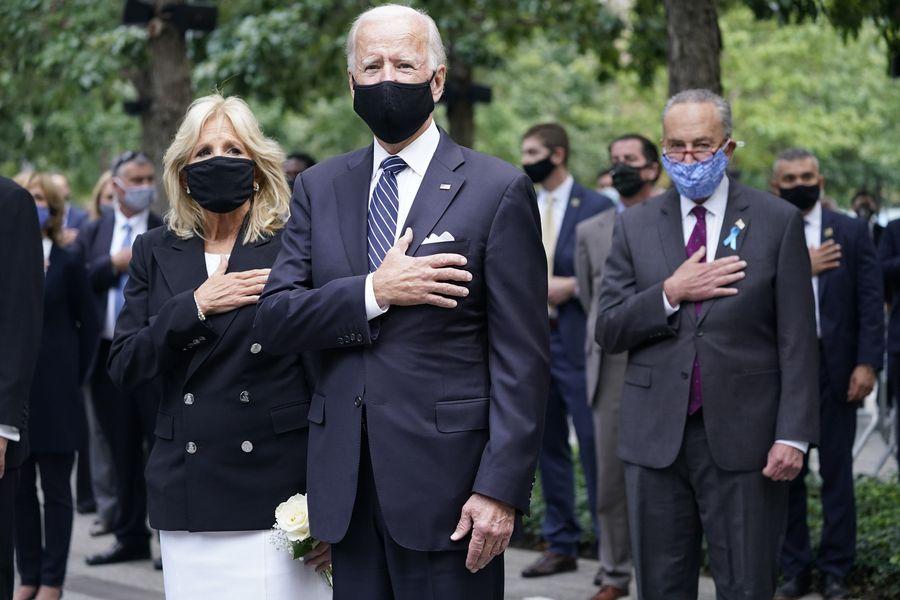
Democratic presidential candidate and former Vice President Joe Biden, center, his wife Jill Biden, left, and Senate Minority Leader Sen. Chuck Schumer of N.Y., stand for the pledge of allegiance during a ceremony marking the 19th anniversary of the 9/11 terrorist attacks at the National September 11 Memorial & Museum, Friday, Sept. 11, 2020, in New York. (AP Photo/Mary Altaffer)
Post-Election Choice for Dems: Retaliation or Reconciliation
COMMENTARY
Published Oct. 30, 2020 • Read time: 4m
If next week’s election results match recent polling, Joe Biden and his party will have control of the House, the Senate and the presidency in 2021. The Nov. 3 battle in the Great Red vs. Blue War will have been won decisively by the Democrats.
The military analogy feels sadly appropriate in an era when one in six Americans think violence is justified if their candidate loses. Within today’s climate of division, Biden and his victorious generals will be left with a crucial and binary choice: retaliation or reconciliation.
Retaliation for Democrats would entail a full-throttled, comprehensive attempt, using every available executive and legislative power, to advance a liberal agenda. Blue power would be consolidated by forming a Cabinet constructed to unite Biden’s party rather than the country, perhaps by appointing Elizabeth Warren and Alexandria Ocasio-Cortez to high level positions.
In Congress, with 51 votes in the Senate, Democrats would abolish the filibuster and advance long-dreamed-about legislation without a single Republican vote. In the judiciary, Democrats would pack the Supreme Court by adding two, or even four, new justices. Blood-thirsty activists would level criminal charges against Donald Trump and even some of his aides and family members. It would all feel good for liberals who have endured not only Trump’s lying and abuse of power, but also his outright denial of their legitimacy as political opponents.
Yet to many Americans, such actions would feel more like vindictiveness. About 43% of the country still approves of President Trump’s job performance and even if he loses big, he will have gotten some 60 million votes. This very large group of people would feel as though salt was being deliberately rubbed into their wounds.
Sanders Seeks Caucus Trifecta Win to Close Delegate Gap
Sanders Fighting Perception He Can't Overcome Clinton Edge
Clinton Targets Trump as Sanders Circles
Sanders, Clinton Differ Sharply at Flint Debate
Worse, choosing the vengeful, partisan path would hasten the tortuous ruin of our federal government. It’s easy to imagine scenarios where, in just eight years, Republicans retake control of the presidency and both houses of Congress, and seek their own revenge by packing the court further, reversing recent legislation, and passing new laws with only their own party’s support. Our country would become the proverbial idiot in the shower; the water that was too hot for most of us would then become too cold.
So, what might reconciliation look like? In the executive branch, it starts with President Biden forming a Cabinet designed to increase national unity rather than party loyalty. Imagine a Secretary of State Mitt Romney or Veterans Affairs Secretary Martha McSally. There’s precedent for this type of bipartisanship. In another divided time, first term Republican President Abraham Lincoln named two Democrats among his seven Cabinet members, including Secretary of War Edwin Stanton.
In Congress, a good beginning would be replacing Chuck Schumer and Nancy Pelosi as Senate majority leader and speaker of the House. There’s too much bad blood between the Republicans and the two of them to allow any real chance of reconciliation. In their place, Democratic legislators would choose more moderate leaders who haven’t been molded by, and scarred by, decades of partisan fighting. Senate Democrats would maintain the filibuster, one of the last remaining tools that encourages cross-partisan cooperation. And they would commit to not passing legislation without at least a few Republican votes.
President Biden would take additional, purposeful actions to signal to the nation that we’re entering a new, post-partisan era. He would call for expanded national service, especially any program that enables young Democrats and Republicans to work side by side for the good of the country. He would fully endorse non-partisan electoral reforms, including ranked-choice voting, that reduce the subservience of legislators to their party bases. Our new president would minimize the partisan talk. His messaging would focus instead on our shared interests as Americans. Finally, and this will sound heretical to his most devoted followers, Biden would preemptively pardon President Trump of all federal crimes.
In 1861, in his first inaugural address, Abraham Lincoln proclaimed, “We must not be enemies. Though passion may have strained, it must not break our bonds of affection.” The country would again be well served if Biden and other Democratic leaders could put country over party, follow the path towards national reconciliation, and end our decades-long dysfunctional politics. President Biden might go down in history as a unifying force similar to Lincoln, rather than as just another general in a tiresome partisan war.

Newsom Defies Voters, Juries and Lawmakers To Spare Murderers While Defending Abortion
Curtis Hill • RealClearPolitics
The Algorithmic Tilt
Frank Filingeri • RealClearPolitics
A RealClear Thanksgiving: Investing in a Better Future
David DesRosiers • RealClearPolitics
Trump’s Newsom Problem: Antagonist-in-Chief
Carolina Lumetta • RealClearPolitics
America’s Free Spirit
John Maxwell Hamilton • RealClearPolitics
The GOP Majority Should Go Out in Glory
Daniel McCarthy • RealClearPolitics
RCP Today
Top stories on RealClearPolitics
The Takeaway
Polling intelligence and analysis delivered to your inbox
World News
Featuring the latest world news
Policy
Featuring the latest policy news
Support Our Mission
As part of RealClearPolitics, authors aim to provide balanced, non-partisan analysis by presenting top reporting and commentary from all sides of the political spectrum.
Trusted by policymakers and citizens alike since 2000