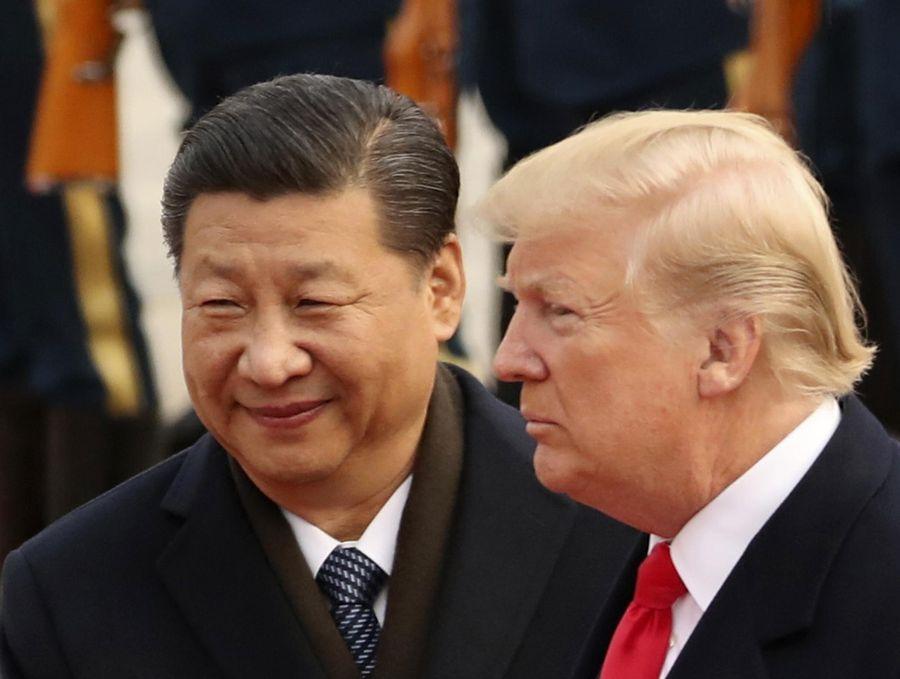
FILE - In this Nov. 9, 2017, file photo, U.S. President Donald Trump and Chinese President Xi Jinping participate in a welcome ceremony at the Great Hall of the People in Beijing, China. This last week, China demanded the United States stop sending ships and military aircraft close to its South China Sea island claims during talks to prepare for a meeting between President Donald Trump and President Xi Jinping later this month. (AP Photo/Andrew Harnik, File)
The End of America's 30-Year Engagement With China?
Published Aug. 23, 2019 • Read time: 4m
Will the demonstrations in Hong Kong come to be seen as the end of a 30-year period, beginning with the Tiananmen Square massacre in 1989, of the American-Chinese economic engagement and entanglement christened "Chimerica" by historian Niall Ferguson?
Quite possibly, and without regard to what happens in Hong Kong. President Donald Trump's on-and-off tariff threats to China have shown his willingness to upend U.S.-China economic ties. Unlike his predecessors, he regards imports from China as harmful. They may provide cheap clothes and toys to American consumers, but they also seem to have destroyed more American manufacturing jobs than expected.
In any case, Chinese economic growth has been flagging, and its workforce has essentially stopped growing. Post-Tiananmen annual growth, unparalleled in history, ranged from 8 to 14 percent from 1991 to 2013 but has tailed off, probably below the official 6 percent level.
And, thanks to China's longtime one-child policy, its working-age population has been declining, down 3 percent since 2011. For years, one big question about China was whether it would get old before it got rich. The answer seems to be that it has gotten old about halfway up the path. Poverty is way down, but incomes significantly lag those in North America, Western Europe and East Asia, including Taiwan and Hong Kong. Meanwhile, just as the United States once lost low-skill manufacturing jobs, so China is now.
The reasons for an American strategic partnership with China have vanished into the mists of history. Henry Kissinger and Richard Nixon, noting little-reported skirmishes on the Chinese-Russian border, saw China as a counterweight to the Soviet Union in a three-way Cold War. That vision became obsolete as the Berlin Wall fell in 1989 and the Soviet Union was dissolved in 1991.
Trade Myths and Realities
The Mistaken Bipartisan Attack on Free Trade
Bernie Sanders' Free Trade Mythology
A Breakthrough on Trade
But Deng Xiaoping's decision to kill thousands -- maybe tens of thousands -- in Tiananmen Square showed the permanence of the communist regime, which had already started to spark -- or permit -- economic growth.
George H.W. Bush decided to stabilize the relationship, and his three successors, despite some contrary campaign rhetoric, concurred. A bipartisan congressional majority voted for normal trade relationships in 2000, and U.S. leaders appreciated China's economic stimulus in the 2007-09 financial crisis.
The hope through these years was that a more prosperous China would also become more democratic and tolerant at home, and less aggressive abroad. But as foreign affairs journalist James Mann pointed out in his 2007 book, "The China Fantasy," and as longtime Kissingerian Michael Pillsbury wrote in his 2015 book, "The Hundred-Year Marathon," China's leaders weren't interested in following this script.
On the contrary, Pillsbury argued that they had their own scenario, in which China would embark quietly but steadily on a long-term race to world supremacy by 2049, the 100th anniversary of Mao Zedong's victory over Chiang Kai-shek.
China would use strategy and tactics laid out by Sun Tzu 2,500 years ago and restore the state to the primacy it enjoyed before the civil wars and invasions that started with the Taiping rebellion in 1849 and ended with Mao's death in 1976, costing millions of Chinese lives. Before this strife, China had 40 percent of the world's population and economic production, and an emperor reigning 60 years, who reportedly told the British envoy Lord Macartney in 1793, "Our Celestial Empire possesses all things in prolific abundance" and has "no need to import the manufactures of outside barbarians."
Xi Jinping, as he disapprovingly watches peaceful marchers in Hong Kong week after week, perhaps feels similarly. His attempted crackdown on the independent judiciary Hong Kong was promised until 2047, and abolition of his 10-year term limit amounts to jumping the gun on Pillsbury's 100-year-marathon finish line of 2049.
Presumably, Xi has the power to squelch the Hong Kong demonstrators as his predecessors squelched Tiananmen protesters 30 years ago. But not without significant economic cost, which he may be willing to pay. The economic ties symbolized by "Chimerica" are already unraveling. They could be completely split if the Red Army ravages Hong Kong.
The cost would not be just economic. "(I)n defying Beijing," Claudia Rosett, who covered the Tiananmen Square massacre for the Wall Street Journal, writes from Hong Kong, the demonstrators "may be taking on the Goliath of modern tyrannies, but even against terrible odds, they are committed to this contest. That's how much they value freedom."
Brute force may prevail for a time. But the yearning for freedom can still somehow survive.
COPYRIGHT 2019 CREATORS.COM

Newsom Defies Voters, Juries and Lawmakers To Spare Murderers While Defending Abortion
Curtis Hill • RealClearPolitics
The Algorithmic Tilt
Frank Filingeri • RealClearPolitics
A RealClear Thanksgiving: Investing in a Better Future
David DesRosiers • RealClearPolitics
Trump’s Newsom Problem: Antagonist-in-Chief
Carolina Lumetta • RealClearPolitics
America’s Free Spirit
John Maxwell Hamilton • RealClearPolitics
The GOP Majority Should Go Out in Glory
Daniel McCarthy • RealClearPolitics
RCP Today
Top stories on RealClearPolitics
The Takeaway
Polling intelligence and analysis delivered to your inbox
World News
Featuring the latest world news
Policy
Featuring the latest policy news
Support Our Mission
As part of RealClearPolitics, authors aim to provide balanced, non-partisan analysis by presenting top reporting and commentary from all sides of the political spectrum.
Trusted by policymakers and citizens alike since 2000