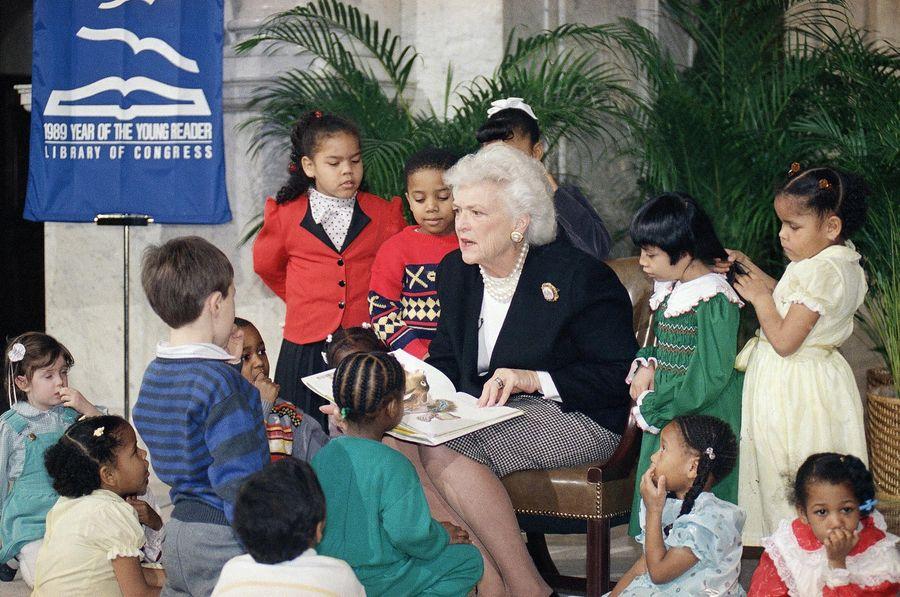
FILE - In this March 7, 1989, file photo, first lady Barbara Bush reads to a group of day care students at the Library of Congress in Washington celebrating
Barbara Bush: A Life Well-Lived
COMMENTARY
Published April 22, 2018 • Read time: 7m
Join the Conversation
0When George Bush was in office -- the father, not the son -- presidents personally handed out the awards at the annual White House Correspondents’ Association dinner. As a young regional correspondent for a California newspaper, I won one of those awards then and was walking toward the stage lectern when an arm shot out and blocked my way. I momentarily feared I’d run afoul of the Secret Service detail by walking behind the president.
Looking down at the constable seated at the head table, I realized it was the first lady who had stopped me. “Young man,” she said, “your tie is askew.”
I asked Barbara Bush what I should do, given that my name was about to be called. Pursing her lips in mock irritation, she motioned for me to bend down. With that, she expertly undid, and redid, my bow tie -- all in about six seconds. Now, you look nice, she said; go get your award from the president. I thanked her profusely, to which she replied, this time in genuine irritation: “I raised four boys. I think I can tie a bow tie!”
Fifteen years later, when Barbara Bush’s eldest son was president and I was seated beside him at the WHCA dinner head table, I related that story to George W. Bush. With a wry smile, he said, “So, I see you have met mother.”
By then, I’d covered the White House beat for a decade, and learned that first ladies had to be studied by anyone who wanted to understand what was taking place inside the executive mansion. This was doubly true of Barbara Bush, the only American in history other than Abigail Adams who was both the wife and mother of a U.S. president. George W. Bush’s closeness to his mom was no secret. He told me that night that he got his caustic sense of humor from her. I believe mother and son initially developed this trait as a defense mechanism. Mrs. Bush, you see, not only raised four boys; she had two daughters, one of whom never reached her 4th birthday.
The Crossroads of History
Nancy Reagan's Inspiring Legacy for Women
The Politics of Homicide
Pope Francis, the Climate and Leftism
“Georgie” Bush, as the family called him, was 6 when his 3-year-old sister, Robin, was diagnosed with childhood leukemia. This was a hard diagnosis to beat in the 1950s, so George and Barbara Bush, then living in Midland, Texas, sought treatment for their daughter at what is now Memorial Sloan Kettering Cancer Center in New York City. One sad October day in 1953, Georgie Bush, who’d entered second grade, saw his parents’ pull up to his school. “My mom, dad, and sister are home!” he excitedly told his teacher. Georgie rushed to the car, expecting to find Robin in the back seat. But she was already gone.
Coming “home,” in a Christian context, has a double meaning, so it’s fitting that in the aftermath of her mother’s death at 92, Robin Bush’s short life has been reprised. One of the most poignant testimonials was a drawing by cartoonist Marshall Ramsey, showing a heavenly reunion between mother and daughter.
In her autobiography, Barbara Bush, who had been dark-haired before her little girl got sick, wrote about the toll Robin’s death took on her -- and on her eldest child -- and also how the tragedy bound she and George together. One “lovely, breezy day,” Mrs. Bush wrote, she was mourning in her room when she overheard her son’s brief conversation with a neighbor boy who’d come to the house to see if Georgie could play. He wanted to, George replied, but he couldn’t leave his mother.
“That started my cure,” wrote Barbara Bush, who had baby Jeb to care for as well as a 7-year-old boy needing attention. By that time, Georgie had already started, if not the family’s “cure,” then at least its healing. His parents couldn’t talk about Robin without crying and family friends had trouble mentioning her at all. It was young George who guilelessly mentioned at a West Texas high school football game that Robin had a better view from above than he did in the stands.
George W. Bush learned that he could make adults smile, even if they were smiling through their tears, and along the way forged a lasting bond with his mother. Over time, observers of this clan assumed that “Bar” wanted Dubya to be president while “Poppy’s” candidate was Jeb. Although family alliances are rarely that tidy, one thing was always certain: There was never much daylight between Bar and Poppy.
They met at a Christmas dance when she was 16 and he was a year older. It was late 1941, and America had just been dragged into World War II. The band played a waltz, a dance neither of them knew, so they sat and got to know each other. Soon, George Bush would be back at Phillips Academy in Andover, Mass., and Barbara Pierce was ensconced at Ashley Hall in Charleston, S.C.
The two smitten teenagers wrote letters, went on a double date during spring break, and shared a first kiss -- their first ever kiss, both always insisted. But this was a family in which public service was second nature, so notwithstanding his newfound love, or his own father’s desire that he attend college before volunteering for military service, Poppy enlisted on his 18th birthday.
Bar visited him while he was stationed in North Carolina learning to fly. They got engaged before he shipped out to the Pacific. Bush, who was the youngest fighter pilot in the U.S. Navy, named his planes Barbara I, Barbara II, and Barbara III. Two of them were shot down in combat, the second one leading to his harrowing rescue in enemy waters. Barbara enrolled in Smith College, but left before graduating to marry her beau on Jan. 6, 1945.
By the end of her life Barbara Bush knew she no longer fit the modern feminist ideal -- and hadn’t for some time. The day she died, for instance, a crippled Southwest Airlines jet was landed safely by a cool-headed Navy combat pilot like Poppy -- except that this pilot was a woman. That wouldn’t have bothered Barbara. She would have been as impressed by Tammie Jo Shults’ commitment to her family and church as to her airline.
“At the end of your life, you will never regret not having passed one more test, winning one more verdict, or not closing one more deal,” Mrs. Bush said at the 1990 Wellesley College commencement. “You will regret time not spent with a husband, a child, a friend, or a parent.”
In this sentiment she had an ally: the man she was married to all her adult life. As I watched George H.W. Bush on Friday, sitting in a wheelchair greeting guests who came by the church to pay their last respects, I thought of the vibrant war hero who in 1999 had celebrated his 75th birthday re-creating his parachute escape from his crippled torpedo bomber over the Pacific. He was skydiving, he explained, “to prove old guys can still do stuff.” He’d do it again on his 80th, 85th, and 90th birthdays. In August 2001, I was writing a magazine piece about what presidents mean when they discuss, as all do, the Declaration of Independence’s soaring promise regarding “the pursuit of happiness.” Bush initially declined my interview request, but when I told his secretary that any septuagenarian who jumped out of an airplane for kicks knew something about pursuing happiness that the American people had to hear, Bush relented.
In his written response, he didn’t dwell much on war or politics, or the presidency. At 77, Bush 41 cited pride in his children and the joys of being a grandparent. He also volunteered his feelings about the matriarch of his sprawling clan. “And then there’s Barbara Bush,” he wrote. “With her I pursued my happiness before we were married way back in 1945, but now there is no pursuit. Our happiness together is locked in. It is, as they say in golf, a gimme. It is strong, unbendable, and rock solid.”

Newsom Defies Voters, Juries and Lawmakers To Spare Murderers While Defending Abortion
Curtis Hill • RealClearPolitics
The Algorithmic Tilt
Frank Filingeri • RealClearPolitics
A RealClear Thanksgiving: Investing in a Better Future
David DesRosiers • RealClearPolitics
Trump’s Newsom Problem: Antagonist-in-Chief
Carolina Lumetta • RealClearPolitics
America’s Free Spirit
John Maxwell Hamilton • RealClearPolitics
The GOP Majority Should Go Out in Glory
Daniel McCarthy • RealClearPolitics
RCP Today
Top stories on RealClearPolitics
The Takeaway
Polling intelligence and analysis delivered to your inbox
World News
Featuring the latest world news
Policy
Featuring the latest policy news
Support Our Mission
As part of RealClearPolitics, authors aim to provide balanced, non-partisan analysis by presenting top reporting and commentary from all sides of the political spectrum.
Trusted by policymakers and citizens alike since 2000