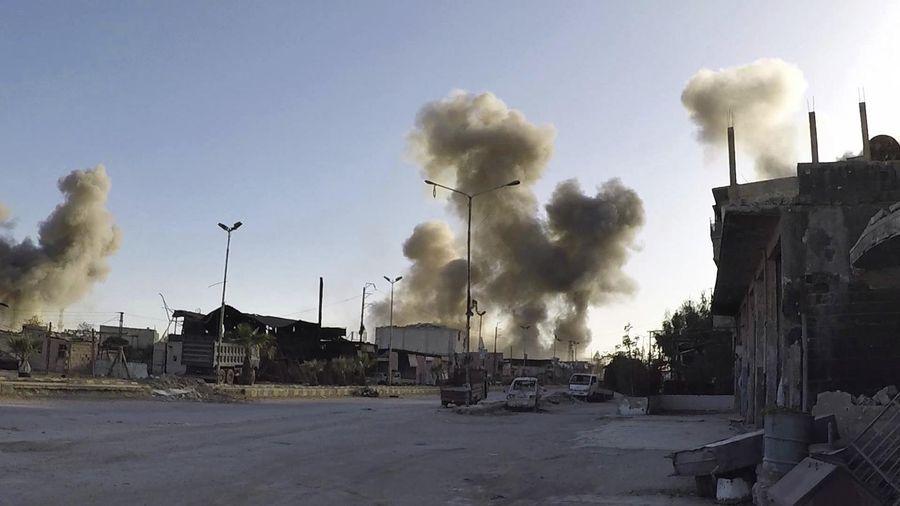
This photo released by the Syrian Civil Defense White Helmets, which has been authenticated based on its contents and other AP reporting, shows smoke rising after Syrian government airstrikes hit in the town of Douma, in eastern Ghouta region east of Damascus, Syria, Saturday, April. 7, 2018. Syrian government forces pressed their offensive against the last rebel-held town in eastern Ghouta near the capital Damascus on Saturday under the cover of airstrikes as shelling of civilian areas on both sides claimed more lives, state media and opposition activists said. (Syrian Civil Defense White Helmets via AP)
The Consequences of a Syrian Strike
Published April 13, 2018 • Read time: 4m
WASHINGTON -- After fulminating about retaliation for the latest Syrian chemical weapons attack, the Trump administration cooled off long enough to consider the dangers of such a strike. That's to the credit of Defense Secretary Jim Mattis, who favored a measured response, and also of President Trump, who tempered his initial bellicose language about an assault.
Trump showed a year ago that he intends to enforce global norms against the use of chemical weapons. And that remains the right stance. But sadly, he still doesn't have a Syria policy. He wants to withdraw U.S. forces even as he tries to look tough -- a recipe for failure on both fronts.
"Whiplash" is probably the best word to describe what Syria watchers are feeling. Two weeks ago, Trump was hectoring his advisers about the need to bring U.S. troops home. Then, after Saturday's apparent chemical attack on Douma, the president was tweeting about firing missiles in retaliation, and making Russia pay a "big price" for backing President Bashar Assad.
This mixed message is still the core problem in Syria. There's a banner headline -- America is responding to chemical weapons, in addition to destroying the Islamic State -- but the body of the story is missing. Perhaps Trump will more clearly see now the need for a broader U.S. strategy to help stabilize Syria.
The best thing that happened this week was that the policy process paused for a careful consideration of military options. Mattis warned the president privately about the dangers, with U.S. and Russian forces so close in Syria and the Mediterranean. Trump evidently listened, and deferred action for several days, allowing more study. The U.S. is also coordinating policy options with Britain, France and other allies, another positive development.
Nuclear Jihad: The Threats Are Inside Our Tent
Israel's "Sorrow of the Left"
Signs of Progress Against Extremists in Syria
The World Is Getting Worse, But This Time America Won't Save It
Mattis voiced his concerns in testimony to a House committee Thursday. "On a strategic level, it's how do we keep this from escalating out of control, if you get my drift on that," he said. Warning statements from Russia and private messages between the two militaries have reinforced the need for caution.
"There remains a robust back and forth," said one Pentagon official about military-to-military contacts. The Russians have recently "reminded us about what they would have preferred to know last year" when the U.S. struck a Syrian air base after a nerve-gas attack on civilians in Khan Sheikhoun.
The trick for U.S. planners is how to calibrate military action this time so that it sends a clear deterrence message to Syria and Russia, without escalating the conflict.
The right sort of message requires discretion: Trump didn't publicly tout his plan to fire 59 cruise missiles after the Khan Sheikhoun attack; the U.S. in February warned Russian liaison officers before a devastating assault on paramilitary forces attacking an oil-and-gas facility near Deir al-Zour; Israel has struck Iranian operations at the T-4 air base in central Syria, without claiming credit for the attacks.
But such measured actions are harder when they're preceded by presidential taunts. Trump tweeted on Sunday morning after the Douma attack: "President Putin, Russia and Iran are responsible for backing Animal Assad. Big price to pay." He cranked up the volume Wednesday morning, tweeting about firing missiles in retaliation: "Get ready Russia, because they will be coming, nice and new and 'smart!'"
Trump appeared to realize this diatribe was a mistake, so he tweeted a sort of correction Thursday: "Never said when an attack on Syria would take place. Could be very soon or not so soon at all!"
Slowing the retaliatory reflex was welcome, partly because it gave Trump time to cool off after the FBI search of his personal lawyer, Michael Cohen -- not the moment to be making decisions about war and peace. This week's delay should also reassure analysts, here and abroad, who feared Mattis' standing with Trump would be diminished after the firing of his friend Rex Tillerson as secretary of state.
As with any use of military force, planners need to think carefully about "the day after." Would a U.S. strike trigger a widening conflict in a part of Syria where its leverage is limited? Would President Vladimir Putin feel he must make his own show of toughness by matching Trump and moving up the escalatory ladder? And what would Trump do if this action, unlike the Syria reprisal of a year ago, failed to win applause?
Trump, like President Obama, is finding that it's easier to talk about withdrawing from Middle East wars than to actually do it. When Trump takes military action in Syria, he owns the consequences.
(c) 2018, Washington Post Writers Group

Newsom Defies Voters, Juries and Lawmakers To Spare Murderers While Defending Abortion
Curtis Hill • RealClearPolitics
The Algorithmic Tilt
Frank Filingeri • RealClearPolitics
A RealClear Thanksgiving: Investing in a Better Future
David DesRosiers • RealClearPolitics
Trump’s Newsom Problem: Antagonist-in-Chief
Carolina Lumetta • RealClearPolitics
America’s Free Spirit
John Maxwell Hamilton • RealClearPolitics
The GOP Majority Should Go Out in Glory
Daniel McCarthy • RealClearPolitics
RCP Today
Top stories on RealClearPolitics
The Takeaway
Polling intelligence and analysis delivered to your inbox
World News
Featuring the latest world news
Policy
Featuring the latest policy news
Support Our Mission
As part of RealClearPolitics, authors aim to provide balanced, non-partisan analysis by presenting top reporting and commentary from all sides of the political spectrum.
Trusted by policymakers and citizens alike since 2000