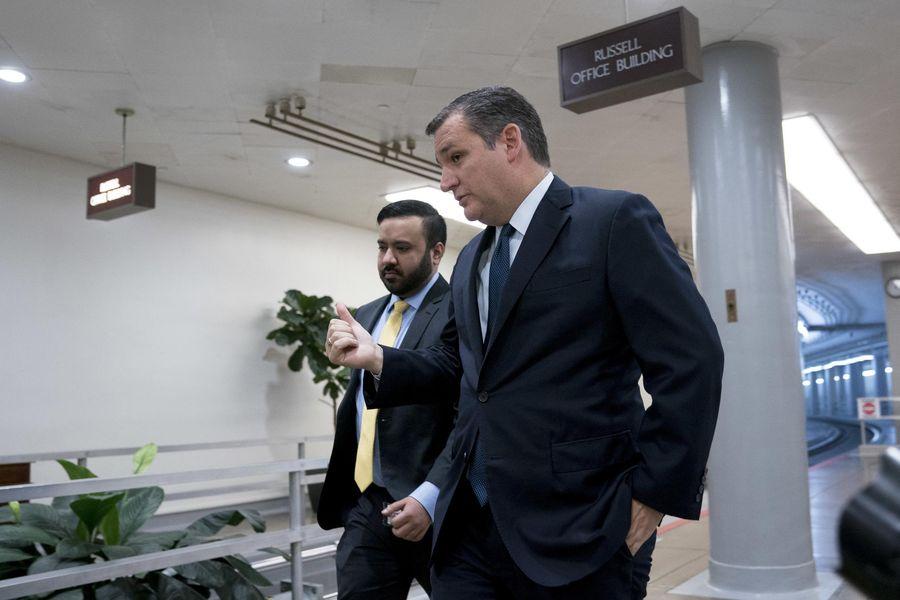
Sen. Ted Cruz, R-Texas, arrives as Congress prepares to vote on the biggest reshaping of the U.S. tax code in three decades, on Capitol Hill, Tuesday, Dec. 19, 2017, in Washington. (AP Photo/Andrew Harnik)
Senate Votes Underscore Immigration Litmus Tests
Published Feb. 16, 2018 • Read time: 7m
Join the Conversation
0The breakdown in the U.S. Senate Thursday over legislative protections for a segment of undocumented immigrants demonstrated -- once again -- how entrenched the two parties have become on the overarching issue of immigration.
Lawmakers put forth three bills aimed at finding a solution for those brought to the country illegally as children and all three failed. A proposal that reflected President Trump's plan to offer a citizenship pathway for nearly 2 million illegal immigrants, approve $25 billion in border security funds and make significant changes to legal immigration received just 39 votes, the fewest of the proposals.
The votes were emblematic of notable shifts over time within each party and suggested why consensus on immigration policy may be intrinsically elusive, particularly as lawmakers brace for midterm elections later this year.
"Immigration has come to define the bases of both these parties now," said Muzaffar Chishti of the Migration Policy Institute, noting that the two parties’ divergence was crystalized in their 2016 election platforms.
While fault lines within the parties also have been on display over the past few weeks, the Senate votes offered additional clues about the power of base politics.
Republican Sen. Dean Heller of Nevada, for example, voted for Trump's immigration plan as well as legislation put forth by Pennsylvania Sen. Pat Toomey to crack down on sanctuary cities, but voted against the two bipartisan DACA proposals. Heller is up for re-election this year in a state Hillary Clinton carried and which has a high Latino population. But he also faces a primary challenge from the right, and has kept most of his votes in line with the president.
The Rise and Fall of Marco Rubio
An Invasion of Artificial Outrage
Obama Administration Tells Agents to ID Which Immigrants Not to Deport
Green Shoots of Sanity?
Meanwhile, 14 Republicans voted against Trump's plan, many of whom argued it was not conservative enough. "We should not be granting citizenship to people here illegally," Texas Sen. Ted Cruz had said.
But though the Senate rejected the president's proposal, it is notable that 39 Republicans voted in favor of the legislation, which would place limits on family immigration and end diversity lottery visas. While Trump made a campaign mantra of "build the wall," his focus was mostly on illegal immigration. His embrace of principles championed by Arkansas Sen. Tom Cotton and former Alabama Sen. Jeff Sessions -- whose former aide Stephen Miller is now Trump's top policy adviser -- demonstrates another shift.
"It's totally contrary to every other thing they claim as a principle, from being pro-life to pro-family to pro-economic growth and pro-business," said David Bier of the libertarian Cato Institute, citing assessments from a variety of economists that cuts to legal immigration would be a net negative to the economy. "There was not a push within the GOP to cut legal immigration and [Trump] single-handedly brought that about."
In another notable shift, Republican senators who voted for the 2013 comprehensive immigration bill voted against a bipartisan plan that would have extended a citizenship pathway for Dreamers and allocated $25 billion for border security measures that would include the wall along the southern border. Among them: Florida Sen. Marco Rubio, who was an architect of the 2013 bill and an also-ran in the 2016 GOP presidential primary. The Trump White House had threatened to veto the proposal if it passed, arguing it lacked interior enforcement. The veto threat represented yet another shift from last month, when the president said he would sign any bill lawmakers sent him.
The votes Thursday also exposed ways in which the Democratic Party has moved leftward on the issue, and how immigration has become something of a litmus test for the party. California Sen. Kamala Harris, considered a potential 2020 presidential candidate, was one of just three Democrats to vote against the bipartisan solution, even though it provided a pathway for Dreamers. Harris objected to the inclusion of a $25 billion appropriation for Trump's border wall, which she called "a waste of taxpayer money."
And Democrats who were once averse to some policy components involving illegal immigrants came around Thursday. Montana Sen. Jon Tester voted against the DREAM Act in 2010, calling it "amnesty" but backed the bipartisan proposals that would include citizenship pathways (the second one did not include funding for a wall). Vermont Sen. Bernie Sanders, who caucuses with the Democrats, voted against comprehensive immigration reform in 2007 because he argued it disadvantaged American workers. On Thursday, the man who took heat from Hillary Clinton over immigration during the 2016 Democratic presidential primary, advocated for Congress to pass not only “clean” protections for Dreamers, but also include a pathway to citizenship for their parents.
"Democrats have become more uniformly pro-immigrant and Republicans are still divided, but the hard-liner wing is ascendant," said Frank Sharry, executive director of the immigration reform group America's Voice. "Finding the sweet spot now is elusive at best and nearly impossible."
Midterm politics have intensified the already fraught issue. Republicans facing primaries have little incentive to back bipartisan immigration bills. House Speaker Paul Ryan, who is under pressure from his conservative members, has said he wouldn't put forward any bill that doesn’t have the president's support.
"There's not much risk in a conservative Republican primary atmosphere for members to hold firm on immigration," said strategist Doug Heye, a former aide to onetime House Majority Leader Eric Cantor, who lost a primary in 2013 largely on the immigration issue. "The word immigration -- legal or not -- has become a charged word in certain parts of the GOP. ... On our side, we have now basically defined anything short of loading up every person who is here illegally and putting them on a bus to Mexico … as amnesty."
Democrats face challenges of their own when it comes to semantics. They are already loath to give Trump any victory on "the wall." Furthermore, their base is energized over the DACA issue, and leaders had gone so far as to advocate for a government shutdown in the absence of immigration legislation. But they have repeatedly found themselves backed into a corner. The activist group United We Dream opposed one of the bipartisan measures that stood the best chance of passage. "Stop playing by Trump’s rules and take principled action now to protect immigrants and people of color from the Trump government," wrote Executive Director Cristina Jimenez.
Meanwhile, several of the party’s senators are up for re-election in states Trump won. Heidi Heitkamp of North Dakota, Joe Donnelly of Indiana and Joe Manchin of West Virginia voted for Trump's immigration plan Thursday. “I share the president's commitment to border security. That’s why I voted for his plan," Manchin said.
Veterans of past immigration battles argue that the hardened positions on both sides will make it nearly impossible to move legislation with multiple components. "Immigration is just fraught with such political and policy landmines," said Cesar Conda, who served as Rubio's chief of staff and as a former policy adviser to Vice President Dick Cheney.
Conda said he would urge Trump to advocate a narrower bill, one that might provide some kind of legal protections for Dreamers as well as funding for his border wall. The president could "claim victory, providing certainty for Dreamers and funds for a lot of photo ops for a wall on the southern border."
But with the Senate unable to forge consensus, it's even more unlikely the House will feel any pressure to act. And soon after the Senate failure, the blame game on Capitol Hill had already begun.

Newsom Defies Voters, Juries and Lawmakers To Spare Murderers While Defending Abortion
Curtis Hill • RealClearPolitics
The Algorithmic Tilt
Frank Filingeri • RealClearPolitics
A RealClear Thanksgiving: Investing in a Better Future
David DesRosiers • RealClearPolitics
Trump’s Newsom Problem: Antagonist-in-Chief
Carolina Lumetta • RealClearPolitics
America’s Free Spirit
John Maxwell Hamilton • RealClearPolitics
The GOP Majority Should Go Out in Glory
Daniel McCarthy • RealClearPolitics
RCP Today
Top stories on RealClearPolitics
The Takeaway
Polling intelligence and analysis delivered to your inbox
World News
Featuring the latest world news
Policy
Featuring the latest policy news
Support Our Mission
As part of RealClearPolitics, authors aim to provide balanced, non-partisan analysis by presenting top reporting and commentary from all sides of the political spectrum.
Trusted by policymakers and citizens alike since 2000