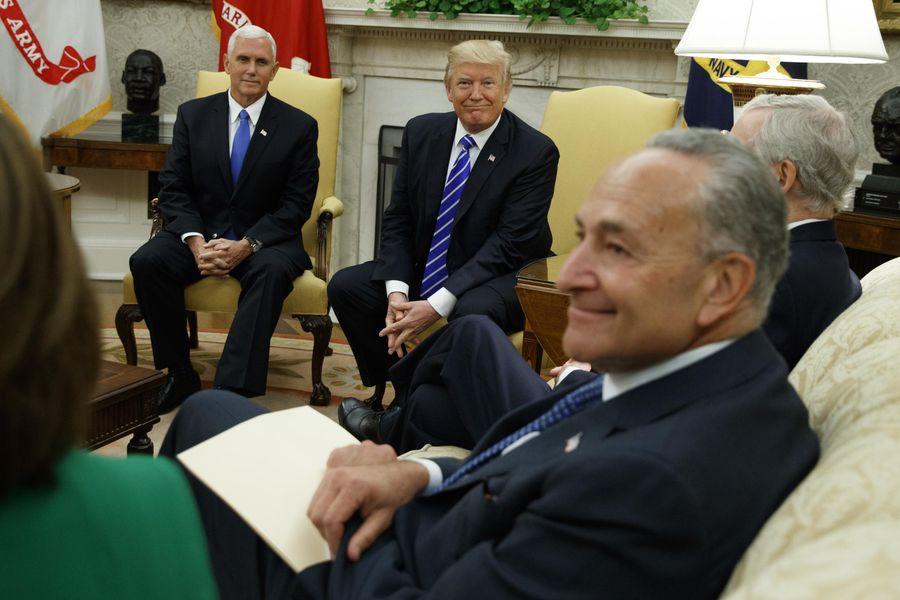
Vice President Mike Pence looks on with President Donald Trump during a meeting with Senate Minority Leader Chuck Schumer, D-N.Y., and other Congressional leaders in the Oval Office of the White House, Wednesday, Sept. 6, 2017, in Washington. (AP Photo/Evan Vucci)
Can Trump and Democrats Make a Deal on Immigration?
Published Sept. 8, 2017 • Read time: 4m
Can President Donald Trump and the Republican-majority Congress make a deal? That's a question raised by the announcement that the Trump administration will end the Deferred Action for Childhood Arrivals program in six months. DACA, put in place by the Obama administration, provided protection from deportation to immigrants who entered the United States illegally as children and who didn't have serious criminal records and were working or in school or the military.
Trump is on strong legal ground. Barack Obama established DACA in 2012, even though, as he had earlier explained, the Constitution gives Congress, not the president, the authority to set policy on immigration and naturalization.
Moreover, Obama's 2014 Deferred Action for Parents of Americans, which would have given protection to some 4 million parents of legal residents, was ruled invalid by federal courts. Ten state attorneys general have been threatening to challenge DACA on identical grounds.
Attorney General Jeff Sessions is thus right when he says that DACA could be overturned by the courts, leaving the 800,000 young people currently covered with no protection. They may be better off with Trump's order leaving DACA in place for six months than they would be then.
Though DACA is, as Democratic Sen. Dianne Feinstein agreed, "on shaky legal ground," the political case for the policy is strong. Polls show large majorities in favor because they agree with what Trump said in his written statement: "I do not favor punishing children, most of whom are now adults, for the actions of their parents." This is an instance, arguably a rare one, of Trump's changing his mind after learning more and reflecting.
The Rise and Fall of Marco Rubio
An Invasion of Artificial Outrage
Obama Administration Tells Agents to ID Which Immigrants Not to Deport
Green Shoots of Sanity?
The equities weigh heavily in its favor. The 800,000 "dreamers" who came forward and sought DACA status are no more responsible for the dubious legal basis for Obama's program than they are for their parents' decision to bring them in the United States illegally. They qualified under the terms of an action of the United States government then in force and have a strong moral case for permanent legal status.
Trump has made clear that he would support a legislative version of DACA, and it could get majority support in both houses of Congress. But because some Republicans, such as Rep. Steve King, are opposed, any bill must be a bipartisan compromise. That means that Democrats will have to make concessions to get the issue on the congressional calendar.
Before the Obama Democrats began passing major legislation on a Democrats-only basis, this was standard operating procedure. It produced major education, Medicare and tax legislation in George W. Bush's years and NAFTA, welfare reform and children's health care legislation in Bill Clinton's.
The late Sen. Edward Kennedy was particularly expert in fashioning bipartisan compromises. He would accept provisions he didn't like in return for others he favored and thought more important. He would oppose as "poison pills" amendments he personally supported but believed would cost a bill needed Republican votes. One such poison pill did pass, with the help of the vote of then-Sen. Obama, and torpedoed the 2007 comprehensive immigration bill, which would have been signed by Bush.
Ten years later, the facts and opinion on immigration have changed. One possible path forward was suggested by Sen. Tom Cotton, co-sponsor of a different comprehensive immigration bill supported by Trump. Giving young people who violated the law -- even if it was through no fault of their own -- legal status would have "negative consequences," Cotton argues, opening up chain migration of low-skilled collateral relatives and incentivizing others to bring children in illegally. So a bill to replace DACA, he says, should be accompanied with limits on extended family unification migration and with "enhanced enforcement measures," such as mandatory E-Verify.
Such provisions will most likely be opposed by the lobbies whose ultimate goal has been giving legal status to almost all of the 11 million immigrants here illegally, a measure that was part of the 2007 and 2013 comprehensive bills. But Democrats may have to accept them to help the dreamers.
Much will depend on the deal-making skill of the president and congressional leaders. Will they measure up to the standard set by Ted Kennedy?
COPYRIGHT 2017 CREATORS.COM

Newsom Defies Voters, Juries and Lawmakers To Spare Murderers While Defending Abortion
Curtis Hill • RealClearPolitics
The Algorithmic Tilt
Frank Filingeri • RealClearPolitics
A RealClear Thanksgiving: Investing in a Better Future
David DesRosiers • RealClearPolitics
Trump’s Newsom Problem: Antagonist-in-Chief
Carolina Lumetta • RealClearPolitics
America’s Free Spirit
John Maxwell Hamilton • RealClearPolitics
The GOP Majority Should Go Out in Glory
Daniel McCarthy • RealClearPolitics
RCP Today
Top stories on RealClearPolitics
The Takeaway
Polling intelligence and analysis delivered to your inbox
World News
Featuring the latest world news
Policy
Featuring the latest policy news
Support Our Mission
As part of RealClearPolitics, authors aim to provide balanced, non-partisan analysis by presenting top reporting and commentary from all sides of the political spectrum.
Trusted by policymakers and citizens alike since 2000