
In 1996, a Preview of Trump's Made-for-TV Convention
Published May 27, 2016 • Read time: 5m
Join the Conversation
0Donald Trump and his campaign have begun to envision the party’s national convention as akin to a hit reality TV show, with ratings to match. But that concept is not as unprecedented as it sounds.
MSNBC host Chris Matthews recently asked Paul Manafort, Trump’s top campaign aide who will also serve as his convention manager, whether the Cleveland gathering would be staged like “a reality show of some kind.”
“This is the ultimate reality show,” Manafort replied. “It’s the presidency of the United States.”
There are few details thus far to suggest how this convention might depart from those in recent years, which have all been tightly scripted, made-for-TV productions.
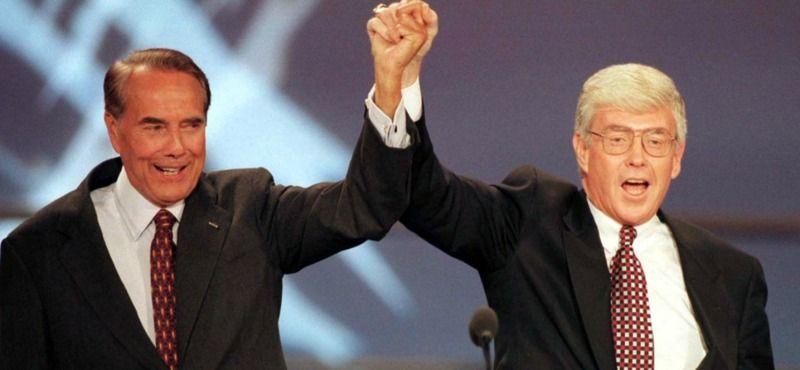
But Trump’s campaign knows the model well: It was pioneered in 1996 by Manafort when he managed the nominating convention for Bob Dole.
If the 2016 event takes its cues from modern-day reality TV, the 1996 iteration in San Diego was fashioned by Manafort as a giant infomercial for the Republican Party and Dole, its standard-bearer. In planning the convention, Manafort watched “hundreds of infomercials,” he told The New Yorker that year, to draw up his own “political programming.”
“I mean programming in the true TV sense,” Manafort added.
At that time, the concept of a neatly packaged convention, with programming paced out deliberately to accommodate commercial breaks and news anchor commentary, was nothing short of an innovation. Manafort’s choreography, too, marked a departure from tradition: Speeches were trimmed to only a few minutes each, and less interesting speakers were relegated to time blocks when the networks would likely cut away. Key moments on stage were complemented by glossy video packages, including one of Dole at home in Russell, Kan. — elements that are now commonplace at all party conventions.
Cruz's Path to Nomination
Trump Stands by His Manager
With Tweets on Heidi Cruz, Trump Sinks to New Depths
A Vote for Kasich Is a Vote for Trump
"We've looked at modern television, and we've looked at what keeps people's attention," Manafort said at the time. "We've taken a look at the opportunities that a national convention can provide in the modern age. … And we've tried to create a program which is exactly that -- a television program that has a political message."
To execute this program, Manafort assembled a team that reflected the convention’s new priorities, with a communications staff larger than the political organization: “A recognition,” Manafort told reporters in July 1996, “of the importance of massive communications in a convention and in these times.”
One effect of this more tightly managed but polished format, Manafort hoped, would be to quash any opportunities to stray from the script. Although Pat Buchanan had pushed for a speaking slot at the convention, the organizers would not grant him one, and he accepted their decision. When there was buzz of a walkout during Colin Powell’s speech (conservatives were bristling over his support for affirmative action and abortion rights), Manafort flooded the aisles around the would-be protesters with other delegates.
“They were locked in their seats, couldn’t move,” Manafort later told Martin Plissner, as recounted in the late CBS News political director’s “The Control Room: How Television Calls the Shots in Presidential Elections.” “No walkout. No way, too, you guys could get to them.”
Many news organizations grumbled that the format, while making it easy for the TV networks to frame the events and digress where appropriate, erased any actual news from the convention proceedings, which up until that time had been fertile ground for political drama.
''We're not there to be an unmediated conduit for their promotions,'' Jeff Gralnick, ABC News vice president and executive producer of the network's convention coverage, told The New York Times at the time.
Ultimately, the dynamic so annoyed Ted Koppel, then the host of the ABC News program “Nightline,” that he and his crew departed the convention ahead of schedule.
''There was a time when the national political conventions were news events of such complexity that they required the presence of thousands of journalists,'' Koppel told the Times. ''But not this year.''
Ahead of the 2016 convention, Trump has teased an event with higher entertainment value relative to past conventions, and featuring musical acts. "You hear a lot of speeches and people end up falling asleep after the 19th speech,” Trump told Fox News recently. “We have some great country-and-western people who want to come in and some entertainers that want to come in.”
But his campaign apparently has not set in motion this vision. And although one Trump source recently told Politico that the presumptive nominee “wants to control it 100 percent,” the campaign so far has not exerted this level of control over the Republican National Committee team organizing the four-day event.
Indeed, the Trump campaign has only within the past few days sent liaisons to Cleveland to begin coordinating, including David Urban, a GOP lobbyist, and Ryan Price, who directed operations at the 2012 party convention in Tampa, according to a source with knowledge of their involvement. Neither Urban nor Price responded to requests for comment, and a spokesperson for Trump did not provide details regarding how hands-on Manafort’s role as manager will be.
Ultimately, the 1996 convention was not successful by one of the few metrics Trump would care about today: ratings. The Democratic convention that year reached 16.4 million homes, according to Nielsen, while the Republican convention aired in roughly 15.8 million homes.
But as the end of the convention neared, Manafort expressed hope that it would achieve its ultimate objective: uniting the GOP and boosting Dole to the White House.
“Republicans will come home, in your words?” one reporter asked Manafort at a press conference.
“They’re already coming home,” he said.
Manafort’s infomercial did not make the sale. Twenty years later, he will try again with a reality show.

The GOP Majority Should Go Out in Glory
Daniel McCarthy • RealClearPolitics
Republican Majorities Could Return Sooner Than Expected
J.T. Young • RealClearPolitics
The Danger Before the Attack
Leslie J. Sullivan • RealClearPolitics
Jon Finer’s Old and Dangerous ‘New Approach’ to Israel
Peter Berkowitz • RealClearPolitics
The President Deserves Better
John Ullyot • RealClearPolitics
Congress Doesn’t Need Another Blame Game. It Needs To Find What’s Broken
Jarrod Bernstein • RealClearPolitics
RCP Today
Top stories on RealClearPolitics
The Takeaway
Polling intelligence and analysis delivered to your inbox
World News
Featuring the latest world news
Policy
Featuring the latest policy news
Support Our Mission
As part of RealClearPolitics, authors aim to provide balanced, non-partisan analysis by presenting top reporting and commentary from all sides of the political spectrum.
Trusted by policymakers and citizens alike since 2000