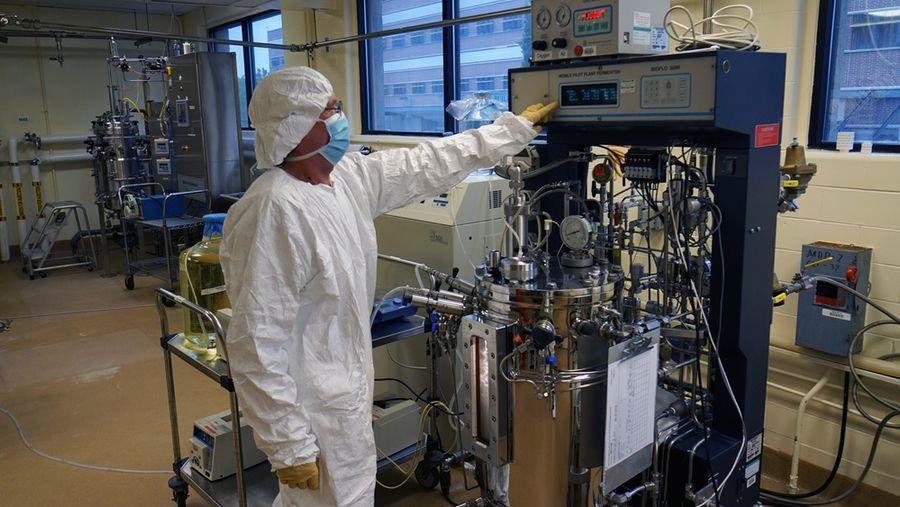
CAMRIS Participates in Army's Vaccine Research
Why America's Future Depends on the Bioeconomy
COMMENTARY
Published April 29, 2022 • Read time: 4m
If the coronavirus pandemic exposed the fragility of our supply chains, Russia’s invasion of Ukraine has laid bare the precarious state of global food security. While inflation and sanctions on Russia have pushed up the price of food and fuel, the latest U.N. climate report provides a further urgent warning to change the status quo for the sake of our planet. It claims that global CO2 emissions must peak by 2025 to avoid catastrophic effects.
But there is an alternative to the uncomfortable choice between economic sacrifice, moral compromise, and ecological ruin. It’s called the bioeconomy, and it has the potential to address the existential challenges posed by climate change, global pandemics, and growing economic inequity. Imagine bio-based antiviral face masks, or carbon-neutral cement produced in facilities located in America’s former industrial hubs.
This vision is already with us. With federal support, biotechnology was born in California in the 1970s. Since that time, it has become a driving force in many economic sectors, from agriculture to energy, generating at least 5% of U.S. GDP.
Biomedical breakthroughs – including the mRNA COVID-19 vaccines – are a typical outcome of biotechnology, yet just a fraction of the bioeconomy’s potential. We are on the cusp of a transformation whose impact on our lives will be as significant as the birth of the Internet. This new era of science can create biologically derived, and in many cases superior, alternatives to the food we eat, the fuel to power our transport, and the materials we need for clothing and chemical production.
Interview with Agriculture Secretary Tom Vilsack
Environmentalism and Human Sacrifice
Interview with Agriculture Secretary Tom Vilsack
Food for Thought on Immigration
For America, the bioeconomy promises major social and economic benefits. Globally, it could be worth up to $30 trillion. It will reduce the nation’s dependence on fossil fuels, revitalize U.S. manufacturing, create more resilient supply chains, and bring us closer to a net-zero carbon economy.
Despite these exciting possibilities, federal spending to support a vibrant U.S. bioeconomy has been stagnant for years. It’s been a decade since the National Bioeconomy Blueprint was published, but there’s been little action to implement it. Since 2012, other countries, particularly in Europe, have surged ahead with educational programs to train workers for the bioeconomy and in the creation of bioproduction facilities to commercialize their innovations. Many U.S. companies are forced to seek talent and infrastructure abroad, perpetuating the “innovate here, produce there” system that hurt so many manufacturing workers in the 1980s.
As strong believers in the power of federal action to spur transformative innovation, we don’t want this great opportunity to be squandered. Schmidt Futures, a philanthropic initiative that bets early on exceptional people making the world better, has released a new strategy for the U.S. bioeconomy. Drawing upon the insights of experts mobilized across multiple disciplines, it proposes three actions the government can take to ensure the bioeconomy is developed for public benefit.
First, federal action can enable a policy environment that incentivizes a thriving bioeconomy by implementing and continuously updating a formal strategy. Now is the time to rethink the subsidies and actions that continue to support petrochemicals at the cost of enabling the bioeconomy to provide safer alternatives for the climate and our collective well-being. By designating a “home” for the bioeconomy, all policy initiatives could be coordinated to maximize their potential.
Second, we need to invest in talent. A 2019 survey found that 78% of biopharmaceutical industry leaders had difficulty filling positions. More accessible technical training, visa reforms for high-skilled workers, and industry-informed work experience – particularly for underserved and underrepresented communities – will help prepare workers for the jobs of the future.
Finally, with an investment of around $2 billion over five years – just a fraction of the $550 billion allocated in the recently passed bipartisan infrastructure deal – the government can catalyze the advanced manufacturing science required to facilitate the transition from laboratory scale to commercial scale.
If America can implement this strategy, it would put the nation in a position to set norms and ground rules for a sector destined to become a major driver of the global economy.
The world will fully transition to a bioeconomy within the next two decades, and the question is whether the United States will lead the way. We already have a template for focused government action to catalyze industrial innovation. The semiconductor and nanotechnology industries, central to Silicon Valley’s success story, addressed their grand challenges with federally funded initiatives, and the quality of our smartphones, cars, and planes is all the better for it. The quality of our economy, our health, and our planet now depends on similar bold action for the bioeconomy.

Newsom Defies Voters, Juries and Lawmakers To Spare Murderers While Defending Abortion
Curtis Hill • RealClearPolitics
The Algorithmic Tilt
Frank Filingeri • RealClearPolitics
A RealClear Thanksgiving: Investing in a Better Future
David DesRosiers • RealClearPolitics
Trump’s Newsom Problem: Antagonist-in-Chief
Carolina Lumetta • RealClearPolitics
America’s Free Spirit
John Maxwell Hamilton • RealClearPolitics
The GOP Majority Should Go Out in Glory
Daniel McCarthy • RealClearPolitics
RCP Today
Top stories on RealClearPolitics
The Takeaway
Polling intelligence and analysis delivered to your inbox
World News
Featuring the latest world news
Policy
Featuring the latest policy news
Support Our Mission
As part of RealClearPolitics, authors aim to provide balanced, non-partisan analysis by presenting top reporting and commentary from all sides of the political spectrum.
Trusted by policymakers and citizens alike since 2000