
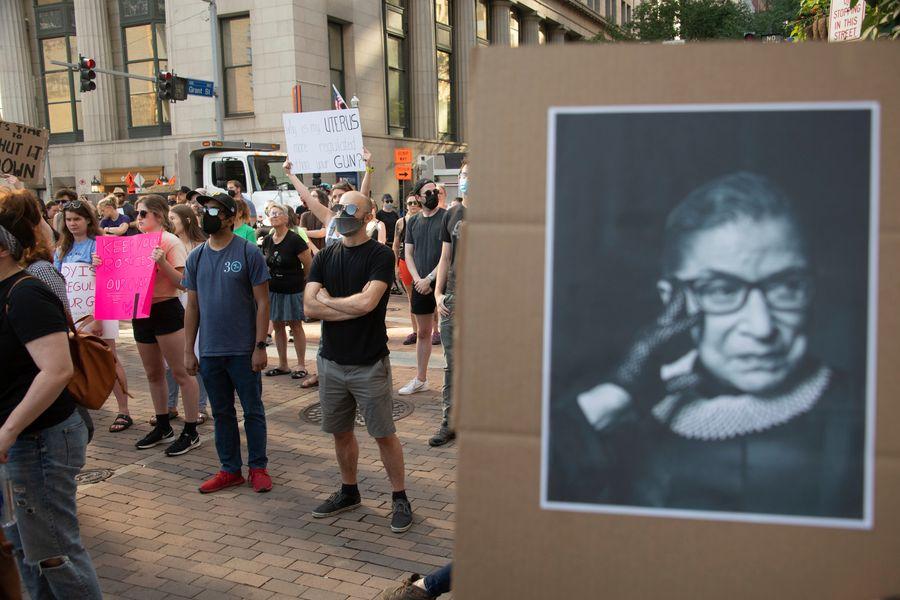
Supreme Court Abortion Pittsburgh
The Road Not Taken
COMMENTARY
Published July 5, 2022 • Read time: 6m
States are scrambling in different directions in the wake of the Supreme Court decision striking down Roe v. Wade, but abortion rights might be more advanced if Roe had never existed. Fifty-five years ago Gov. Ronald Reagan signed a permissive abortion rights law that was passed by a bipartisan majority of the California legislature.
The Therapeutic Abortion Act of 1967 authorized physicians to perform abortions up to the 21st week of pregnancy in cases where the physical or mental health of the mother was endangered. The law was interpreted broadly by the medical profession, as abortion opponents had warned, so that its practical effect was to make abortions widely available.
Because of its huge population and diversity, California has been a trend-setting state on issues ranging from automobile emissions to tax policy. The California law triggered a flood of similar legislative proposals in states across the country, most of them bipartisan.
Not every proposal became law, but within the next four years Alaska, Hawaii, New York, and Washington state repealed anti-abortion statutes, and allowed licensed physicians to perform abortions on request before fetal viability.
These states, except New York, required a woman seeking an abortion to be a state resident for at least 30 days prior to the procedure. Since New York did not have a residency requirement, it became “an option for the affluent” in the words of the pro-abortion rights Alan Guttmacher Institute.
Grassroots organization on behalf of abortion rights virtually ended after the Supreme Court in 1973 discovered a constitutional right to abortion in Roe. Abortion (pro-choice) supporters afterward focused on upholding Roe against legal and political challenges.
Meanwhile, abortion (pro-life) opponents in every state formed grassroots groups that relentlessly lobbied legislatures and Congress to pass laws that would overturn the decision.
This division shattered the bipartisan approach to abortion rights that had existed when the California law was passed. As the issue became more politicized, it inevitably became more partisan with Republicans on the pro-life side while Democrats gathered under the pro-choice banner.
All but one endangered Democratic member of the House currently supports abortion rights, befitting a party with a 2020 platform that called for “codifying” the right to abortion. On the other side, the 2020 Republican Party platform said the GOP was “proud to be the party that protects human life…and strongly opposes infanticide.”
One distinguished liberal who supported abortion rights anticipated the danger of a partisan approach. Ruth Bader Ginsburg, both before and after she became a Supreme Court justice, contended that a more incremental strategy for legalizing abortion would have been preferable to the nationwide ruling in Roe that invalidated dozens of state anti-abortion laws.
Ginsburg also suggested a ruling protecting abortion rights would have been more durable if based on the Equal Protection Clause of the Constitution – in other words, if it had focused on gender equality rather than the right to privacy that the justices discerned and highlighted in Roe.
As a reporter for the San Jose Mercury-News, I covered the passage of the Therapeutic Abortion Act by the California legislature in 1967. It was an emotional debate by its nature but also an enlightening discussion without any partisan notes.
State senator Anthony Beilenson, the author of the bill, was a Democrat and a remarkable legislator. He visited every one of the 39 other state senators, even those he knew opposed his bill, because he felt that each of them was entitled to a personal explanation of its purpose.
I was allowed to sit in on one of these meetings and heard Beilenson tell about women who had died or been injured in back-yard abortions. The senator who heard these accounts was impressed and voted for the bill.
After the legislation passed the Senate, it was carried in the Assembly by a Republican who had been a district attorney and prosecuted someone who had hurt a woman while performing an illegal abortion. California at the time, along with many other states, allowed an abortion only if necessary to save the life of the mother.
The abortion issue at the time usually divided on religious rather than political grounds. This proved a problem for Gov. Reagan when the Beilenson bill reached his desk, because Catholics in his inner circle wanted him to veto the bill and Protestants wanted him to sign it.
Reagan finally signed the bill after Republican legislators threatened to pass it and dare him to veto it. When I interviewed Reagan a year later for my first book, he emphasized that he had been in office less than four months during the controversy over the Beilenson bill. Reagan told me he regretted signing the bill and had become an opponent of permissive abortion, a position he maintained throughout his political career.
The bill was emotionally wrenching for Assembly Speaker Bob Moretti, a Catholic, a Democrat, and a graduate of Notre Dame. Moretti reluctantly decided the bill was necessary. George Skelton of the Los Angeles Times observed that Moretti was in tears as he cast his aye vote.
Opponents of the Beilenson bill predicted a “flood” of abortions in California, and they were right about that – although the flood began as a trickle. From about 5,000 abortions the year after the bill was passed, abortions in California reached a high point of more than 320,000 abortions in 1991, according to Guttmacher data.
Then began a long decline in U.S. abortions for reasons that are much debated. In 2020, the last year for which figures are available, there were 154,000 abortions in California, about 17% of the 930,160 abortions in the United States.
The figures on illegal abortions are unreliable, but we’re bound to have more of them if women do not have access to such procedures. That was a focal point of the debate on the Beilenson bill, which won support from legislators less because of the legal abortions it allowed than because of the illegal ones it prevented.
One never knows what would have happened on the road not taken, but I believe that Justice Ginsburg was right in favoring a more incremental approach. I don’t know if abortion could have escaped our current civil strife, but discussion of the issue on both sides was more rational and productive before it became scarred by hyper-partisanship.



RCP Today
Top stories on RealClearPolitics
The Takeaway
Polling intelligence and analysis delivered to your inbox
World News
Featuring the latest world news
Policy
Featuring the latest policy news
Support Our Mission
As part of RealClearPolitics, authors aim to provide balanced, non-partisan analysis by presenting top reporting and commentary from all sides of the political spectrum.
Trusted by policymakers and citizens alike since 2000