
Jackson, the Klan and Abortion
Published June 19, 2013 • Read time: 4m
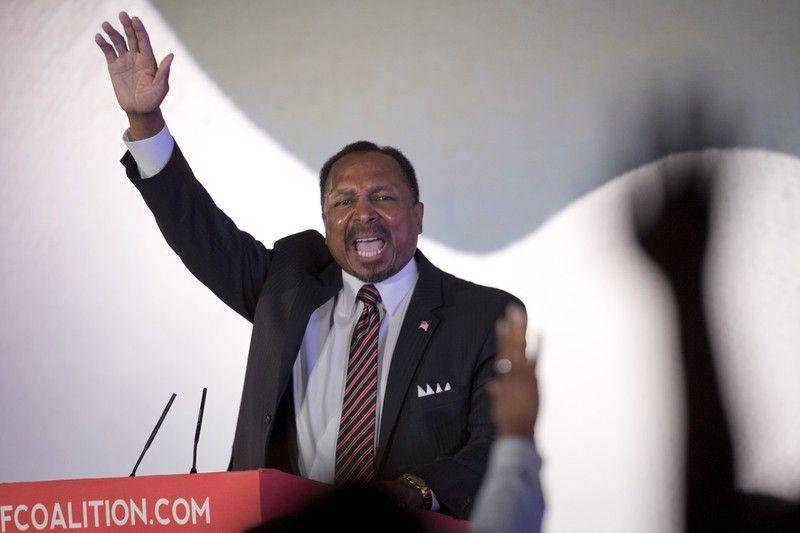
E.W. Jackson, the Virginia Republican Party’s nominee for lieutenant governor, says “Planned Parenthood has been far more lethal to black lives than the KKK ever was.” Jackson may be — as an exquisite Bloomberg headline called him — the “candidate of Virginia’s swivel-eyed loons.” But on this point he is technically correct.
According to a tally at Tuskegee University, 3,446 African-Americans were lynched between 1882 and 1968. By contrast, Planned Parenthood performs more than 300,000 abortions each year, and the abortion rate among African-Americans is more than three times higher than the rate among whites. Even if we assume that Planned Parenthood is a wild outlier and performs only 1 percent of all its abortions on blacks, Jackson’s statement still qualifies as true.
But so what? The Vietnam War killed almost twice as many African-Americans as the Klan did. Murder took the lives of 6,329 blacks in 2011, and blacks were the offender in nine out of 10 cases. By itself, Jackson’s statement is not that interesting.
But liberal and conservative reaction to it is. Conservatives (generally speaking) holler and stomp in approval. Liberals (generally speaking) howl in protest. The Washington Post, for instance, denounced “the Planned Parenthood canard,” lamenting “the idea that Planned Parenthood is a racist, even genocidal enterprise” as “scurrilous and estranged from the truth” despite being “an article of faith among some right-wing Republicans.”
This completely inverts the orthodox left and right positions on certain questions of race — specifically, those having to do with the doctrine of disparate impact.
GOP Abortion Bill Punt: Sell Out or Smart Politics?
Republicans Unanchored
What Is the GOP Thinking?
Republicans Surrender to Infanticide
That doctrine says (in the words of the Center for Equal Opportunity’s Roger Clegg) that institutions “can be held liable for policies that have disproportionate racial effects — even if those policies make no racial distinctions, are adopted with no discriminatory intent, and are applied in nondiscriminatory ways.”
So, for example, The Post reported the other day that the federal Equal Employment Opportunity Commission has “accused two major companies (BMW and Dollar General) of indirectly discriminating against African Americans by using criminal background checks to screen out workers.” Here in Central Virginia, others have been alarmed by a report on school discipline in Henrico showing black students make up 75 percent of students who are suspended, though they make up only 37 percent of the student population.
Two local black leaders, State Sen. Donald McEachin and Henrico County Supervisor Tyrone Nelson, wrote to the superintendent of the county school system to say they were “deeply disappointed and ... very concerned” by the report.
To conservatives, racial discrimination does not explain such disparities; individual behavior does. But the doctrine of disparate impact argues otherwise: It assumes facially neutral lending policies, for example, are discriminatory if they result in fewer blacks than whites getting loans.
This dichotomy of explanation showed up again last week, when the Urban Institute released an update of the Moynihan Report. The late Daniel Patrick Moynihan’s treatise on the plight of the African-American community focused heavily on individual factors — specifically, high rates of single parenthood. The new report downplays that explanation in favor of broader structural ones, such as “geographic concentrations of poverty”:
“Living in profoundly poor neighborhoods undermines people’s well-being and long-term life chances. High-poverty neighborhoods suffer from high rates of crime and violence, poor schools, and weak connections to the labor market. ... Neighborhood environment influences teens’ sexual activity. ... Young people who live in high-crime areas are more likely to commit crimes themselves, other things being equal.” The new report also cites structural factors such as “disproportionate incarceration” and other “obstacles that ensnare black families.”
To conservatives, this is an error of chickens and eggs. Conservatives would say profoundly poor neighborhoods do not cause crime, violence, teen sex, and so on, but result from them. Disproportionate incarceration does not weaken the black family; weakened families lead to disproportionate incarceration. And so on.
But then the topic turns to abortion and Planned Parenthood, and suddenly tunes change. Conservatives act as if individual agency has little to do with the disproportionately high rate of abortion among blacks. It is, they suggest, entirely the fault of malevolent institutions such as Planned Parenthood — and the fact that abortion has a disparate impact on blacks proves the abortion industry is racist.
And liberals? They retort that this is nonsense. If blacks have more abortions, why, that flows in part from individual choices. As one Planned Parenthood fact sheet puts it, “unintended pregnancy rates are higher for black Americans and Latinas than for white women.” The liberals may be marginally more consistent, since Planned Parenthood goes on to argue that such choices flow from “broader health disparities” such as limited access to birth control. But “marginally more consistent than conservatives” is not anything you would want to inscribe on a plaque, now is it?

The GOP Majority Should Go Out in Glory
Daniel McCarthy • RealClearPolitics
Republican Majorities Could Return Sooner Than Expected
J.T. Young • RealClearPolitics
The Danger Before the Attack
Leslie J. Sullivan • RealClearPolitics
Jon Finer’s Old and Dangerous ‘New Approach’ to Israel
Peter Berkowitz • RealClearPolitics
The President Deserves Better
John Ullyot • RealClearPolitics
Congress Doesn’t Need Another Blame Game. It Needs To Find What’s Broken
Jarrod Bernstein • RealClearPolitics
RCP Today
Top stories on RealClearPolitics
The Takeaway
Polling intelligence and analysis delivered to your inbox
World News
Featuring the latest world news
Policy
Featuring the latest policy news
Support Our Mission
As part of RealClearPolitics, authors aim to provide balanced, non-partisan analysis by presenting top reporting and commentary from all sides of the political spectrum.
Trusted by policymakers and citizens alike since 2000