Obama's N.C. Overture May Pay Off in Virginia
Published Sept. 7, 2012 • Read time: 9m
Join the Conversation
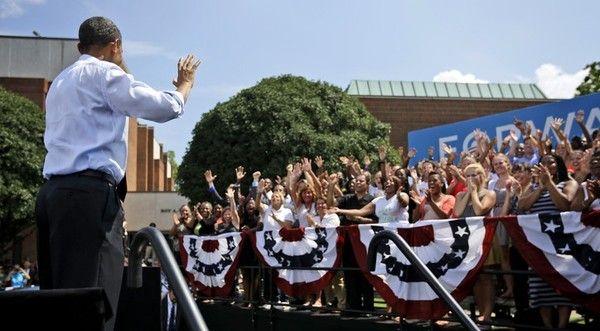
0CHARLOTTE, N.C. -- President Obama officially accepted his party's nomination Thursday night in a state many thought he would lose four years ago. Despite his previous underdog success here, the odds of the president winning the Tarheel State in November are even slimmer this time.
One indication of the obstacles he faces: Obama won North Carolina in 2008 by just 14,000 votes -- representing about two-thirds of the seats in the Time Warner Cable Arena. But nowhere in his speech to the 20,000 gathered there did the president mention, or thank, the Queen City.
Obama gave the most important speech of his campaign thus far in a state where unemployment (9.6 percent) is higher than the national average, the Democratic governor and other congressional candidates are retiring in part to avoid difficult re-election bids, and where Republicans control the state legislature. Even Bill Clinton, who gave an electrifying speech to delegates Wednesday night, couldn’t carry this growing Southern state in his own presidential races.
But Obama didn’t just have Carolina on his mind as Democrats staged the convention here this week. The campaign sees up-and-coming Charlotte as a mega-organizing tool to help gain steam in other Southern battlegrounds, namely neighboring Virginia. The president trails Romney in North Carolina, but leads him in the Old Dominion. On the opening day of the convention, Charlotte Mayor Anthony Foxx cited the border his state shares with Virginia, and suggested he anticipates some kind of “ripple effect” from the gathering in the South. Foxx and others hoped that free media in the lead-up to, and during the course of, the convention would pay dividends as neighboring-state voters see the enthusiasm emerging from Charlotte.
Lies, Assault and Cover-ups Don't Stop Donald Trump
Trump Stands by His Man; Obama on a Health Scourge; Hayden Interview; Reagan's Courage
Analysis: For Trump, Few Limits to Win-At-Any-Cost Approach
What If Clinton Isn't Indicted?
Obama bucked tradition by winning Virginia and North Carolina four years ago. The last Democrat to win the former was Lyndon Johnson; the last to win the latter was Jimmy Carter. The president hopes to repeat his victories in November, and sees potential in their similar demographics: Both states have a high youth population, are home to many universities and colleges, have a growing diversity in suburban areas, and are friendly to transplants and tech jobs. These dynamics buoyed Obama in 2008, but his political future in both battlegrounds is unclear.
“He really had a perfect storm in 2008 that allowed him to win [in North Carolina],” says Eric Heberlig, a political science professor at the University of North Carolina-Charlotte. “The economy was bad under the Republican administration, so people were willing to take a risk on Obama, who invested heavily in the state when McCain didn’t. . . . To me, the fact that everything went right in 2008 and he won in by very small amount suggests that when you don’t have everything right, it’s going to be difficult.”
The campaign, though, touts the strength of its ground operation in the state, which has been enhanced by hosting the convention. Staffers and volunteers hit the crowded streets here all week seeking to register voters. Registered Democrats already outnumber their Republican counterparts here by about 800,000, according to the state board of elections. Democrats also hoped to gin up enthusiasm for the president by having him accept the nomination at Bank of America Stadium, where the Carolina Panthers play and which has more than triple the capacity of Time Warner Cable Arena.
Of course, weather concerns scotched those plans. Obama campaign adviser David Axelrod suggested that the stadium had been an integral part of the mobilizing plan. “The stadium is a great venue. It’s a dramatic venue, but it’s also a great organizing tool,” he told RCP. “ . . . We were over-subscribed, so it was going to be great. But what we couldn’t risk were the thunderstorms.”
It did rain in Charlotte on Thursday, though the skies had cleared by the evening. But it wasn’t until the final day of the convention that the Democratic speakers really focused on the state. (Former Virginia Gov. Tim Kaine, a candidate for the U.S. Senate, did thank Charlotte for hosting the event in his speech Tuesday night -- before giving a shout-out to his home state.)
In a conference call with supporters who had been shut out of Thursday’s events because of the venue change, President Obama called North Carolina “Exhibit A of the unbelievable work that’s being done on the grass-roots level. You guys are blowing it out [of the water] when it comes to registering voters.”
Inside the arena, North Carolina Sen. Kay Hagan addressed the convention and touted her state as a part of a winning map for the president. “The eyes of the nation are on North Carolina tonight,” she said. “I know that the energy we see here tonight is going to carry us on through November and carry this country to a better and brighter future.”
The president could do well in the Research Triangle -- 13 counties around Raleigh-Durham that are home to many young, well-educated transplants in high-tech jobs. The area’s several universities also enhance the organizing and mobilizing of voters 18 to 29, who made up roughly 18 percent of the state’s electorate in 2008. (In Virginia, that age group comprised 21 percent of voters.) Obama hopes to appeal to this group by touting his extension of low student loan interest rates. Mitt Romney wants to attract them with an economic message, which could hit home in light of the 17.1 percent unemployment rate among those between the ages of 16 and 24, according to the July jobs report.
But the president left North Carolina right after the convention to campaign in New Hampshire and then Iowa. Over the weekend, he'll be in Florida.
On Tuesday, while the first lady was preparing to deliver what would be considered one of the most effective speeches of the convention, her husband campaigned in Norfolk. The town, with its high concentration of active-duty military and veterans, is where Romney introduced Paul Ryan as his running mate; just two hours from the Carolina border, Obama was wise to stop there on his way to Charlotte, as the Old Dominion could prove to be the linchpin in his re-election effort.
Obama doesn’t have to win North Carolina to remain in the White House, but Romney does. Democrats view the state as a bonus of sorts, where their efforts will force Republicans to spend more time and resources in a must-win state for them.
It is too soon to tell whether the convention has moved the polling needle for Obama there. But observers say that, despite the energy of the convention, other factors make the state difficult for him. Virginia, though, looks more promising. And Obama has been spending more time there than just across its southern border.
“We see similar demographic changes in both states, but Virginia’s demographic change has given him a larger progressive Democratic base to work with, particularly the Northern Virginia, Washington, D.C., suburbs,” says Heberlig. “In North Carolina, Obama won by generating extremely high levels of turnout, and the urban areas make up a much larger proportion of the vote in North Carolina than they used to, but they can’t determine the outcome of the state like Northern Virginia [does].”
Obama has visited Virginia several times this campaign cycle. Democrats believe that in addition to their traditionally favorable voting groups there, they can make inroads with military voters now that Obama has polished his credentials with the killing of Osama bin Laden, ending the war in Iraq and the planned withdrawal of troops from Afghanistan. Democrats dedicated a sizable portion of Thursday’s program to honoring active-duty service members and veterans. In an address focused on foreign policy, Massachusetts Sen. John Kerry rebuked Romney for not mentioning war in his acceptance speech last week in Tampa. Jill Biden, the vice president’s wife and a community college professor, introduced herself to the crowd as a “military mom.” (The Bidens’ son Beau is an Iraq War veteran.) The second lady also gave a nod to education, recalling her decision to continue teaching even after her husband became the country’s second in command.
“Virginia is close now. I think it will continue to be close,” Axelrod said Thursday at a forum hosted by Politico. “Obviously we're going to run our numbers up in Northern Virginia. I think the positions that Governor Romney has taken . . . on issues like choice and contraception are motivations to voters in that area. I think Virginia is a state that prides [itself on] education . . . so I think they appreciate a president who believes that education has to be a core of our economic strategy, and that's going to help us in that state.”
Several North Carolina delegates and convention attendees surveyed by RCP acknowledged that the race would be tough and close in North Carolina. But many said Obama’s history-making election there four years ago gives them the confidence it can be done again. “It’s a tossup. Polls are close,” said Beth, a delegate from Marion who declined to give her last name. But Democrats, she noted, “are enthusiastic as ever, fighting back. Democrats have a tendency to not be as aggressive as Republicans.”
“This is a different campaign” than the last one, she added. “It’s not the ra-ra it used to be. It’s no longer the pep rally. We are serious about winning this thing. Everyone has a job and they know what they need to do.”
Edwin Booth, a delegate from Washington, N.C., said Obama’s run against a “do-nothing Congress” resonates with the base, which sees the Republican-led House as a roadblock to the president’s agenda. “[Obama] needs to get the message out of ‘what I could have done if they had worked with me.’ [Paul] Ryan was one of those guys.” Booth and his wife, Eltha, said if the president loses their state, it will be because of low turnout, especially among young voters.
Alexis Simendinger contributed to this report.

A RealClear Thanksgiving: Investing in a Better Future
David DesRosiers • RealClearPolitics
Trump’s Newsom Problem: Antagonist-in-Chief
Carolina Lumetta • RealClearPolitics
America’s Free Spirit
John Maxwell Hamilton • RealClearPolitics
The GOP Majority Should Go Out in Glory
Daniel McCarthy • RealClearPolitics
Republican Majorities Could Return Sooner Than Expected
J.T. Young • RealClearPolitics
The Danger Before the Attack
Leslie J. Sullivan • RealClearPolitics
RCP Today
Top stories on RealClearPolitics
The Takeaway
Polling intelligence and analysis delivered to your inbox
World News
Featuring the latest world news
Policy
Featuring the latest policy news
Support Our Mission
As part of RealClearPolitics, authors aim to provide balanced, non-partisan analysis by presenting top reporting and commentary from all sides of the political spectrum.
Trusted by policymakers and citizens alike since 2000