
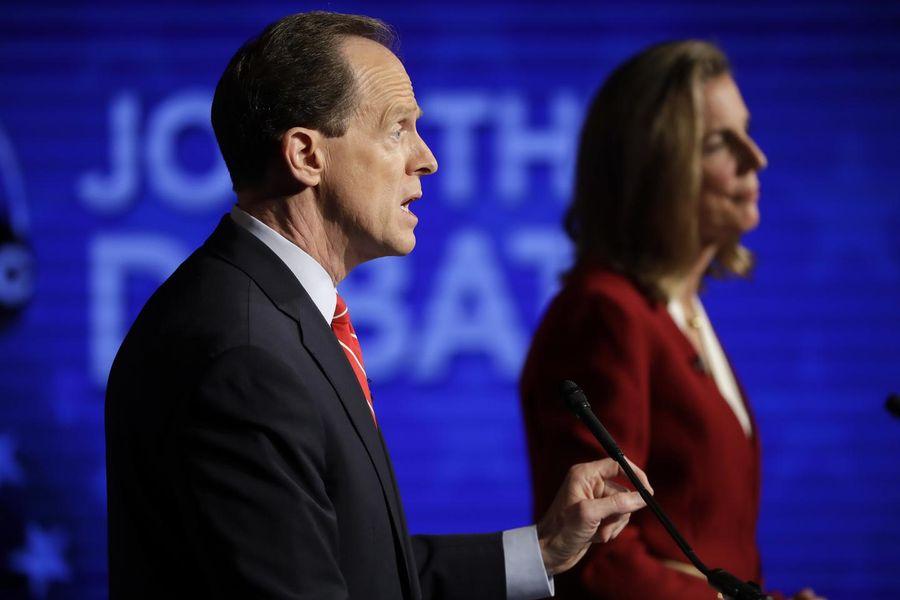
Pennsylvania U.S. Senate candidates Republican Sen. Pat Toomey, left, and Democrat Katie McGinty take part in a debate at Temple University in Philadelphia, Monday, Oct. 24, 2016. (AP Photo/Matt Rourke)
How the Senate Contest Could Shake Out
Published Nov. 7, 2016 • Read time: 4m
Join the Conversation
0Back in 2014, I put together a model to get a sense for how that year’s midterms were likely to play out in the Senate. It used three simple variables: The president’s job approval, whether the incumbent was a member of the president’s party, and whether there was a “problematic” candidate. It suggested that if the president’s job approval were 44 percent, the Democrats would lose nine Senate seats. His job approval was 44 percent, and the Democrats lost nine seats.
I re-ran the model in early 2016. Before I go further, I would direct you to this piece I wrote for Politico Magazine in July, in which I discuss the limitations of predictive models. A lot depends on the subjective assumptions you plug into the models, and I think overall, they should be used as heuristics rather than concrete predictions.
In any event, in early 2016 the model suggested that if the president’s job approval was 52 percent, about where we have it in the RCP Averages, then Democrats should pick up three Senate seats, although potential outcomes range from a loss of one to a gain of eight.
The stakes in the race are high. If Democrats gain five seats (or just four if Hillary Clinton and Tim Kaine win the White House) they will take control of the Senate, which Republicans now dominate with a 54-person majority.
While this projection might seem under-confident, it’s important to remember that the model builds in some uncertainty as to whether Republicans will nominate problematic candidates early on; it also assumed that Sen. Marco Rubio’s Florida seat would be open. Moreover, this goes pretty far out on the tails, to events that have a five percent chance of happening either way. As of right now, if Republicans sweep the toss-up races, they would lose no Senate seats, while if they lose all of the toss-ups, they would lose eight seats.
Portman-Strickland Senate Race Finally Set in Ohio
Portman Wastes No Time Attacking Strickland
Strickland Skirts Primary Debates in Ohio Senate Race
Senate Says Climate Change Is Real
I’ve re-estimated the model using a hard 52 percent for Obama’s job approval, adding Rubio as an incumbent, and eliminating the uncertainty over “problematic” candidates (I could probably change Illinois Sen. Mark Kirk to a “problematic” candidate, but it wouldn’t really matter). I also set California to 100 percent certainty for Democrats, although that doesn’t change much. The distribution of the outcomes of 10,000 simulations looks like this:
As you can see, the most likely outcome is three Democratic pickups. But Democrats do take the Senate a little more than 44 percent of the time. Statistically speaking, that’s barely a thumb on the scale for Republicans. About 93 percent of the time, Democrats pick up two or more seats, while about 95 percent of the time, Democrats pick up fewer than six. Incidentally, this is pretty much in line with the RCP Senate averages, which currently have Democrats picking up three seats.
I’ve listed the projected Democratic vote shares in the states, in order, below. Importantly, these aren’t two-party vote shares, so receiving under 50 percent can still win the race (we assume you generally need 48.5 percent to win).
What’s interesting is that this gets the races pretty much how I think most analysts would rank them right now for the Democrats: I’d give Democrats a better chance in Colorado than Illinois, though both are basically done deals. I’d make Pennsylvania a more likely pickup than New Hampshire, and move Arizona up a bit. The only one I would move considerably is Ohio.
In any event, this is about how I see the race. I’d be surprised if it were precisely correct, especially on individual race estimates, but the idea is that the errors should more or less cancel out (a good model has errors, but they are random). Personally, I think Democrats are most likely to pick up three seats, with New Hampshire being a pure toss-up; this is more or less consistent with the model. My “working” range is a Democratic pickup of between two and five seats, with one or six seats as realistic outside chances.
What’s most interesting is that, if it proves to be more or less correct, it will suggest that the fundamental assumption of the model – that these races are referenda on the party in power – held under pretty stressful conditions. Thankfully, we’ll know in two short days.

Democrats Won the Midterms. Common Sense Won, Too
Jordanne Kemper • RealClearPolitics
The 120th Congress Shapes Up
Carolina Lumetta • RealClearPolitics
Flooding GOP Primaries With Democrats
Robert Natelson • RealClearPolitics
Washington Keeps Rewarding Oracle—Veterans Keep Paying the Price
Darin Gaub • RealClearPolitics
The Seeds of Unrestricted Warfare
John Teichert • RealClearPolitics
The Primary System Is Losing the Next Generation
Sean Trende • RealClearPolitics
RCP Today
Top stories on RealClearPolitics
The Takeaway
Polling intelligence and analysis delivered to your inbox
World News
Featuring the latest world news
Policy
Featuring the latest policy news
Support Our Mission
As part of RealClearPolitics, authors aim to provide balanced, non-partisan analysis by presenting top reporting and commentary from all sides of the political spectrum.
Trusted by policymakers and citizens alike since 2000