
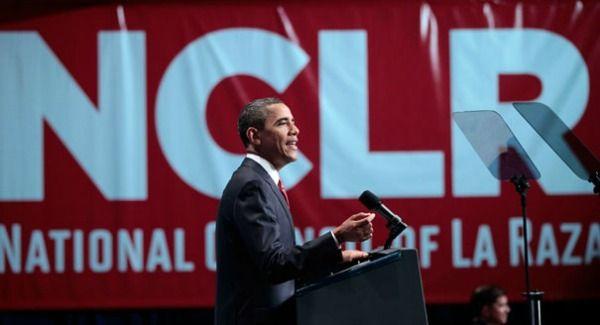
La Raza Toils to Energize Latino Voters in Fla.
Published Oct. 22, 2012 • Read time: 9m
Join the Conversation
0KENDALL, Fla. -- The perspiration on Meyra Garcia's face and her well-worn athletic shoes told a story Sunday as she knocked politely on door after door in this tidy middle-class and predominantly Hispanic suburb near Miami in Dade County.
Garcia, who is divorced and has a grown son, is a paid member of the National Council of La Raza's nonpartisan get-out-the-vote effort. Her assignment through Nov. 6 is to contact the registered voters whose names and addresses appear on lists furnished to her by NCLR via an iPod she signs out and then signs back in each time she works.
Garcia’s task is to discern if personal attention and encouragement might propel registered voters to follow through and cast their ballots, perhaps even to vote early (which in Florida is possible beginning Oct. 27). If they need help -- for instance to locate the right voting site, or figure out transportation to get there -- NCLR can offer guidance.
For seven months beginning in March, the regional team in Miami registered 34,000 new voters in Dade County, about 1,000 short of its initial goal. Success ultimately will be measured by Hispanic voter turnout by Nov. 6, said Natalie Carlier, NCLR’s 28-year-old Miami regional field coordinator with its department of civic engagement. Until a federal judge overturned a challenging requirement that the Florida government receive voter registration forms within 48 hours of completion, the NCLR’s registration goal seemed optimistic, Carlier added.
Canvassing to turn out votes, the successor to the registration phase, can be repetitive, often frustrating -- and in Dade County, uncomfortably hot. If questioned by potential voters, the NCLR team is permitted by law to support specific policies and legislation, and explain candidates’ positions, but canvassers are instructed not to advocate for specific candidates.
The Rise and Fall of Marco Rubio
An Invasion of Artificial Outrage
Obama Administration Tells Agents to ID Which Immigrants Not to Deport
Green Shoots of Sanity?
Some residents, annoyed or suspicious, declined on Sunday to chat with Garcia in Spanish or English. The rejections did not erase the pleasant expression on her face as she carried her clipboard and literature to the next address. Barely slowing her pace, Garcia plugged her information into the device in her hand. Her data was uploaded from the iPod at the end of her shift into a vast, shared voter-contact database tailored for NCLR (using the Voter Action Network, a system originally created under the guidance of Obama for America.) It’s just one of many tracking systems that afford snapshots of the 2012 electorate in key states.
In Florida, Mitt Romney leads President Obama by 2.1 points in the RCP Average as the two candidates prepare for their third and final debate Monday night in Boca Raton, north of Miami. In 2008, South Florida propelled Obama’s victory over John McCain. He captured 67 percent of the votes in Broward County; 61 percent in Palm Beach County; and 58 percent in Miami-Dade. Predictions are not nearly as robust for the incumbent this time around.
But Obama’s campaign team continues to argue that lining up at least 270 votes in the Electoral College can succeed without Florida and its prized 29. The president and Joe Biden hold frequent rallies in the state and their advisers believe the administration’s posture on Medicare, immigration and women’s issues, plus the campaign’s operations on the ground, will make the difference.
The 2008 contest in the Sunshine State played to Obama’s strengths. “A lot of people were motivated in certain ways that is not as apparent this year, but as Election Day nears, I think more and more people are going to get out and vote,” Carlier said. “I haven’t come across too many people who don’t know who they’re voting for.”
The Hispanic community is so diverse, she noted, it’s difficult to gauge anecdotally how voter sentiments for either candidate will eventually stack up. “I think people here feel that Florida is a very important state and can make or break a candidate’s election,” Carlier added. “People are animated. They’re talking about it.”
By the time RCP caught up with Garcia, she had spent four hours on Sunday trying to locate assigned targets in a neighborhood that is home to Hispanics of various backgrounds, including Cubans, Colombians and Nicaraguans. She patiently waited on stoops, stepped confidently over Halloween tombstones and ghouls assembled on lushly landscaped (if petite) lawns, and proceeded with caution when homeowners’ dogs sounded an alarm.
By 5 p.m., Garcia had made 39 attempts to find names on her contact list, and the results were mixed. Twenty-three residents she sought were not at home. Their names went back into the hopper and the NCLR team planned to make future attempts to meet them face-to-face. Garcia spoke with five people she was assigned to find who refused to discuss their election plans. Eight of her targets said they expected to vote. Three people told Garcia she was searching for someone who had moved.
NCLR’s compensation to canvassers who cover about a square mile of territory in a day is about $10 an hour, capped at 36 hours a week. The team is almost entirely female. Quitting is not unusual among canvassers in any election, whether paid or volunteer. The work can be physically exhausting, intimidating and only incrementally useful. But Garcia, who cast her first ballot for a U.S. president in 1996 (for Bill Clinton), said she enjoys the NCLR project because she likes talking with people.
Normally, Garcia said she would be relaxing at home on a Sunday. But with key choices across the Florida ballot this year, and Hispanic participation historically unreliable nationwide, Garcia believes she’s making an important contribution. “It is much better for people to vote,” she told RCP.
Carlier, who was raised in Florida and Colombia, began working with NCLR in 2009. She’s now in charge of 25 canvassers who together are trying to knock on 2,025 doors a day to get a hoped-for 20 percent contact rate. That means the group realistically hopes to locate 400 residents of Dade County per day in order to gauge their plans to vote.
NCLR is concentrating its efforts and limited resources in Florida (Orlando, as well as Miami); Colorado (Denver); Nevada (Las Vegas); and Pennsylvania (Philadelphia), Carlier said.
Obama and Romney are each trying to appeal to Florida’s Hispanic population via advertising, direct mail, text messaging and social media, plus public appearances. The president is making an especially strong pitch to younger Hispanic voters, and Romney hopes that older Hispanics, Catholic conservatives and voters of Cuban heritage will add to his vote tally here.
An NCLR canvassing team last week crossed paths in the same Hispanic neighborhood with volunteers working for the Romney campaign, Carlier said, but her group has not seen any pro-Obama volunteers to date.
Romney’s campaign and pro-Romney groups appear flush with cash in Florida, judging from the Romney-Ryan yard signs seen in Palm Beach County, the highway billboards in Broward, bumper stickers on cars in Kendall, plus the direct-mail appeals, including to some South Floridians who voted Democratic in past elections.
By tapping volunteer canvassers and phone bank helpers in Broward, organized labor has been working to increase absentee balloting and early voting for Obama and other Democratic candidates among the members of the American Federation of State County and Municipal Employees, part of the AFL-CIO.
In Plantation, Fla., on Saturday, union workers and volunteer Democrats cold-called more than 1,000 phone numbers belonging to AFSCME members who reside in Broward County, guided by yet another iteration of the Voter Action Network database. If they reached someone, which was not easy on a weekend afternoon, the volunteers read from a neutral script that inquired how they “felt” about Florida’s hotly contested Senate race and other questions on the ballot.
Finding Broward members who answered telephones, and then getting them to remain on the line to discuss the election seemed a bit of a challenge, at least during the period in which RCP eavesdropped. Stephen Heim, a volunteer from nearby Parkland whose business is commercial real estate, finally said he was skeptical the cold-calling was accomplishing much. “I’m not sure this is worth anything,” he said as the Internet system they used hit some snags, few calls seemed to go through, and the tribe of volunteers dwindled to four enthusiasts.
Door-knocking canvassers assigned to visit union members and other Floridians at home, however, sounded more certain of their mission Saturday. Viviene Dixon-Shim -- born in Jamaica and at age 62 the president of an AFSCME local with 2,500 members -- said it was important to explain to fellow workers how their contracts and benefits are influenced by the outcome of local, state and national races.
“People are motivated to vote because they realize what is at stake” Dixon-Shim said, meaning “their future, pensions, retirement, Medicaid, and we can go on and on.”
But some Broward union workers have made it clear they are backing Romney, she conceded. “They’re just Republicans and they’re just not going to vote any other way.”
Michael Jordan, 38, a water department public service supervisor and vice president of a 99-member union local, said he’s run into complaints that the president has not fixed the economy fast enough. Working as a canvasser in hotly contested Florida often means getting an earful.
If he could offer Obama some last-minute advice in the final weeks of the race, Jordan said it would be to listen “to what people really need. . . . Get out in the neighborhoods. Go and talk to the everyday working person, because when you’re surrounded by the upper echelons of the political atmosphere, you’re on that train of thought most of the time. When you get a chance to step away from that, you get a chance to see what those people go through on a daily basis. It would increase his insights.”
Sixteen days left before the voters are heard.

The GOP Majority Should Go Out in Glory
Daniel McCarthy • RealClearPolitics
Republican Majorities Could Return Sooner Than Expected
J.T. Young • RealClearPolitics
The Danger Before the Attack
Leslie J. Sullivan • RealClearPolitics
Jon Finer’s Old and Dangerous ‘New Approach’ to Israel
Peter Berkowitz • RealClearPolitics
The President Deserves Better
John Ullyot • RealClearPolitics
Congress Doesn’t Need Another Blame Game. It Needs To Find What’s Broken
Jarrod Bernstein • RealClearPolitics
RCP Today
Top stories on RealClearPolitics
The Takeaway
Polling intelligence and analysis delivered to your inbox
World News
Featuring the latest world news
Policy
Featuring the latest policy news
Support Our Mission
As part of RealClearPolitics, authors aim to provide balanced, non-partisan analysis by presenting top reporting and commentary from all sides of the political spectrum.
Trusted by policymakers and citizens alike since 2000