
John B. Taylor On Economy: "The Problem Is Policy"
Last updated 6:59 PM ET
Join the Conversation
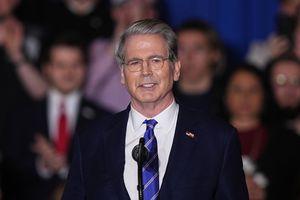
0John B. Taylor, the Mary and Robert Raymond Professor of Economics at Stanford University and the George P. Shultz Senior Fellow in Economics at Stanford's Hoover Institute, delivers the Manhattan Institute's Eighth Annual Hayek Lecture.
(Transcript begins at 2:10)
"Let me start and talk a little bit about this book, 'First Principles.' It starts with the fact that the American economy is just not doing very well. That's pretty obvious. We had a growth rate of just 1.9 percent [according to] the most recent data, unemployment is very high, long-term unemployment astronomically high. We've just gone through a deep financial crisis and a very serious recession, and the recovery is by any definition unprecedentedly weak compared to American history. So, we've got a problem here. And, also, as Paul [Gigot] mentioned in his introduction, our debt is exploding.
"And my view, looking at this and thinking of alternative explanations, I think the problem is policy. And the way I put it simply is that policy has deviated from the basic principles of economic freedom. Now, if Hayek were here, he'd be saying, 'Tell us what you mean. What do you mean by economic freedom, Taylor?' What I mean is the situation where individuals, families decide what to buy, what to produce -- they decide where they will work, they decide how they're going to help other people. But they do this within a framework. It's kind of the American vision, if you like. And that framework involves five things: 1) predictable policy, 2) rule of law, 3) a reliance on markets, which generates 4) good incentives, and 5) a limited role of government.
"And when you think about America, those five principles have pretty much defined the country since its founding, and I think that's why it's done well. That's why so many people have come here and how so many people have done well by coming here. And we're certainly, over the long span of time, much better than any other country. But we've had our ebbs and flows in the degree to which we adhere to these principles of economic freedom. And I think we can learn a lot from those ebbs and flows, see what happens when you move one way or the other in terms of policy.
"So, just think of it, just think of history. The Great Depression. We deviated from a reasonably predictable policy by cutting money growth. The Federal Reserve did that. Friedman and Schwartz pointed that out long ago. Started things off, made what may have been a minor downturn much worse. So, that's the first deviation, if you like, from good principles. We raised taxes, we raised tariffs big time, and then we put in place this National Industrial Recovery Act, which was price controls, discouraging competition by allowing collusion, all the things that you would define, I would define, based on that definition, as deviations from basic economic freedom. Well, what's happened? Of course, we don't have to repeat that mess in describing it.
"Another example: In the mid-60s all through the 70s, policy also deviated from these principles. We started these kind of temporary stimulus packages, the Federal Reserve was go-stop, go-stop, we had wage and price controls for this entire economy. The performance was terrible. Double-digit inflation came, double-digit unemployment came, growth slowed down dramatically. Of course, interest rates were astronomical.
"OK? Next period: The 1980s, 90s until recently, we seemed to move back, if you like, towards these principles. Temporary stimulus packages of the unpredictable variety, discretionary variety were out. Long-term tax reduction, tax reform was in. Go-stop monetary policy was out. Steady as you go monetary policy came in, focused on price stability, largely under [Paul] Volcker. The remnants of price controls were removed. A major federal welfare program was devolved to the states, a reflection on more limited federal government power. The performance was unbelievably good. Unemployment trickled down all that period, inflation came down, growth started to pick up pretty dramatically, productivity growth. Economists call it the Great Moderation. It was such a good time for performance.
"Unfortunately, now, we've drifted back, in my view, away from these principles. And I can go on with a long, long list in this case. The Federal Reserve, I think, in leading up to the crisis deviated from the kind of rules it was using by and large for most of the 80s and 90s. And they held interest rates too low. The mantra these days is 'too low for too long.' That set off some of the excesses, the housing boom, in my view, particularly. Regulators, I think, of financial institutions failed to enforce the rules. That's a deviation from a rule. On the major financial institutions, risk-taking rules, and especially on institutions like Fannie Mae and Freddie Mac.
"Then the crisis came, and we had massive deviations from predictable policy with the bailouts. I'll come back to the bailouts in a few minutes, but whatever what you think about those, they were massive deviations from predictable kinds of policies. Then we had the stimulus packages. We had one in 2009, but don't forget, we had one in 2008. We had 'cash for clunkers' and first-time home buyers. And we had temporary reductions in the payroll tax…for two months. We had quantitative easing, unprecedented amount of intervention by the Federal Reserve. And policies which will apparently try to hold interest rates to zero through 2014.
"If you look at just some data here, in the three years around 2000, there were 11 provisions in the tax code that were up for grabs, up for a change. Now, there's 131, a massive amount of increase in unpredictability, if you like. And just think of this 'fiscal cliff' everyone's talking about. That just wasn't dropped on us. That is a self-inflicted policy. That is sort of the epitome of unpredictable policy put in place, and rightly, people are concerned about that.
"So, as I look at this situation, it seems to me the evidence is pretty clear, and you can debate this and go back and forth, but I just think it's so powerful, the evidence. And the implications are very clear, aren't they? We should apply those principles, and we should apply them to the current circumstances that we're in."
Latest Videos

Hakeem Jeffries: Imagine How Angry People Will Be If Washington Fails To Do Anything About Affordability
Face the Nation
Director of National Intelligence: Putin Is "Not America's Friend" But "Entirely Appropriate" For Trump To Say He Is
This Week
Rahm Emanuel: Democratic Voters Aren't Socialists, They're Angry
Bloomberg Politics
Zelensky: Putin Needs To Understand Crimean Bridge "Will Not Stay"
World News0:27
Obama to Jeffries: "You've Got To Figure Out How To Actually Get Sh*t Done With Your Colleagues"
White House
Rubio: The Idea That The U.S., Russia, & China Should Not Engage Is Absurd
White House
Hemingway: Dems Are Being Transparent About Plans For "Political Payback" Against Trump Allies
FOX News ChannelObama to Jeffries: "You've Got To Figure Out How To Actually Get Sh*t Done With Your Colleagues"
White HouseRubio: The Idea That The U.S., Russia, & China Should Not Engage Is Absurd
White House
David Brooks: China-U.S. Power Shift Mirrors Germany-Britain Dynamic Before World War I
PBS NewsHour
Texas Gov.-Elect Hinojosa: I'm An "Economic Populist," "Corporate Interests Have Corrupted Both Parties"
Special Report
Musk: Zelensky Asking To Use Starlink For Offensive Military Actions
World News