
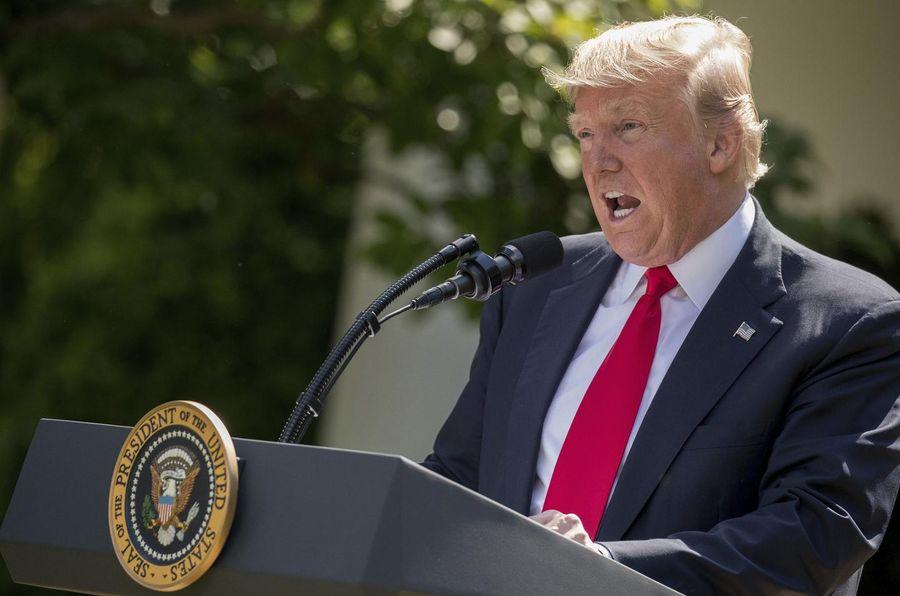
President Donald Trump speaks about the U.S. role in the Paris climate change accord, Thursday, June 1, 2017, in the Rose Garden of the White House in Washington. (AP Photo/Andrew Harnik)
GOP Leaders Laud Trump Decision to Exit Climate Pact
Published June 2, 2017 • Read time: 7m
In a made-for-television address in the sun-soaked Rose Garden, President Trump announced his intention to withdraw the United States from a global accord to combat climate change, known as the Paris Agreement. The move signaled a campaign promise kept — a nod to themes of economic nationalism championed by one faction of the West Wing and a defiance of big business.
"I was elected to represent the citizens of Pittsburgh, not Paris," Trump said, describing the deal as the "latest example of Washington entering into an agreement that disadvantages the United States."
At a time when his approval rating hovers at historic lows for a new president and controversy consumes the White House, Trump's decision to step back from an agreement forged by the Obama administration (and seen as a key legacy item of his successor) figures to endear him to the base of the Republican Party. GOP leaders on Capitol Hill cheered the decision, as did conservative groups that saw the accord as symbol of government overreach.
Senate Majority Leader Mitch McConnell applauded Trump for "dealing yet another significant blow to the Obama administration’s assault on domestic energy production and jobs." The Kentucky lawmaker is one of 22 coal-state senators who urged the president to back away from the agreement.
The accord was signed in December 2015 by 195 countries that agreed to reduce greenhouse gas emissions. The United States joins Syria and Nicaragua as the only countries absent from the pact. But complete withdrawal won't be attainable until November of 2020, leaving room for negotiations and for the issue to remain a volatile factor in upcoming elections.
Cruz's Path to Nomination
Trump Stands by His Manager
With Tweets on Heidi Cruz, Trump Sinks to New Depths
A Vote for Kasich Is a Vote for Trump
The decision put the Republican president at odds with top business executives who had urged him to back the accord. They argued that the agreement would benefit American companies that harness new technology and energy sources and compete on the global stage. ExxonMobil, where Secretary of State Rex Tillerson served as CEO, has been among the most vocal in support of the deal.
Tillerson, along with Trump's daughter Ivanka, had favored remaining in the agreement, while White House senior aide Steve Bannon and Environmental Protection Agency head Scott Pruitt championed withdrawal from the accord.
Yet for others in the White House interested in deepening alliances with business and technology leaders, the decision is already having consequences. Tesla CEO Elon Musk quit Trump's economic council in protest.
— Elon Musk (@elonmusk) June 1, 2017Am departing presidential councils. Climate change is real. Leaving Paris is not good for America or the world.
General Electric Chairman Jeffery Immelt expressed similar sentiments, tweeting:
— Jeff Immelt (@JeffImmelt) June 1, 2017Disappointed with today’s decision on the Paris Agreement. Climate change is real. Industry must now lead and not depend on government.
Meanwhile, the announcement served as a rallying cry among the base of the Democratic Party. Billionaire environmentalist Tom Steyer went so far as to call it a "traitorous act of war."
Democratic leaders in Congress argued withdrawal from the agreement weakened America's standing in the world in terms of climate and the economy. Former President Obama released a statement saying the new administration "joins a small handful of nations who reject the future."
Democrats are also seizing on divides within the GOP and business leaders’ economic arguments to approach voters outside the base who may not be motivated simply by Trump's withdrawal. Some suggest independents can be persuaded that leaving the accord will harm the country in indirect ways.
"We don’t have to focus on the topline and say 'Paris climate agreement,' but how did this impact the overall U.S. economy? There are people who worry about our stature worldwide," one Democratic strategist told RCP.
Beyond business leaders, some in the GOP are concerned about the impact withdrawing from the accord could have in terms of the United States' global stature and in terms of being a leader in national security issues. South Carolina Sen. Lindsay Graham told CNN over the weekend that a withdrawal "would be a definitive statement from the president that he believes climate change is a hoax," and would present problems for the party and the country. And Mitt Romney said affirmation of the deal is "not only about the climate: It is also about America remaining the global leader."
Other more moderate Republicans also distanced themselves, including Florida Republican Rep. Carlos Curbelo, who represents a district Hillary Clinton won by double digits in 2016:
— Carlos Curbelo (@carloslcurbelo) June 1, 2017Our country has just given up its seat at the table & yielded world leadership to countries like China and Russia. #parisclimateagreement
Elise Stefanik, who represents a swing district in upstate New York, sounded a similar tune. "Withdrawing from the Paris Agreement is misguided and harms the ongoing effort to fight climate change while also isolating us from our allies," she said.
But Republicans at large aren't concerned about political fallout. "In the swing districts, the issue that matters to these people is jobs, jobs and then jobs," said Republican strategist Rory Cooper. "Lest the Democrats learn no lessons from 2016, outside of their bubbles, the American people are looking for people who put their economic interests first. While they may tell a pollster they support the Paris Agreement, in theory, or however it is described, it will not rank high in priorities nor will it motivate independent voters."
Polling shows notable partisan divides on the issue. A recent Pew poll found that just 20 percent of Republicans see climate change as a serious problem, while 68 percent of Democrats do.
On the campaign trail, Trump described climate change as a "hoax" and a "money-making industry." He repeatedly criticized the Paris Agreement and pledged to withdraw from it.
But the president extended the decision-making process, entertaining input from different sides of the debate. European leaders urged him to remain in the pact during meetings as part of Trump's first foreign trip last week. Pope Francis gave the president a copy of his encyclical on climate change.
During his Rose Garden speech on Thursday, Trump did not speak to whether he still believed climate change is a hoax. And while the spoke to what he believed would be the domestic economic benefits of withdrawing from the agreement, particularly the impact he sees on coal and energy jobs, he said he would be open to a renegotiation of the deal.
"The United States will withdraw from the Paris climate accord but begin negotiations to re-enter either the Paris accord or an entirely new transaction on terms that are fair to the United States," Trump said.
"We will see if we can make a deal that’s fair," he continued. "And if we can, that’s great. And if we can't, that's fine."
But in a joint statement, leaders of France, Germany and Italy said the Paris climate agreement could not be renegotiated.
Back home, the move represented the consequences of elections. "Things like the Paris Agreement are part of the core reason why Donald Trump is president," said Josh Holmes, a Republican strategist and former chief of staff for Senate GOP leader McConnell. "If you were to go out and ask an average American what this Paris Agreement is, they would be hard-pressed to tell you exactly what it is. But even if they could, they give zero amount of care about what happens. This is like an activist discussion, and we had an election that was based on ideology versus jobs and the economy. Jobs and the economy won."

Congress Doesn’t Need Another Blame Game. It Needs To Find What’s Broken
Jarrod Bernstein • RealClearPolitics
Democrats Won the Midterms. Common Sense Won, Too
Jordanne Kemper • RealClearPolitics
The 120th Congress Shapes Up
Carolina Lumetta • RealClearPolitics
Flooding GOP Primaries With Democrats
Robert Natelson • RealClearPolitics
Washington Keeps Rewarding Oracle—Veterans Keep Paying the Price
Darin Gaub • RealClearPolitics
The Seeds of Unrestricted Warfare
John Teichert • RealClearPolitics
RCP Today
Top stories on RealClearPolitics
The Takeaway
Polling intelligence and analysis delivered to your inbox
World News
Featuring the latest world news
Policy
Featuring the latest policy news
Support Our Mission
As part of RealClearPolitics, authors aim to provide balanced, non-partisan analysis by presenting top reporting and commentary from all sides of the political spectrum.
Trusted by policymakers and citizens alike since 2000