
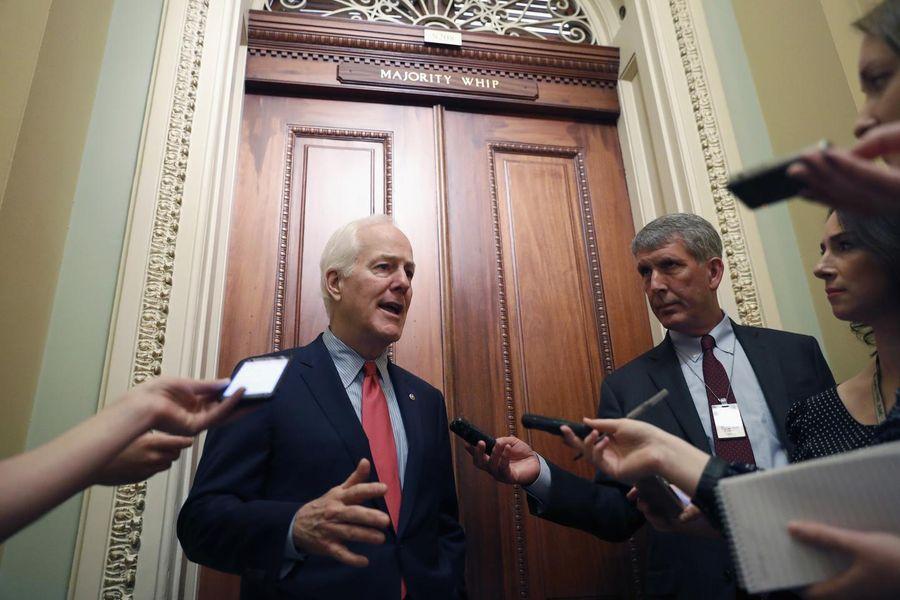
Senate Majority Whip John Cornyn of Texas speaks with reporters on Capitol Hill in Washington, Tuesday, April 25, 2017. (AP Photo/Alex Brandon)
GOP Lawmakers Warn Against Trump Ally as FBI Head
Published May 16, 2017 • Read time: 5m
As President Trump and his lieutenants weigh potential successors to ousted FBI Director James Comey, Republicans are publicly warning the administration against selecting a loyalist or GOP lawmaker for the post.
The fear among Republicans, expressed in stark terms in recent days, is that such a nominee would cast doubt on the FBI’s independence at an already vulnerable moment — with questions swirling regarding the president’s abrupt decision to fire Comey, in part due to the FBI’s accelerating inquiry into possible collusion between Russia and the Trump campaign.
Democrats have raised alarm about those circumstances surrounding Comey’s ouster, with Senate Minority Leader Chuck Schumer calling for a special prosecutor to be named. Republicans have called the timing of Comey’s firing “troubling,” but so far have dismissed the idea of a special prosecutor, insisting that the FBI is well equipped to continue its investigation.
Should the president select an ally to head the bureau, however, the Republican position could crumble — and party lawmakers are acutely aware of the risk.
An unusual dynamic has resulted. With Sen. John Cornyn under consideration to succeed Comey, his GOP colleagues have attempted to discourage his nomination.
The Texas Republican, for his part, told reporters on Tuesday that he is “not lobbying” to be nominated.
“It’s very important position, and I can’t think of many more important things than restoring public confidence in the FBI and the Department of Justice,” Cornyn explained. “It’s a serious matter, so I’m taking it seriously.”
But some of his fellow Republicans are not taking any chances, and not mincing words.
“John Cornyn under normal circumstances would be a superb choice to be FBI director,” Sen. Lindsey Graham said Sunday on “Meet the Press.” “But these are not normal circumstances.”
"I think the world of John Cornyn, and he would be a great choice in normal times,” Sen. Susan Collins echoed to CNN on Monday, “but we're not living in normal times.”
Indeed, Senate tradition would typically dictate that lawmakers of both parties support a colleague for a major nomination. But, instead, some Republican senators are now actively lobbying for a non-Republican, non-lawmaker pick.
Sen. Mike Lee last week approached senior White House officials with a seemingly offbeat suggestion for the position: Judge Merrick Garland, formerly President Obama’s pick for the Supreme Court.
“I think Merrick Garland would be a particularly good option, given that he would have so much support from both sides of the aisle,” Lee explained on “Fox News Sunday.” “…I’m absolutely serious about this.”
The pitch was met with mixed reactions within the White House, according to one aide with knowledge of the conversations. But the idea has buy-in from Senate Majority Mitch McConnell, according to one former adviser, Josh Holmes.
"I think the Senate majority leader thinks that's a fantastic idea," Holmes said during a panel discussion on "Fox News Sunday." "... [McConnell] certainly thinks he will be qualified and he certainly thinks he would be somebody that he could support.”
Garland is an unlikely nominee: after all, he’d be trading a lifetime appointment on the D.C. Circuit Court of Appeals for a job reporting to Trump. That Republicans are floating his name, however, reflects an area of agreement among Democrats and many Republicans: that the next FBI director should be unquestionably independent.
Rep. Adam Schiff, the top Democrat on the House Intelligence Committee, said Sunday on “Face the Nation” that he “would strongly urge the administration to pick someone who is completely apolitical, who doesn't come out of the political process, someone who is a retired judge or an acting judge willing to step down from their judgeship.”
The FBI “needs to be led by a person of unquestioned character and completely divorced from partisan politics,” Rep. Tom Cole, an Oklahoma Republican, echoed in a column Monday.
Cornyn is the only sitting lawmaker currently under consideration. Rep. Trey Gowdy, who spearheaded the House Benghazi investigation, was also rumored to be in the mix — but, in dual conversations Saturday and Monday, the South Carolina Republican told Attorney General Jeff Sessions “that I would not be the right person,” Gowdy said in a statement Monday.
“Our country and the women and men of the FBI deserve a director with not only impeccable credentials,” he said, “but also one who can unite the country as we strive for justice and truth.”
To that end, Republicans are urging a nominee who could win approval from some Democrats. In an interview Tuesday on Hugh Hewitt’s radio show, Sen. Tom Cotton said any nominee would ideally be “someone who deserves to attract bipartisan support in Senate.”
Indeed, anything short of unanimous or near-unanimous support would mark a sharp break with precedent. Historically, FBI directors have been approved either by a voice vote or with unanimous support. Comey was the first director since 1972, when the Senate began confirming nominees for the post, to receive even a single vote in opposition — from Sen. Rand Paul.
But broad support for a nominee might be of greater importance this time, with the president facing sharp questions about his rationale for firing Comey, and with lawmakers of both parties seeking assurances that the FBI will not be subject to political pressures.
Bipartisan support, Lee also noted in his Sunday interview, “could be important because as we move forward, the outcome of investigations ought not carry any taint or potential for taint with respect to partisan affiliation.”
Cornyn, for his part, has remained coy about his discussions with the administration. But whoever the president nominates, he predicted to reporters, “it'll be a tough confirmation battle.”
His colleagues are hoping the president will take a gentler path, however.
“This is up to the president. He has a duty and obligation to pick somebody beyond reproach outside the political lane,” Graham said in his Sunday interview. “I think he'll do that. I hope he'll do that.”




RCP Today
Top stories on RealClearPolitics
The Takeaway
Polling intelligence and analysis delivered to your inbox
World News
Featuring the latest world news
Policy
Featuring the latest policy news
Support Our Mission
As part of RealClearPolitics, authors aim to provide balanced, non-partisan analysis by presenting top reporting and commentary from all sides of the political spectrum.
Trusted by policymakers and citizens alike since 2000