
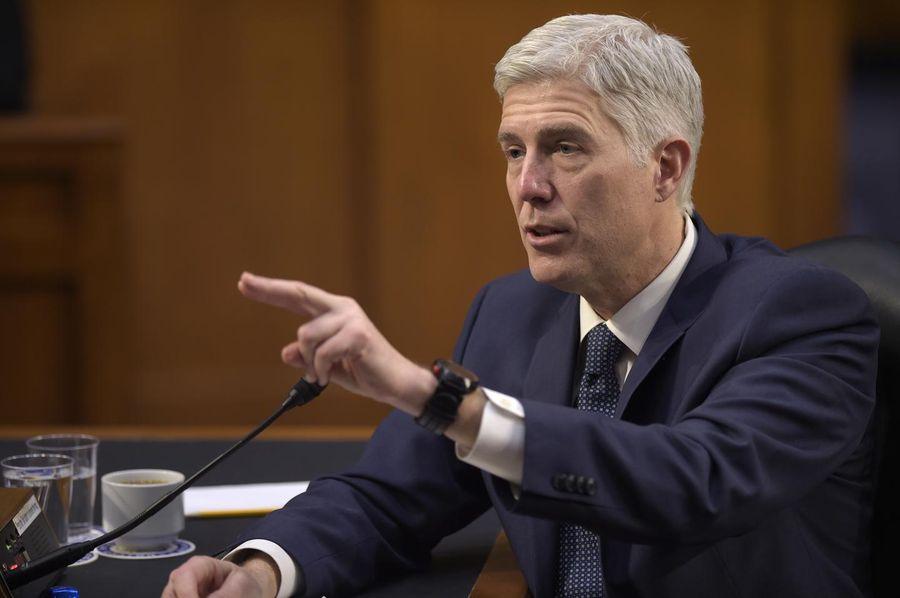
Neil Gorsuch Is a Mainstream and Independent Nominee
Published April 4, 2017 • Read time: 5m
Within days of Judge Neil Gorsuch’s nomination to the Supreme Court, Senators Charles Schumer and Richard Blumenthal announced that they could not vote to confirm Gorsuch unless he could establish two things: that he was in the “judicial mainstream” and “independent” of party loyalty and the President who nominated him. As Schumer put it, “The burden is on Judge Neil Gorsuch to prove himself to be within the legal mainstream and, in this new era, willing to vigorously defend the Constitution from abuses of the Executive branch.”
During his confirmation hearings, Judge Gorsuch did just that, demonstrating to the nation that he is one of the most qualified, mainstream, and independent judges in the country today.
Judge Gorsuch’s record speaks for itself. During nearly eleven years on the Tenth Circuit, he participated in more than 2,700 cases. Of those, 97% were decided unanimously. He voted with the majority 99% of the time.
And what of the remaining 1% where Judge Gorsuch issued a dissent? Was he “outside the mainstream” there? In those 36 cases, he dissented roughly evenly from opinions written by judges nominated by Republican and Democratic presidents.
Breaking the numbers down even further, the statisticians at Nate Silver’s 538 recently found that when it came to immigration and employment discrimination cases, Gorsuch was in the ideological center of the Tenth Circuit and significantly more “liberal” than seven of his more conservative colleagues.
Put simply, if Neil Gorsuch is not in the mainstream, the entire Tenth Circuit Court of Appeals is out of the mainstream. But in fact, the Tenth Circuit is an ideologically balanced court, with 7 active judges nominated by Democratic presidents and 5 active judges nominated by Republican presidents. It is an ideologically centrist court of appeals, and Neil Gorsuch sits at its center.
Yet some senators continue to express “serious concerns” that Judge Gorsuch is outside the “mainstream.” At a press conference on Wednesday afternoon, Senator Schumer insisted that by nominating Judge Gorsuch, “President Trump didn’t go to the mainstream.”
As Inigo Montoya said, “You keep using that word. I do not think it means what you think it means.”
Perhaps “mainstream” means deciding cases so that the most sympathetic party always prevails or in conformance with the Democratic-party platform. But to even state such a definition is to refute it. That definition would obviously violate Senator Schumer and Blumenthal’s second test of “judicial independence.”
And on that count, Gorsuch has demonstrated that he is his own man. It was no surprise when he told Senator Blumenthal and the nation that criticism of his fellow judges was both “disheartening” and “demoralizing.” When asked what he would have done had President Trump asked him to overturn Roe v. Wade, or any other precedent of the Supreme Court, he told the Senate that he would have simply “walked out of the room.” And when asked whether he could rule against the Trump administration, he said emphatically that he could do so “without hesitation” because “no man is above the law.”
It is this commitment to judicial independence and the rule of law that has garnered Gorsuch an historic level of praise from across the ideological spectrum.
Neal Katyal, the former acting Solicitor General under President Obama who introduced Gorsuch to the Senate Judiciary Committee, said he possessed a “resolute commitment to the rule of law and the judiciary’s independence.” Dennis Hutchinson, a University of Chicago Law Professor and self-professed lifelong Democrat, observed that “Judge Gorsuch's record is one of acute skepticism toward complacent exercises of executive power.” David Frederick, a Supreme Court advocate and member of the Board of Directors of the left-leaning American Constitution Society, observed that “He has ruled for plaintiffs and for defendants; for those accused of crimes as well as for law enforcement; for those who entered the country illegally; and for those harmed by environmental damage.” And Harvard Law Criminal Law Professor Alan Dershowitz observed that “I don't think it would be fair to call him an extreme right-wing ideologue; that doesn't seem to fit what I know about him.”
Thirty-six active members of the Supreme Court Bar wrote on his behalf, citing his ability to be “fair-minded.” Six former Solicitors General under four different Presidents described him as “highly respected and admired by his colleagues appointed by Presidents of both parties and law clerks of all political stripes.”
And the American Bar Association, after an exhaustive study of his background and record, gave him their highest rating of “Well-Qualified” for the position of an Associate Justice of the Supreme Court. When asked during the hearings last week whether Gorsuch was in the “mainstream,” representatives from the ABA testified that if there was a quality end of the stream, Gorsuch “is fishing in it.”
If Neil Gorsuch is not in the mainstream and not independent, nobody is. This may be why in a recent Rasmussen poll, a majority of American voters said that opposition to Gorsuch is driven more by politics than by genuine concern about his judicial thinking. As Senators Schumer and Blumenthal and their other colleagues consider whether to vote for Judge Gorsuch in the coming weeks, I would respectfully suggest that they put politics aside and vote for a judge who has precisely the qualities they said they are looking for.
Behringer is an operating executive at the private equity firm Warburg Pincus. He received his AB in political science from Columbia University and his JD from the University of Michigan School of Law.





RCP Today
Top stories on RealClearPolitics
The Takeaway
Polling intelligence and analysis delivered to your inbox
World News
Featuring the latest world news
Policy
Featuring the latest policy news
Support Our Mission
As part of RealClearPolitics, authors aim to provide balanced, non-partisan analysis by presenting top reporting and commentary from all sides of the political spectrum.
Trusted by policymakers and citizens alike since 2000