
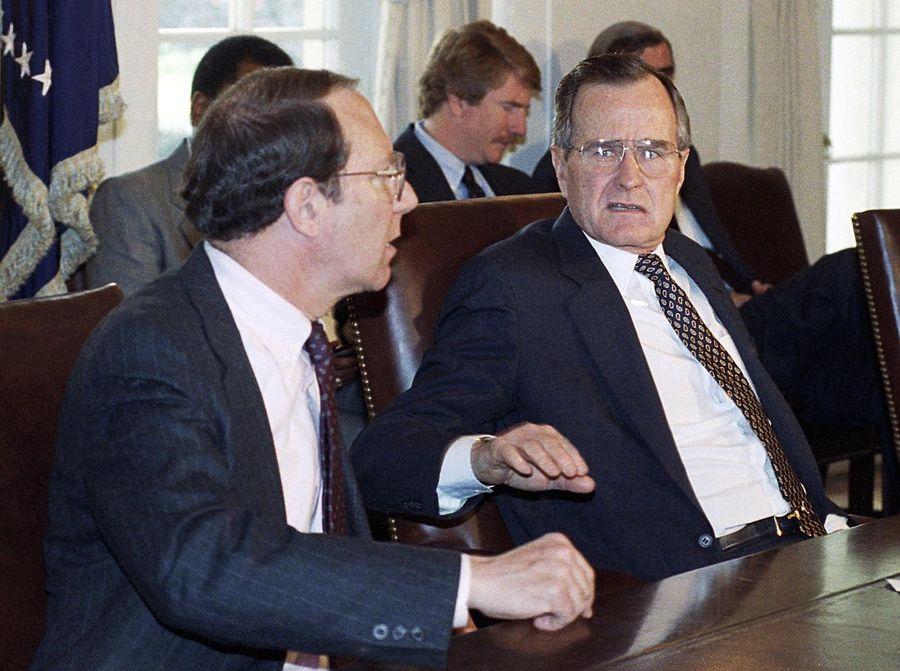
FILE - In this Dec. 20, 1990 file photo, President George H.W. Bush, right, talks with Rep. Anthony Beilenson, D-Calif., chairman of the House Permanent Select Committee of Intelligence, during a Cabinet Room meeting in Washington. Beilenson, a 10-term Southern California congressman who championed abortion rights and helped create the Santa Monica Mountains National Recreation Area, has died at age 84. His son, Adam, tells the Los Angeles Times that Beilenson died Sunday, March 5, 2017, in Los Angeles. (AP Photo/Marcy Nighswander, File)
Anthony Beilenson, the Consequential Legislator
Commentary
Published March 9, 2017 • Read time: 5m
Fifty years ago this month a freshman state senator from Beverly Hills called on the powerful president of the California state Senate to tell him that thousands of women were dying from backyard and alley way abortions and asking him to allow consideration of a bill that would stop this practice by making abortion legal.
The Senate president, crusty and skeptical, was a Roman Catholic opposed to abortion. But he was impressed with the earnestness of the young lawmaker and asked the opinion of a lobbyist crony who was hanging out in the office. “Give the kid a chance,” the lobbyist said.
That was the beginning of the path to passage of the Therapeutic Abortion Act, reluctantly signed into law by Gov. Ronald Reagan on June 14, 1967, and at the time the most permissive abortion rights bill in the nation. Its author was Anthony C. Beilenson, who went on to become a 10-term member of the U.S. House of Representatives and the author of major environmental and consumer-protection legislation.
Beilenson died March 5 at his home in Los Angeles of a heart attack. He was 84. I knew him for 55 years and consider him a rare politician who was committed not only to causes but to civil and consistent dialogue with those who disagreed with him. He retired at the height of his powers from a safe district in Congress in 1996 because he could no longer stand the partisan rancor.
“What has really bothered me about the congressional environment now is all this ideological and mindless politics,” Beilenson told the Los Angeles Times in announcing his decision not to seek another term. “Moderate, sensible, middle-of-the-road resolutions of issues seem no longer possible.”
GOP Abortion Bill Punt: Sell Out or Smart Politics?
Republicans Unanchored
What Is the GOP Thinking?
Republicans Surrender to Infanticide
Although left of center on most issues, Beilenson did not toe any ideological or partisan line. He opposed establishing the federal Department of Education, believing that education should be a matter for the states. He voted against establishing Martin Luther King Day as a holiday, saying federal employees did not need more holidays. He voted against National Grandparents Day, which he considered a sop to the greeting card industry. He was an expert on the budget and took the federal deficit seriously, more than once telling constituents that the deficit needed to be reduced even if this meant higher taxes and reduced benefits for veterans and the elderly.
Beilenson, who was described by The Washington Post as a “workhorse” on the influential House Rules Committee, also proposed cuts in military spending. As chair of the House Permanent Select Committee on Intelligence, he favored cuts in covert aid to the contras supported by President Reagan in Nicaragua.
Under both Republican and Democratic presidents, Beilenson advocated free trade. He strongly supported the North American Free Trade Agreement even though labor unions in his district were opposed to it.
More conventionally, he supported gun control and was a consistent advocate of environmental causes. Beilenson opposed oil drilling off the California coast and tried to preserve the endangered African elephant by restricting U.S. imports of African ivory. He was particularly proud of a 1978 measure he authored creating the Santa Monica Mountains National Recreation Area, a sprawling 156,000-acre area of parks and open space in one of the nation’s largest urban metropolises.
But “proud” is not a word I associate with Tony Beilenson. Although a scholarly, Harvard-trained lawyer who stood out in the California Legislature and Congress, he was a hard-working and modest man who was not puffed up about his achievements. I met Beilenson in Sacramento when he was trying to round up votes for the Therapeutic Abortion Bill, which permitted abortions in cases of rape or incest or when a doctor deemed that the birth was likely to impair the physical or mental health of the mother. Beilenson called on every senator, telling those who opposed his bill on moral or religious grounds that he understood their point of view.
It was Beilenson’s respect for adversaries and absence of guile that commended him to his colleagues, who in the wide-open Sacramento of the time often partied while he went home to his wife and children. It also commended him to the Sacramento press corps, which voted him “best all-around legislator.” He answered all questions from reporters patiently and did not disdain news outlets that were opposed to the bills he favored.
Beilenson’s big achievement in the California Legislature was the abortion bill. At the time it became law no one anticipated that the Supreme Court would discover a constitutional right to abortion, as it did in Roe v. Wade in 1973. Instead, it was believed that the abortion rights battle would be fought in state legislatures, and Justice Ruth Bader Ginsburg has suggested that the United States might be more accepting of abortion rights if that had happened. Beilenson told me he also believed this.
Earlier this year, on Beilenson’s 84th birthday, my wife and I went with him and his wife of 58 years, Dolores, to the library of the University of California at Santa Barbara, which contains items from the Peter Pauper Press. The press was founded by Anthony Beilenson’s parents and famously sold literary classics at prices “even a pauper could afford.”
We had lunch with the archivist and an assistant, and Beilenson and I reminisced about the old days in Sacramento. At one point he said that going into politics had been a gift to him. It’s also true that he was a gift to politics.

Jon Finer’s Old and Dangerous ‘New Approach’ to Israel
Peter Berkowitz • RealClearPolitics
The President Deserves Better
John Ullyot • RealClearPolitics
Congress Doesn’t Need Another Blame Game. It Needs To Find What’s Broken
Jarrod Bernstein • RealClearPolitics
Democrats Won the Midterms. Common Sense Won, Too
Jordanne Kemper • RealClearPolitics
The 120th Congress Shapes Up
Carolina Lumetta • RealClearPolitics
Flooding GOP Primaries With Democrats
Robert Natelson • RealClearPolitics
RCP Today
Top stories on RealClearPolitics
The Takeaway
Polling intelligence and analysis delivered to your inbox
World News
Featuring the latest world news
Policy
Featuring the latest policy news
Support Our Mission
As part of RealClearPolitics, authors aim to provide balanced, non-partisan analysis by presenting top reporting and commentary from all sides of the political spectrum.
Trusted by policymakers and citizens alike since 2000