
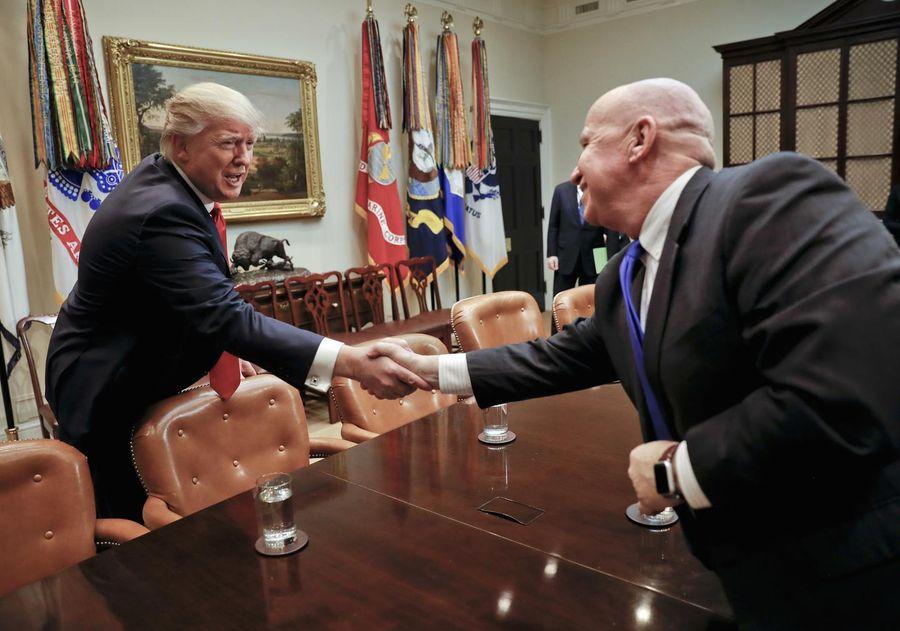
President Donald Trump shakes hands with Rep. Kevin Brady, R-Texas during a meeting with House and Senate legislators in the Roosevelt Room of the White House in Washington, Thursday, Feb. 2, 2017. (AP Photo/Pablo Martinez Monsivais)
GOP Point Man on Obamacare, Taxes Remains Confident
Published Feb. 9, 2017 • Read time: 4m
Rep. Kevin Brady, chairman of the powerful House Ways and Means Committee, is at the center of two of the biggest legislative debates on the horizon for Congress: repealing and replacing the Affordable Care Act, and plans to overhaul the tax code. And despite a lack of party consensus and an uncertain timeline, Brady remains confident that Republicans will accomplish both this year.
First up for the congressional GOP, and Brady, is addressing lingering questions about the Affordable Care Act’s demise. Originally, there was hope on Capitol Hill and among President Trump’s transition team that a repeal vote could happen within weeks of Inauguration Day. But as concerns increased about undoing the law without a set-in-stone replacement ready, Brady and his colleagues began working to determine how much of a replacement could be done simultaneously.
Despite Trump’s pronouncement over the weekend that the effort could go into next year, Speaker Paul Ryan insisted that legislation on Obamacare would be finished in 2017. Brady said his committee is still operating on a March timetable.
“We’re moving ahead deliberately. We want to make sure we get it right, not rushed,” the Texas congressman told RealClearPolitics during an interview in his Capitol office for RCP's “The First 100 Days” podcast. “But we are moving forward at a pretty steady clip. So the answer is sooner rather than later."
Brady said his committee’s goal is to have key elements of the replacement, including access to health savings accounts and tax credits to make insurance more affordable, included in their bill repealing President Obama’s signature law. The 11-term lawmaker also said that no decision has been made as to how long the transition between plans will be.
Gavin Newsom's Misguided Redistricting Initiative
A Warning Against the Overuse of Sanctions
Open The Books on the California State Checkbook
Senate Passes Bill Addressing Heroin, Opioid Crisis
But while Brady continues focus on this enormous task – which also involves the Energy and Commerce Committee – an effort is already well underway to find consensus on, and sell, the GOP’s tax reform agenda. Though that legislation isn’t expected until summer, it’s a complex undertaking that balances a number of competing interests, and Brady is working hard to get his colleagues, and the White House, on board.
“The good news is we started with two plans that were 80 percent the same,” Brady said of House Republicans and Trump. “We’re working on some of the differences in narrowing them. I’m really optimistic and confident that tax reform will occur in 2017."
One of those differences, a key component of the House GOP plan called border adjustability, has already proven to be a major issue. The idea proposed by Brady and fellow Republicans, simply put, is to end taxes on U.S. exports, and tax imports consumed in the U.S. at a 20 percent rate. It’s expected to raise trillions of dollars in revenue, thus keeping Brady’s tax plan revenue neutral.
But there are concerns among Republican senators, some retail businesses that rely heavily on imports (such as Wal-Mart) and, most critically, Trump. The president originally said he found the tax too complicated and didn’t support it; then, his press secretary seemed to suggest that the White House supports the idea and believes it could be used to finance the border wall; later, the White House backed away, suggesting the border tax was just one option under consideration. Brady said he is confident that Trump will ultimately support the idea, and that congressional Republicans will coalesce around it. If just three Senate Republicans balk at the idea, it could jeopardize the larger tax overhaul.
“I’m confident that at the end of the day, we will no longer have a tax code that favors foreign products over American products,” Brady said.
The chairman, who took over the Ways and Means Committee when his predecessor, Paul Ryan, became speaker of the House in 2015, acknowledged that it is a bold agenda, but said 2017 provides a “once in a generation” opportunity for a tax overhaul. When asked if he has concerns that moving too big and too fast, as Democrats did at the beginning of Obama’s first term, could imperil Republicans in future elections, Brady said no.
“I see a big difference between the Obamacare/global warming priorities of the Obama administration that [weren’t] shared by the public, and our focus, which is get the economy going and deliver affordable health care that’s personalized and not what Washington needs but what the American people need,” he said.

The GOP Majority Should Go Out in Glory
Daniel McCarthy • RealClearPolitics
Republican Majorities Could Return Sooner Than Expected
J.T. Young • RealClearPolitics
The Danger Before the Attack
Leslie J. Sullivan • RealClearPolitics
Jon Finer’s Old and Dangerous ‘New Approach’ to Israel
Peter Berkowitz • RealClearPolitics
The President Deserves Better
John Ullyot • RealClearPolitics
Congress Doesn’t Need Another Blame Game. It Needs To Find What’s Broken
Jarrod Bernstein • RealClearPolitics
RCP Today
Top stories on RealClearPolitics
The Takeaway
Polling intelligence and analysis delivered to your inbox
World News
Featuring the latest world news
Policy
Featuring the latest policy news
Support Our Mission
As part of RealClearPolitics, authors aim to provide balanced, non-partisan analysis by presenting top reporting and commentary from all sides of the political spectrum.
Trusted by policymakers and citizens alike since 2000