
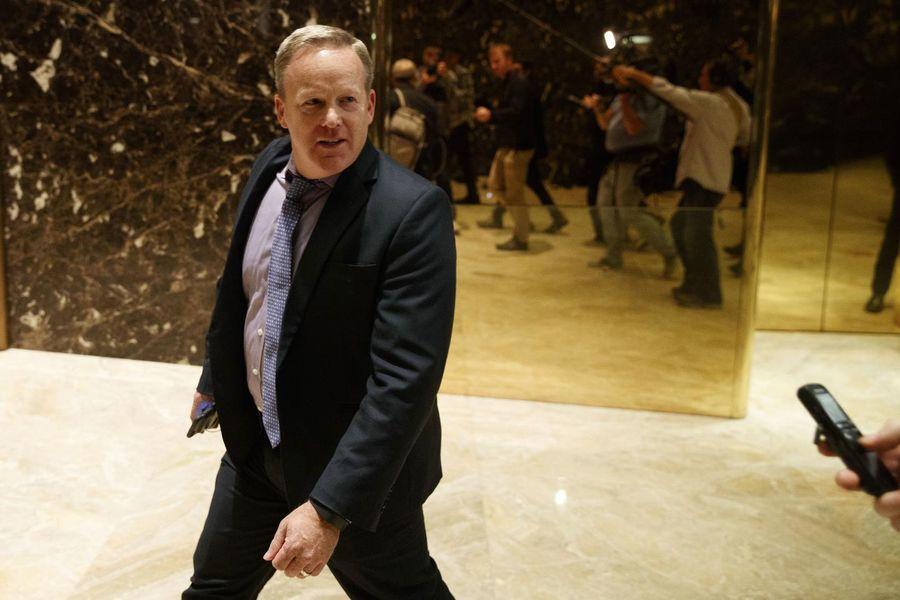
Republican National Committee communications director and chief strategist Sean Spicer leaves Trump Tower, Sunday, Nov. 13, 2016, in New York. (AP Photo/ Evan Vucci)
Trump's New WH Messaging Model Will Bring Challenges
Published Dec. 30, 2016 • Read time: 8m
Join the Conversation
0President-elect Donald Trump and his top advisers have signaled that they plan to reimagine the White House communications apparatus — but that task will fall to an unusually lean and inexperienced team in the West Wing and at federal agencies.
Whereas previous presidents have brought with them dozens of communications aides from the campaign to populate key posts in the White House and beyond, Trump has just a handful, many of whom joined the campaign at a later stage. This lack of tested manpower could limit the new administration’s messaging efficiency early on and amplify any missteps.
The staffing squeeze came into sharp focus last week when Jason Miller, Trump’s campaign communications director and his pick for that role in the White House, announced suddenly that he would not take the position after all. Sean Spicer, the outgoing communications director at the Republican National Committee, now plans to handle the dual role of press secretary and communications director — an unusual and potentially unsustainable arrangement.
As President Bill Clinton’s communications director, George Stephanopoulos also delivered daily press briefings, a role typically reserved for the press secretary. But he was yanked from the briefing room after a few months, and Clinton brought in David Gergen to clean up the administration’s communications practice.
Martha Joynt Kumar, director of the White House Transition Project and a retired Towson University professor, wrote that “there is no substitute for having some sort of official in charge of communications” who is separate from the press secretary.
Lies, Assault and Cover-ups Don't Stop Donald Trump
Trump Stands by His Man; Obama on a Health Scourge; Hayden Interview; Reagan's Courage
Analysis: For Trump, Few Limits to Win-At-Any-Cost Approach
What If Clinton Isn't Indicted?
“The press secretary spends too much time on daily operations to plan ahead effectively,” Kumar continued. “If there is no one to oversee the planning and implementation of communications, those jobs tend to end up haphazard or undone.”
Former White House press secretary Ari Fleischer, who served under President George W. Bush, echoed these concerns: “The press secretary spends an inordinate amount of time prepping for policy questions with experts just to handle today’s news,” Fleischer said. “I’m curious to see how Sean will have the time and bandwidth” to do both jobs.
And whereas Spicer has not needed deep policy expertise in his current role, Fleischer noted, he will face a steep learning curve in the White House to get up to speed on a wide range of foreign policy and domestic issues, in addition to managing his other responsibilities.
One transition source said Spicer nevertheless plans to tackle both jobs on his own, although there is no consensus on this matter: Another source close to the transition said that decision is still “in flux.” It is possible that Kellyanne Conway, Trump’s campaign manager who will serve as his counselor in the White House, will also take a lead role in communications strategy, having been the ubiquitous face and voice of the campaign in the final stretch of the election. Steve Bannon, who will be Trump’s chief strategist in the White House, also has a deep understanding of media, having previously built the conservative media outlet Breitbart News as its chairman. Also in the mix are Hope Hicks, who will manage Trump’s media opportunities as director of strategic communications, and Dan Scavino, who managed Trump’s social media during the campaign and will continue to do so in the White House; both were new to politics when they joined Trump’s campaign.
Publicly, Spicer has maintained an ambitious tone for the group, promising that they will rethink how the White House communications shop operates. In an interview Thursday with radio host Hugh Hewitt, Spicer suggested Trump’s White House would rely more on social media platforms and less on traditional news outlets.
“Business as usual is over,” Spicer said.
To be sure, Trump has taken an unorthodox approach to messaging throughout his presidential campaign and the transition, at times assuming the role himself of top communications strategist. He has been visible in particular on cable news and Twitter, where he has often stoked controversy with his comments.
Trump’s advisers have insisted that Twitter, in particular, will remain key to Trump’s White House communications strategy, even as some of his confidants have urged restraint.
“The president of the United States can’t randomly tweet without having somebody check it out,” former House Speaker Newt Gingrich told USA Today recently. “It makes you wonder about whatever else he’s doing. It undermines much more than a single tweet.”
But all aspects of the campaign’s communications operation could take on a haphazard quality, not just his Twitter feed. Former Rep. Jack Kingston recalled having reached out to the Trump team for weeks about signing on as an official surrogate — but only after a cable news anchor misidentified Kingston as a senior campaign adviser did he finally hear back.
“They called me back and said, ‘OK, you are now a senior Trump adviser. We want you on the daily call,’” Kingston told RCP last month. He went on to do more than 100 press hits, by his count, to boost Trump’s candidacy.
The effects of such disorganization would likely multiply in the White House, however, with even more daily demands put on the communications staff.
In Fleischer’s experience, “a well-functioning White House needs strong lines of authority and responsibility” to effectively and efficiently meet those demands, he said.
“The transition is drinking from two fire hoses trying to get this job done. When they get to the White House, they’ll have another three or four fire hoses added,” said Fleischer. “You can quickly drown in your workload.”
Among Trump’s communications aides, Spicer, Hicks and Scavino will boast “assistant to the president” designations, essentially affording each an independent power center in the White House, with staffs reporting to them.
Every White House has taken a different approach to managing communications, with teams that often reflected the president’s emphasis on messaging, or lack thereof.
Karl Rove told The New Yorker magazine in 2004 that President George W. Bush had a “cagey respect” for the press — and his wariness translated into an operation that could be aloof, with Bush personally keeping his distance and choosing to minimize press conferences.
“My biggest frustration is that this White House has chosen an approach with the White House press corps, generally speaking, to engage us as little as possible,” reporter David Gregory, then working at NBC News, told The New Yorker in the same story.
Trump has so far established a combative but symbiotic relationship with the press — calling out reporters and outlets by name for coverage he does or doesn’t like, while attempting to personally shape coverage and often eagerly participating in it. He loves Twitter but also has shown a deep appreciation for some of the lions of traditional media, like the magazines whose covers he has graced, or the cable news networks he watches religiously.
But attacking the media has also been a key part of his political strategy, at a time when public faith in many institutions, including news outlets, has dropped sharply. In the White House, Spicer has suggested he and other top advisers will assess how to work around the press, as much as how to work with it.
President Obama tried a similar approach at the start of his presidency, fresh off a campaign during which he harnessed social media in innovative ways to rally his supporters, and established himself as a celebrity figure as well as a political one. But Obama’s team discovered, as past presidents also have and Trump soon might, that campaign messaging is markedly different from that of a White House, and is not always transferable.
"If you make a decision that your campaign strategy is to be used in a governing mode, you tend to think you can go over the heads of everybody," former Reagan and George H.W. Bush White House press secretary Marlin Fitzwater told The New York Times in 1993, as the nascent Clinton administration shook up its communications staff following an uneven start.
Clinton, Fitzwater added, had sought to bypass the press, Republicans, and other interest groups, forging ahead without their buy-in. "And when you ignore all those components, you're going to get into trouble."
Nor is communications strategy a concern solely for the White House: Trump will also need to fill top communications jobs at each of the federal agencies, and will do so lacking the deep, trusted staff that most campaigns would already have ready and waiting. Most likely, those slots will be awarded to people who have never worked closely, or even indirectly, with Trump’s team — meaning they will need extra time to begin working seamlessly with Spicer and others at the White House.
”It’s good for the agencies to have people in those big jobs who are close to the White House,” said Fleischer. “The Trump team is so much leaner, I do question how they’re going to go about doing this and be effective.”

Congress Doesn’t Need Another Blame Game. It Needs To Find What’s Broken
Jarrod Bernstein • RealClearPolitics
Democrats Won the Midterms. Common Sense Won, Too
Jordanne Kemper • RealClearPolitics
The 120th Congress Shapes Up
Carolina Lumetta • RealClearPolitics
Flooding GOP Primaries With Democrats
Robert Natelson • RealClearPolitics
Washington Keeps Rewarding Oracle—Veterans Keep Paying the Price
Darin Gaub • RealClearPolitics
The Seeds of Unrestricted Warfare
John Teichert • RealClearPolitics
RCP Today
Top stories on RealClearPolitics
The Takeaway
Polling intelligence and analysis delivered to your inbox
World News
Featuring the latest world news
Policy
Featuring the latest policy news
Support Our Mission
As part of RealClearPolitics, authors aim to provide balanced, non-partisan analysis by presenting top reporting and commentary from all sides of the political spectrum.
Trusted by policymakers and citizens alike since 2000