
Experts: Trump Needs WH Team Before Cabinet
Published Dec. 23, 2016 • Read time: 11m
Join the Conversation
0Donald Trump will be president in less than 30 days. Prior to Thursday he had announced little more than a handful of White House staff appointees, most of them former campaign advisers with scant federal executive or legislative experience, all of whom hope to upend the status quo in Washington.
As a businessman learning the bureaucratic ropes, Trump is making his West Wing life more challenging by revamping the White House organization chart to create co-equal power centers that will offer his staff only days to figure out what their new jobs entail, let alone sufficient time to meld with hundreds of new colleagues, according to presidential transitions experts interviewed by RealClearPolitics.
“The key will be, are they able to create clarity for themselves, as well as those around them?” said Max Stier, president and CEO of the nonprofit Partnership for Public Service, referring to Trump’s pending staff appointments. “They need to build a team, and they need to get it all done” in the next month, he said.
Stier’s group, which advocates for improved government management and has shared information and case studies describing best practices during presidential transitions, believes White House structural innovations can be beneficial in a rapidly changing world. But the combination of competing power positions, a tight deadline before Jan. 20, and relative inexperience in governing among Trump’s new hires could be a recipe for confusion.
“I do think they very much need to understand how the government operates,” he said Wednesday. “My advice would be to be clear, and to challenge the existing approach, but to understand what’s gone before.”
Trump, who won the White House by running as a Washington outsider, is poised to become the No. 1 insider merely by reciting the oath of office. He favors the business world for his management and decision-making models, and publicly celebrates the achievements of those who are financially successful and who backed him during his long-shot campaign. He likes to be in charge, and he wants to make the decisions.
Obamas Host "Hamilton" Cast at White House
Obama Starts 2015 on the Upswing, But Can It Last?
Obama Tests His Sway Against a GOP-Run Congress
Obama Looks Past GOP in Promoting 2015 Agenda
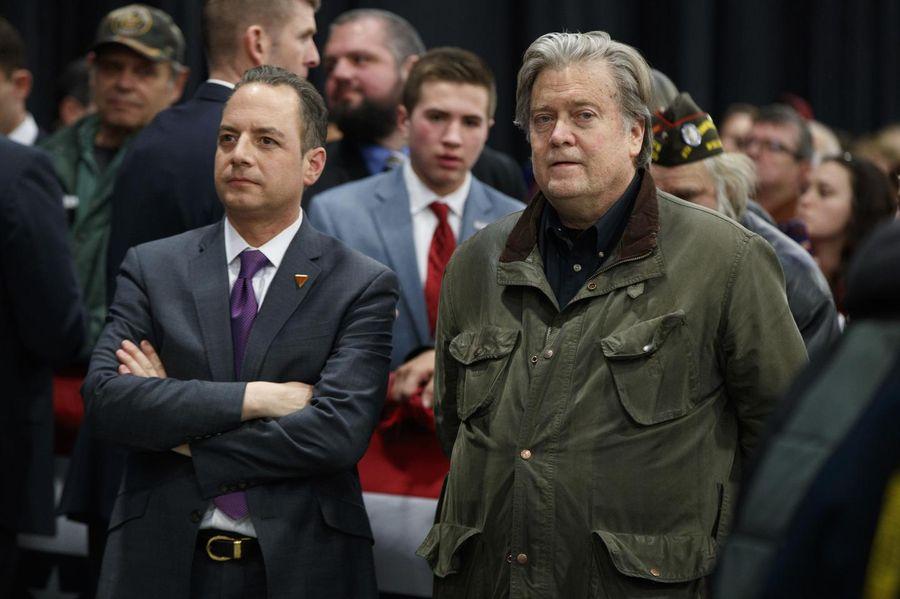
Incoming White House Chief of Staff Reince Priebus and chief strategist and senior counselor Steve Bannon, for example, are to serve as co-equals in the Trump White House, both reporting to the 45th president. How supervision is to be divvied up remains unclear, and there are hints that reaching consensus and mapping those future West Wing practices has lengthened the transition decision-making during a period in which Trump first focused on his Cabinet. Vice President-elect Mike Pence and his staff are expected to create a separate power cluster of their own.
On Thursday, Trump named pollster Kellyanne Conway, his campaign manager and a political strategist who publicly wavered about helping the administration from inside or outside government, as his counselor in the West Wing. He said Conway, a frequent surrogate for Trump on television, would focus on communications tied to “legislative priorities and actions.”
The president-elect previously named Stephen Miller, a former aide to Attorney General-designate Sen. Jeff Sessions and a campaign adviser and surrogate, as senior White House adviser for policy.
“We’re still trying to form the overall government,” Trump transition spokesman Jason Miller told reporters this week while touting the president-elect’s rapid progress appointing a Cabinet.
Trump has not yet announced nominees for the Veterans Administration and the Agriculture Department, but could do so before Christmas if he reaches decisions, Miller added.
“At the same time, the president-elect has been working very hard to get the proper structure together within the White House as well as the rest of the administration,” Miller said on Tuesday.
“The transition staff has been working around the clock to put together the rest of the staff,” he added. “We have full confidence that the team that is ultimately put together at the staff level will be just as impressive as the team that was put together at the Cabinet level.”
Six weeks after the election, the incoming president on Thursday said more key campaign aides would follow him into the West Wing. He awarded the White House communications director title to Jason Miller, and hired Republican National Committee spokesman Sean Spicer to be White House press secretary. Hope Hicks, a Trump Organization gatekeeper for her boss before leaping with him into politics for the first time with a title of campaign press secretary, will become assistant to the president for strategic communications. Campaign social media expert Dan Scavino will apply his tech skills to Trump’s digital outreach. Conway and Bannon, each with “counselor” in their new titles, played important roles in strategic communications during the campaign, suggesting the White House press and communications aides may ultimately report to the pair of counselors and to Trump, rather than to the incoming president through the chief of staff.
Cabinet nominees require Senate approval, while about 400 White House staff members serve at the pleasure of the president. Without new hires, the White House on Jan. 21 will be empty. The service of every political employee will terminate on or before Jan. 20, and Trump’s staff – those with appropriate security clearances -- will walk through the famous iron gates to discover ringing phones and a blank email architecture, systems they will have to learn to navigate. Their desks and bookshelves will be empty. There will be no how-to manuals waiting for them in their cubicle drawers. The National Archives and Records Administration will, by law, have removed all paper and electronic records associated with the 44th president.
Trump has named at least 13 senior White House staff members, and he also plans to nominate Rep. Mick Mulvaney to lead the powerful Office of Management and Budget, located adjacent to the White House in the Eisenhower Executive Office Building. Trump’s first spending blueprint will be due to Congress in February.
The incoming president has yet to name a legislative affairs director (key to guiding Trump’s ambitious goals on Capitol Hill); a staff secretary (the little known but essential aide, usually an attorney, supervises every piece of paper that goes in or out of the Oval Office); and a homeland security and counterterrorism adviser, a position created after 9/11. He has not named a White House director of personnel, considered essential to a smooth transition over the first 18 months to two years when a government seeks to fill up to 4,000 Senate-confirmed vacancies.
Trump has not announced a deputy chief of staff for White House operations, or a director for intergovernmental affairs.
The number of senior-most White House positions – “assistants to the president” – is limited to 25, and the ceiling pay scale for the top positions in 2016 was about $176,000. Obama innovated by making the salary lists public on the White House website, a practice Trump has not commented on. The vice president, who holds the position of president of the Senate under the Constitution, hires staff members who are compensated by the Senate on a different pay scale, although they serve inside the White House. White House staff jobs demand personal transparency unlike what corporate employees encounter. The financial assets and liabilities of senior White House aides must be reported by law to the Office of Government Ethics to avoid conflicts, and categories of information from those annual reports are accessible by the news media.
As Trump plans to do, some previous presidents (Ronald Reagan is one example) devised multiple power nodes within White House teams, including longtime friends, political loyalists, and even relatives (Hillary Clinton attempted unsuccessfully to write a health reform bill Congress would approve). But the hydra-headed organizations of the past spawned infighting and turf scuffles, policy confusion, and led to unforced errors pinned on the president.
“The risk is poorer decision-making,” Stier said.
At the outset of the Obama administration, Republican lawmakers criticized the president’s reliance on a collection of White House senior policy advisers they dubbed “czars.” Trump’s business interests, family ties and friendships with corporate and financial power brokers could spark complaints about motives and influence within the White House inner circle that would dwarf those in 2009.
On Wednesday, Trump announced that billionaire investor Carl Icahn would become an informal, outside adviser to him on federal regulatory policy. The regulatory portfolio is of keen interest on Wall Street, K Street and in corporate boardrooms. Trump’s Cabinet designees for Commerce, Labor, Energy, Treasury, the Environmental Protection Agency, and the Small Business Administration have joined the president-elect in seeking to weed through federal rules. (The Office of Management and Budget already has a statutorily created office, traditionally headed by an administrative law expert or attorney confirmed by the Senate, to oversee all major proposed and final regulatory actions.)
Priebus, as the incoming chief of staff, is steeped in state and national politics and was a corporate litigator, but never worked in the White House, never juggled international affairs, and never helped lawmakers pass legislation on Capitol Hill. His sway over the impatient and unpredictable Trump is being tested during the transition.
Bannon, a latecomer to the campaign, has an eclectic resume, including graduate degrees in business and national security, a stint in the U.S. Navy, and a track record as a media executive for the conservative Breitbart News Network. But Bannon never managed decision-making across an enterprise as complex as what Trump will inherit.
The president-elect on Wednesday also announced a new national trade policy council at the White House, to be layered alongside the National Economic Council, which was created by President Clinton. The trade council, to be chaired by academic Peter Navarro, author of “Death by China,” will need to intersect with the statutorily created Office of the U.S. Trade Representative, a 200-strong staff of trade experts created in 1962 and strengthened by law during the last 50 years.
The new West Wing trade team must also navigate the portfolio Trump handed Commerce secretary-designate Wilbur Ross, a billionaire donor and campaign adviser, who was told to take the lead in crafting Trump’s trade policy, reporting to the president, according to a statement released by the transition this week.
The trade council, led by Navarro, an economics professor at the University of California at Irvine, will also coordinate with the National Security Council (to be headed under Trump by retired Gen. Michael Flynn and national security deputy Kathleen “KT” McFarland). It must mesh with the separate NEC, to be chaired by outgoing Goldman Sachs President Gary Cohn, as well as the White House Domestic Policy Council, whose chair has not been named.
If it sounds like competing roles and a tangle of type-A bigwigs huddled around Trump, that may be because the president-elect has left so many questions unanswered. He is reaching decisions on his own timetable and in a sequence that transition experts suggest should ideally have been reversed to put the Cabinet after the White House hires.
President Clinton, a former governor who liked to think of his Arkansas Cabinet as his senior staff, tackled his West Wing hiring decisions in 1993 well after laboring to fill his federal Cabinet posts. He later said he should have reversed the order. Clinton’s initial chief of staff, childhood friend and fellow Arkansan Thomas “Mack” McLarty, conceded years later that he had been a poor fit to help steer his friend’s first-year decisions through Washington’s many blockades. Clinton went on to hire three more chiefs of staff over two terms. Obama is on his fifth.
“You need a White House staff in place early because that’s a president’s decision-making framework, where you lay out what kind of information a president wants before making a decision,” said Martha Joynt Kumar, a presidency scholar and director of the nonprofit White House Transition Project.
But to understand what information he needs, Trump’s staff has to look around corners and see what the president doesn’t know and what he needs to know. The council structure inside the White House was originally designed to put “honest brokers” in charge of policy development. Under that model, Navarro and Cohn, for instance, would be expected to help Trump sift through competing views and differing opinions, placing their own advice at the end of the process.
In any transition, Cabinet posts may go unfilled for more than a year as the Senate moves through the lengthy confirmation process. It’s why the Senate has scheduled hearings for Trump’s nominees to lead Justice and State prior to the inauguration.
Departments and agencies are capable of functioning with the guidance of career federal employees, experts who know more than almost all political appointees at the outset. There is no backup staff hanging around the West Wing if positions are vacant.
Kumar said the White House Transition Project maintains a website with information and documents for use by the incoming administration, based on historical data, statutes, and select interviews with officials in past administrations, all designed to help a new team sort through choices and avert errors. For example, the material includes White House staff organizational charts showing past lines of authority that worked well (or wobbled), along with detailed descriptions of various White House offices, such as presidential personnel, as well as the functions of key staff roles inside the Executive Office of the President.
Kumar said the most valuable resources presidents have are skilled White House advisers, and the careful deployment of any president’s time. Without one, Trump cannot rely on the other.
And time is now a factor.
“He’s behind,” she said.

Jon Finer’s Old and Dangerous ‘New Approach’ to Israel
Peter Berkowitz • RealClearPolitics
The President Deserves Better
John Ullyot • RealClearPolitics
Congress Doesn’t Need Another Blame Game. It Needs To Find What’s Broken
Jarrod Bernstein • RealClearPolitics
Democrats Won the Midterms. Common Sense Won, Too
Jordanne Kemper • RealClearPolitics
The 120th Congress Shapes Up
Carolina Lumetta • RealClearPolitics
Flooding GOP Primaries With Democrats
Robert Natelson • RealClearPolitics
RCP Today
Top stories on RealClearPolitics
The Takeaway
Polling intelligence and analysis delivered to your inbox
World News
Featuring the latest world news
Policy
Featuring the latest policy news
Support Our Mission
As part of RealClearPolitics, authors aim to provide balanced, non-partisan analysis by presenting top reporting and commentary from all sides of the political spectrum.
Trusted by policymakers and citizens alike since 2000