
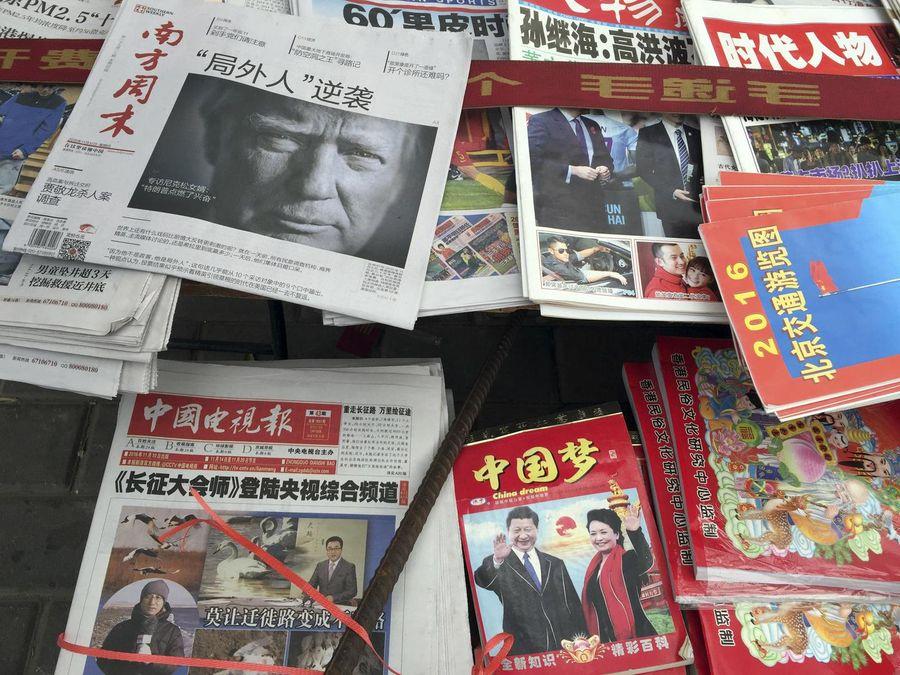
FILE - In this Nov. 10, 2016 file photo, a front page of a Chinese newspaper with a photo of U.S. President-elect Donald Trump and the headline
Trump's Bold Transition Moves Flout Tradition
Published Dec. 6, 2016 • Read time: 4m
Join the Conversation
0With little more than a month to go before he takes the oath of office, Donald Trump has begun to wade into the presidency, shaping American policy and speaking publicly about it — a break with tradition forged by previous presidents-elect.
Although protocol or precedent has rarely impressed Trump, his aggressive transition could tinge early impressions of his administration, while making for an uncomfortable dynamic with President Obama in the meantime.
Trump underscored his approach Friday when he took a call from Taiwan President Tsai Ing-wen, marking the first official communication between the two heads of state since the United States broke ties in 1979.
Facing some backlash over the conversation, Trump responded on Twitter:
— Donald J. Trump (@realDonaldTrump) December 3, 2016Interesting how the U.S. sells Taiwan billions of dollars of military equipment but I should not accept a congratulatory call.
Jon Huntsman, a former ambassador to China and a possible pick to be Trump’s secretary of state, also defended the call in an interview Monday with ABC News: “He made the choice to take it, which I think was absolutely right.”
But the episode, which sent the Obama administration scrambling to explain that its one-China policy had not changed, put Trump at odds with longstanding tradition among presidents-elect to not interfere with the purview of the current commander-in-chief.
“Usually, presidents are very sensitive that presidents are president until noon on January 20,” said James Pfiffner, a professor at George Mason University’s Schar School of Policy and Government.
Over Here: Competence Amid Repulsive Politics
We're Not a Poor Country, Donald
What America Should Learn from the Attack in Brussels
Anti-Muslim Rhetoric Profits the Enemy
Trump’s political style, however, has been that of a bull in a china shop, and his transition efforts have been no exception.
In the sphere of domestic policy, typically viewed as less delicate than foreign affairs during a transition, Trump and Vice President-elect Mike Pence marched forward with talks to keep a manufacturer, Carrier, from shipping jobs out of Indiana. Trump and Pence offered millions of dollars in incentives, plus assurances that the new administration will lower corporate tax rates, and Carrier agreed to keep some jobs in the United States.
The incoming president announced the coup during a buzzy, campaign-like event earlier this month, not shying from promoting his pre-presidency dive into economic matters.
But Trump has also on occasion injected himself into foreign affairs, territory more traditionally reserved for the current president. Last month, for example, he took the unusual — some would say uncouth — step of urging Britain to select Nigel Farage, former leader of the United Kingdom Independence Party, as its ambassador to the United States.
— Donald J. Trump (@realDonaldTrump) November 22, 2016Many people would like to see @Nigel_Farage represent Great Britain as their Ambassador to the United States. He would do a great job!
Britain already has an ambassador in place, however.
During his first post-election press conference on Nov. 14, Obama noted “there is one president at a time.” That tradition is not always so simple in practice, however. During his transition to the presidency, Richard Nixon authorized secret talks between his national security adviser, Henry Kissinger, and the North Vietnamese, to revive negotiations to end the Vietnam War.
Immediately after winning the presidency in 2008, Obama took a proactive role in pushing for an economic stimulus “sooner rather than later.”
“If it does not get done in a lame-duck session, it will be the first thing I do as president of the United States," Obama said.
That push was the source of some debate but was ultimately less scrutinized because it was a domestic policy.
During the transition to George W. Bush’s administration, press secretary Ari Fleischer took a strict approach to foreign policy matters when reporters posed questions.
“I had a stock answer, which was, ‘We have one president at a time,’” Fleischer said. The cagey response was deliberate. “It really does send a signal of confusion if our country is speaking with two voices at one time,” he added.
In Trump’s case, Pence defended the call with Taiwan as “a reflection of the tremendous energy” Trump has during the transition. “And I think it's the kind of approach that you're going to see him bring to challenges at home and abroad,” Pence said Sunday on “Meet the Press.”
“Bush’s style was just a lot more buttoned-down and internally deliberative,” Fleischer acknowledged. “Trump’s style is the opposite.”
Even so, Fleischer said he is not surprised or offended by how Trump has acted during the transition. “Donald Trump was elected to change the way things always have been. I welcome and enjoy what he is doing.”

Jon Finer’s Old and Dangerous ‘New Approach’ to Israel
Peter Berkowitz • RealClearPolitics
The President Deserves Better
John Ullyot • RealClearPolitics
Congress Doesn’t Need Another Blame Game. It Needs To Find What’s Broken
Jarrod Bernstein • RealClearPolitics
Democrats Won the Midterms. Common Sense Won, Too
Jordanne Kemper • RealClearPolitics
The 120th Congress Shapes Up
Carolina Lumetta • RealClearPolitics
Flooding GOP Primaries With Democrats
Robert Natelson • RealClearPolitics
RCP Today
Top stories on RealClearPolitics
The Takeaway
Polling intelligence and analysis delivered to your inbox
World News
Featuring the latest world news
Policy
Featuring the latest policy news
Support Our Mission
As part of RealClearPolitics, authors aim to provide balanced, non-partisan analysis by presenting top reporting and commentary from all sides of the political spectrum.
Trusted by policymakers and citizens alike since 2000