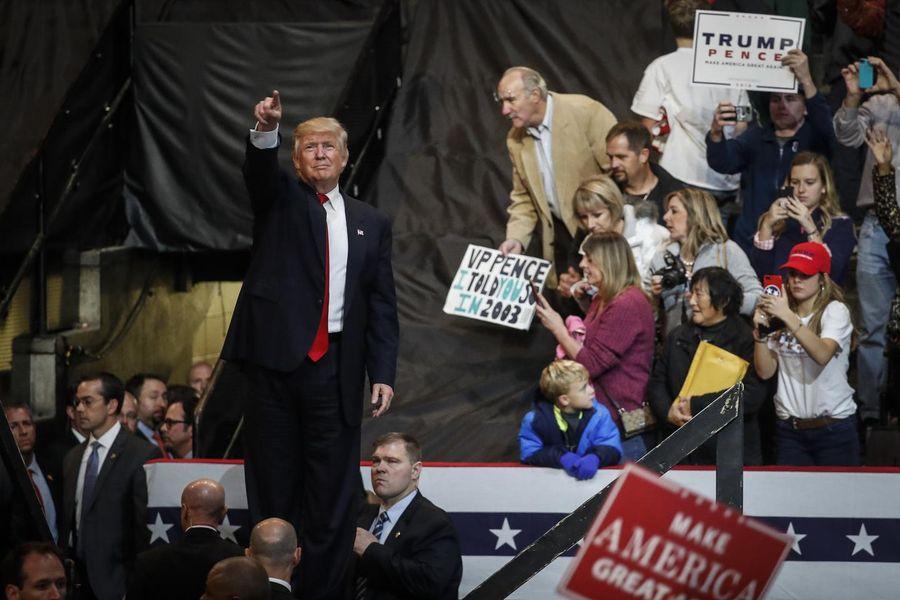
President-elect Donald Trump gestures to the crowd after speaking during the first stop of his post-election tour, Thursday, Dec. 1, 2016, in Cincinnati. (AP Photo/John Minchillo)
The Election's Over But Trump Is Still Campaigning
Published Dec. 5, 2016 • Read time: 6m
Join the Conversation
0A few days before taking office in January 2009, President-elect Barack Obama embarked on a whistle-stop train tour from Philadelphia to Washington, D.C., a route modeled after the one Abraham Lincoln took ahead of his own swearing-in. In 1993, Bill Clinton opted for a bus tour from the home of Thomas Jefferson in Virginia to the nation’s capital.
While those trips may have had the hallmarks of campaign events, their focus was the upcoming inauguration of each new president, designed to spotlight a new leader in touch with the people.
Now Donald Trump has undertaken a tour of his own but with a route, rhetoric, and purpose unique to him.
His “thank-you” events are being seen as a perpetuation of his presidential campaign, with big rallies, the propensity to veer off script, and the inclination to hit former foes. It continues this week, with stops through the electoral battlegrounds of North Carolina, Iowa, and Michigan, which helped deliver him a historic victory.
But in Cincinnati last week, Trump seemed to return to the stump, recalling the “fun fighting Hillary Clinton.” During an event to announce a deal to retain jobs in Indiana, he reminded the audience that his GOP rivals tried to defeat him in that state’s primary.
At the same time, Trump has blended campaigning and governing during the transition period -- and has breached protocol by communicating with the president of Taiwan, for example. “Interesting how the U.S. sells Taiwan billions of dollars of military equipment but I should not accept a congratulatory call,” he wrote on his Twitter account.
Lies, Assault and Cover-ups Don't Stop Donald Trump
Trump Stands by His Man; Obama on a Health Scourge; Hayden Interview; Reagan's Courage
Analysis: For Trump, Few Limits to Win-At-Any-Cost Approach
What If Clinton Isn't Indicted?
And, over the weekend, the president-elect tweeted that any U.S. company that takes its business overseas, or builds a new factory or plant in another country, “then thinks it will sell its product back into the U.S. … without retribution or consequence, is WRONG!”
It is well established that Trump views Twitter as an effective – and preferred -- communication tool, one that allows him to circumvent traditional media that he considers “dishonest.” Unlike other incoming presidents, Trump has not yet given a news conference, though he plans to hold one soon to discuss his children taking over his business amid concerns about potential conflicts of interest.
He has used social media and other avenues to talk about his Cabinet considerations, introducing theater and intrigue to a process that typically happens behind the scenes. Over the weekend, Kellyanne Conway said Trump is now looking at additional candidates for secretary of state beyond the four contenders the team mentioned last week.
As for the transition travel, it provides the president-elect clear benefits, allowing him to connect with his base while attempting to bridge some divides. It also reinforces his outsider brand and helps to underscore the election message about the disconnect between Washington and those who feel forgotten by it.
And perhaps hitting the road has a more fundamental appeal for him: Trump simply relishes campaigning.
“It's a brilliant move. The message to the voters is ‘I won't forget you!’” said Ed Rollins, a GOP strategist who served as White House political director during the Reagan administration. “He loves crowds. They love him.”
It is something Trump will likely continue once in office. “He certainly will be a very actively traveled president,” Conway said Sunday on “Meet the Press.”
It’s not unprecedented for presidents-elect to engage the public or debate policy during the transition period. Clinton held an economic summit in December 1993, for example. Obama had begun working with Congress on plans to boost the economy before he took office.
Trump’s thank-you tour comes with post-election emotions on all sides still raw, as evidenced by heated arguments at last week’s forum for both sides’ campaign staff at the Harvard Institute of Politics.
In some ways, Trump, who lost the popular vote, has some campaigning left to do.
“All newly elected presidents claim some sort of mandate … that suggests their election is an affirmation by the American people of their policy proposals, agenda, campaign promises,” said Gerhard Peters, co-founder of the American Presidency Project. “The problem for Trump is that he has a negative mandate of 2.5 million popular votes. He's also a generally extremely polarizing figure and very unpopular among half the country.”
The Trump team indeed believes it has a mandate to govern. “We are the ones who understood America,” Conway said on “Meet the Press.” “The idea that Donald Trump doesn't have a mandate, after he got 100 more electoral votes than Mitt Romney did -- he got 306 electoral votes, it wasn't close. He won states that had not gone Republican in decades.”
And Trump's continued pounding of this message may also be in response to opponents’ campaign against him, which hasn't quite subsided either. Democrats in Congress have criticized many of his Cabinet choices so far. Sen. Elizabeth Warren has been particularly vocal, tweeting, for example:
— Elizabeth Warren (@SenWarren) November 15, 2016Keeping these lobbyists & insiders on your team sends a clear message, @realDonaldTrump: your campaign was a giant con.
At the Harvard forum, Clinton campaign chief strategist Joel Benenson said Trump did not earn an endorsement from most voters: “The fact of the matter is that more Americans voted for Hillary Clinton than for Donald Trump.”
In Cincinnati last week, Trump began to make a unity pitch, saying his administration will “condemn bigotry and hatred in all forms” and would seek “a truly inclusive society.”
Criticizing those who "spend too much time focusing on what divides us,” he added that “now it's time to focus on what truly unites us: America. We are going to bring this country together. We'll find common ground and we'll get the job done.”
Yet he also reveled in recalling the shock factor of his victory. “We didn’t break it, we shattered that sucker,” he said of the proverbial blue wall that Democrats saw as their bulwark against a GOP win.
“We shattered it, man. That poor wall is busted up.”
And despite winning the Electoral College and thus the White House, the incoming president has tried to explain his popular vote loss by making an unfounded claim of “millions” of people voted “illegally.”
Trump’s continuance of campaigning carries risks, however, one being “simply that he is continuing to divide and polarize the country,” said Peters.
Trump is expected to travel to Pennsylvania and Florida next week as an extension of the tour.
“He is trying to remind [people] that what got him and the party in this advantageous position was the personal resonance he has with his constituency,” said Victor Davis Hanson, senior fellow at the Hoover Institution. The overarching message is: “Remember I still have a base.”
Hanson believes this continuation of the campaign will be helpful in governing, particularly in ginning up national support for certain policy proposals. “He has a different constituency than his own party, and he has to replenish it.”

Newsom Defies Voters, Juries and Lawmakers To Spare Murderers While Defending Abortion
Curtis Hill • RealClearPolitics
The Algorithmic Tilt
Frank Filingeri • RealClearPolitics
A RealClear Thanksgiving: Investing in a Better Future
David DesRosiers • RealClearPolitics
Trump’s Newsom Problem: Antagonist-in-Chief
Carolina Lumetta • RealClearPolitics
America’s Free Spirit
John Maxwell Hamilton • RealClearPolitics
The GOP Majority Should Go Out in Glory
Daniel McCarthy • RealClearPolitics
RCP Today
Top stories on RealClearPolitics
The Takeaway
Polling intelligence and analysis delivered to your inbox
World News
Featuring the latest world news
Policy
Featuring the latest policy news
Support Our Mission
As part of RealClearPolitics, authors aim to provide balanced, non-partisan analysis by presenting top reporting and commentary from all sides of the political spectrum.
Trusted by policymakers and citizens alike since 2000