
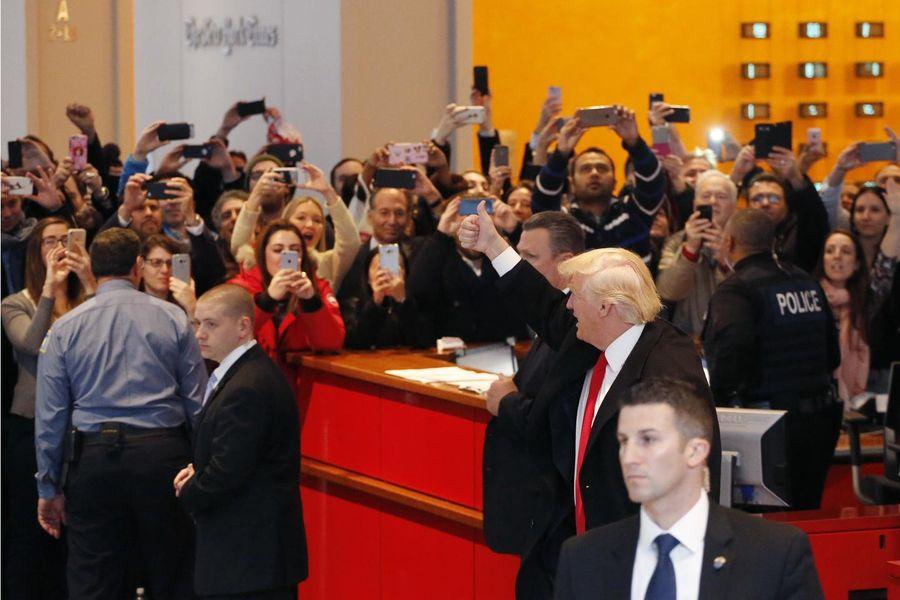
President-elect Donald Trump gives a thumbs-up to the crowd as he leaves the New York Times building following a meeting, Tuesday, Nov. 22, 2016, in New York. (AP Photo/Mark Lennihan)
Trump Transition: Public Meetings, Private Deliberation
Published Nov. 23, 2016 • Read time: 6m
Join the Conversation
0From the stately clubhouse at his golf course in New Jersey to the boardroom at Trump Tower in Manhattan, the president-elect has held roughly 60 meetings with a wide range of individuals helping him chart his transition to the Oval Office.
Whether those summoned by Donald Trump will be selected for the administration or are there to offer counsel -- and the extent to which the incoming president is staging some sort of show, with television cameras fixated on who enters his properties -- remains to be seen.
The president-elect has also indicated a change in thinking on some of his campaign promises, including his vow to jail his former rival for the job, and shift on climate change.
And as Trump prepares to transition from a businessman to commander-in-chief, questions about potential conflicts of interest remain -- particularly as his children, who will likely assume control of the family business, remain part of the transition team and the president-elect holds interviews for administrative posts at Trump Tower.
Many of those interviews have stirred intrigue. They include Mitt Romney, who railed against Trump earlier this year but is being considered for secretary of state, despite his foreign policy differences with the incoming president. Democratic Rep. Tulsi Gabbard, a former Democratic National Committee vice chair who broke with her party earlier this year over procedure and the DNC’s treatment of Bernie Sanders, also met with Trump this week. Retired Marine Corps Gen. James Mattis visited the New Jersey golf club over the weekend, and is considered the top candidate for secretary of defense. South Carolina Gov. Nikki Haley, who had also been critical of Trump, is being considered for U.N. ambassador, according to the Wall Street Journal.
Obamas Host "Hamilton" Cast at White House
Obama Starts 2015 on the Upswing, But Can It Last?
Obama Tests His Sway Against a GOP-Run Congress
Obama Looks Past GOP in Promoting 2015 Agenda
While Trump has been very public about his meetings -- greeting interviewees at the door and tweeting about the interviews -- he has given little indication as to his direction.
For example, Trump met with Sen. Ted Cruz, who was once a bitter foe, as chatter spread he was considering the Texas senator for attorney general. But the president-elect later announced Alabama Sen. Jeff Sessions will head the Justice Department. His transition team insists he is considering a diverse range of talent, but so far his choices have been limited to white men.
On Tuesday, Trump tweeted that he is considering another former rival, Ben Carson, for Housing and Urban Development secretary -- even though Carson had taken himself out of the running for a Cabinet position. (On Tuesday, Carson spokesman Armstrong Williams dialed back that position, saying the retired surgeon would “seriously consider a position in the administration” if Trump could find no one else.)
“Many will soon be a part of our government,” Trump said of his interviews in a video outlining his priorities for his first 100 days.
Until now, he has largely stayed away from the press except for public appearances outside his Bedminster golf club over the weekend, limiting his on-record statements and musings to Twitter. He also held an off-the-record meeting with television news executives, in which he reportedly criticized their coverage.
But Trump emerged from the confines of his Manhattan home and office tower on Tuesday to venture across town to the New York Times, where he sat down for an on-the-record interview on a range of topics, and reversed himself on a number of positions he held during the campaign. (Trump had tweeted about canceling the meeting earlier in the day, before saying it was back on, and has continued to criticize the newspaper’s coverage of him.)
In the interview with the Times, Trump said he believes there is “some connectivity” between human activity and climate change, and added he has an “open mind” about the Paris climate agreement, which he had said the U.S. should withdraw from.
Despite having joined supporters in calling for Hillary Clinton to be locked up, he said that he now does not "want to hurt the Clintons” and, when asked if he was ruling out prosecuting her for her email practices — something FBI Director James Comey recommended against — Trump said that “it’s just not something that I feel very strongly about.”
While such investigations are under the purview of the Justice Department and not the president's, former campaign manager Kellyanne Conway told MSNBC that Trump’s latest comment “sends a very strong message, tone and content, to the members [of Congress]."
Former New York City Mayor Rudy Giuliani, a close ally of Trump’s who is vice chairman of the transition team, said that “there’s a tradition in American politics that after you win an election, you sort of put things behind you.”
“I think the president-elect had a tough choice there; you could go either way,” Giuliani told reporters, adding that his new stance could “unite the nation” by prompting those who didn’t vote for Trump to “take another look at him.”
But other controversies remain. Trump defended his chief strategist Steve Bannon, whose nationalist agenda has been widely condemned by critics who say he does not belong in the White House. Trump told the Times that if he thought Bannon was “racist or alt-right or any of the things, the terms we use, I wouldn’t even think about hiring him.”
He brushed off concerns over Breitbart, the controversial website Bannon formerly headed, saying it was “just a publication.”
But asked about the alt-right conference held in Washington over the weekend, in which several people celebrated Trump’s election with Nazi-era salutes, he said, “I disavow and condemn them.”
The president-elect also pushed back on multiple reports of possible conflicts of interest that have arisen recently, and the appearance that he is using his elevation to commander-in-chief to further his business empire. The Times reported Monday that Trump used a meeting with British politician Nigel Farage to discourage the building of a wind farm near Trump’s golf course in Scotland — which Trump confirmed Tuesday, saying, “I might have brought it up.”
He acknowledged that his new hotel in Washington, D.C., became a more valuable asset after his election, and said his brand is “hotter” now. He disagreed with the assessment that these issues present a conflict of interest.
“The law’s totally on my side,” Trump said. “The president can’t have a conflict of interest."
He later added, “In theory I could run my business perfectly and then run the country perfectly. There’s never been a case like this.”
James Arkin contributed to this article.

Jon Finer’s Old and Dangerous ‘New Approach’ to Israel
Peter Berkowitz • RealClearPolitics
The President Deserves Better
John Ullyot • RealClearPolitics
Congress Doesn’t Need Another Blame Game. It Needs To Find What’s Broken
Jarrod Bernstein • RealClearPolitics
Democrats Won the Midterms. Common Sense Won, Too
Jordanne Kemper • RealClearPolitics
The 120th Congress Shapes Up
Carolina Lumetta • RealClearPolitics
Flooding GOP Primaries With Democrats
Robert Natelson • RealClearPolitics
RCP Today
Top stories on RealClearPolitics
The Takeaway
Polling intelligence and analysis delivered to your inbox
World News
Featuring the latest world news
Policy
Featuring the latest policy news
Support Our Mission
As part of RealClearPolitics, authors aim to provide balanced, non-partisan analysis by presenting top reporting and commentary from all sides of the political spectrum.
Trusted by policymakers and citizens alike since 2000