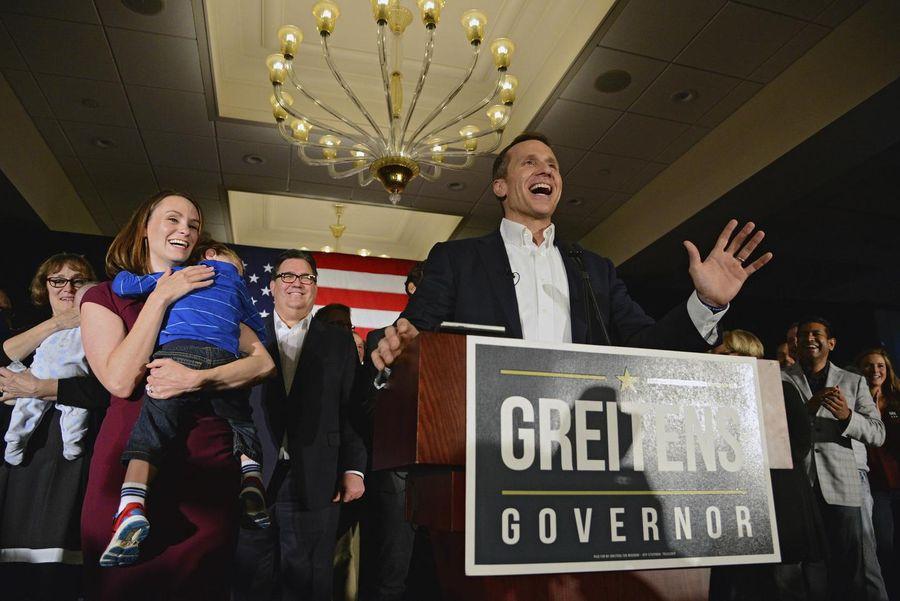
Missouri Republican Governor-elect Eric Greitens delivers a victory speech along side his wife Sheena and son Joshua Tuesday, Nov. 8, 2016, in Chesterfield, Mo. (AP Photo/Jeff Curry)
Dems Eke Out Legislative Race Wins, Lose Governorships
Published Nov. 10, 2016 • Read time: 4m
Despite the unexpected triumph of Donald Trump, Democratic state legislative candidates held their own Tuesday in their efforts to close the gap on Republicans in the nation’s statehouses.
Republicans, however, won previously Democratic governorships in Missouri, Vermont and New Hampshire, giving them 33 governors, the most since 1922. Democrats are cautiously optimistic about North Carolina where Democrat Roy Cooper has claimed victory over incumbent Republican Pat McCrory in a tight race that has not been officially called.
In state legislative contests, Democrats won four chambers previously held by Republicans: the Nevada Senate and House, the Washington Senate and the New Mexico House. Republicans won three Democratic-held chambers: the Kentucky House, the Iowa Senate and the Minnesota Senate. The Kentucky victory means that every legislative chamber in what was once the Solid South for Democrats is under Republican control.
The Connecticut Senate, controlled by Democrats before the election, is now tied. The New York Senate is also tied with one seat too close to call.
“The [legislative candidates] fought to a draw in a 10-round fight,” said Tim Storey, a political analyst for the National Conference of State Legislatures. “The Republicans are still champions.”
There were few, if any, coattails in the legislative contests. Republicans gained 30 state Senate seats and Democrats gained five state House seats for a net GOP gain of 25, less than half of 1 percent of the 5,915 legislative seats at stake Tuesday. In the half-century since the Supreme Court mandated legislative redistricting on the basis of “one man, one vote,” the party winning the White House has gained an average of 129 state legislative seats.
Kids' Lives Matter Too
In a Corner of Ohio, Lessons of 2016
2016 Presidential Election Could Decide State Legislative Races
McCaskill Says No to Run for Missouri Governor
Overall, after netting more than 800 state legislative seats during the Obama years, Republicans are hugely dominant in the nation’s statehouses, controlling 66 of the nation’s 98 partisan legislative chambers. Democrats control 30. There are two ties, pending the outcome in the New York Senate. (Nebraska has a nominally non-partisan unicameral legislature.)
Latinos, who were supposed to make a difference for Hillary Clinton in the presidential election, determined the control of legislative chambers in at least three states. Storey credited Latino voters for Democratic takeovers of both legislative chambers in Nevada and the House in New Mexico. He said Latinos also helped Democrats hold the House in Colorado.
Some of the statehouse victories on both sides Tuesday look more impressive on paper than in practice. No matter who wins the too-close-to-call Senate seat in New York, the chamber is functionally controlled by a coalition of Republicans and independent Democrats. Republicans have functional control in the Washington Senate despite the Democratic victory. In Connecticut, despite losing their Senate majority, Democrats will retain functional control.
On balance, Democrats are breathing a collective sigh of relief over the state legislative results. “It could have been much worse for Democrats,” Storey said.
Even if they wind up winning North Carolina, Democrats can take no similar comfort from the governors’ races. In Missouri, former Navy SEAL Eric Greitens (pictured) emerged from a five-person primary to become the Republican nominee. He spent $12.7 million on ads, more than any other gubernatorial candidate in the country, and defeated Attorney General Chris Koster, the Democratic nominee. Republicans, who already held the legislature, now control the entire Missouri state government.
In Vermont, Republican Phil Scott spent far less than Democrat Sue Minter on ads but nonetheless won handily.
In New Hampshire, both sides spent heavily to win a governorship vacated by Democrat Maggie Hassan, who ran for the Senate. Republican Chris Sununu, son of a former governor, won narrowly over Democrat Colin Van Ostern.
The most notable example of how little coattails mattered at the statehouse level in this election occurred in West Virginia, Trump’s best state. Republicans tried to tie Democratic nominee Jim Justice, a coal magnate, to Clinton and President Obama, but Justice said he had never donated to either of them or voted for Obama. He won by seven percentage points. Democrats also won governor’s races in Delaware, Montana, Oregon and Washington, while Republicans won Indiana, North Dakota and Utah.
None of these outcomes was a surprise. The closest race was in Montana where Gov. Steve Bullock fended off a stiff challenge from Republican software mogul Greg Gianforte, who sunk $5.1 million of his own money into late television buys.

Newsom Defies Voters, Juries and Lawmakers To Spare Murderers While Defending Abortion
Curtis Hill • RealClearPolitics
The Algorithmic Tilt
Frank Filingeri • RealClearPolitics
A RealClear Thanksgiving: Investing in a Better Future
David DesRosiers • RealClearPolitics
Trump’s Newsom Problem: Antagonist-in-Chief
Carolina Lumetta • RealClearPolitics
America’s Free Spirit
John Maxwell Hamilton • RealClearPolitics
The GOP Majority Should Go Out in Glory
Daniel McCarthy • RealClearPolitics
RCP Today
Top stories on RealClearPolitics
The Takeaway
Polling intelligence and analysis delivered to your inbox
World News
Featuring the latest world news
Policy
Featuring the latest policy news
Support Our Mission
As part of RealClearPolitics, authors aim to provide balanced, non-partisan analysis by presenting top reporting and commentary from all sides of the political spectrum.
Trusted by policymakers and citizens alike since 2000