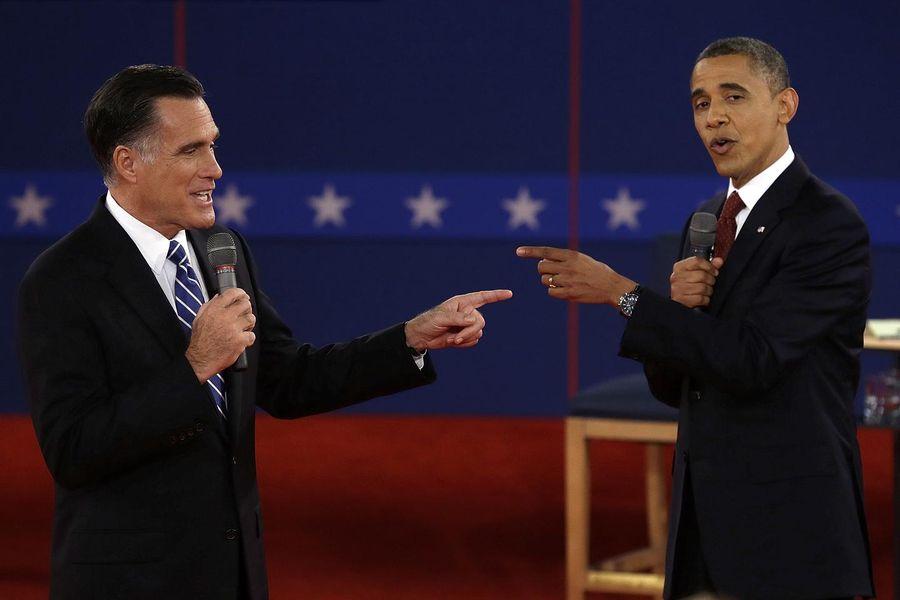
FOR USE AS DESIRED, YEAR END PHOTOS - FILE - In this Oct. 16, 2012 file photo, Republican presidential nominee Mitt Romney, left, and President Barack Obama spar during the second presidential debate at Hofstra University in Hempstead, N.Y. (AP Photo/Charlie Neibergall, File)
Do Presidential Debates Change the Polls?
Published Sept. 22, 2016 • Read time: 4m
On Monday night, Hillary Clinton and Donald Trump will take the stage at Hofstra University for one of the most highly anticipated events of this election -- the first presidential debate. Tens of millions of Americans will watch the spectacle and partisans on both sides expect their candidate to do well. But amid all the hype, it’s worth asking: Do presidential debates actually matter? More specifically, do they cause lasting shifts in public opinion?
The data show that while individual debates can shift the polls, the debate season (which includes all three presidential debates, the vice presidential debate and the media coverage surrounding them) typically doesn’t change the state of the race very much.
Most election watchers can remember at least one debate where a candidate’s performance temporarily shifted the polls. In the first debate of the 2012 general election, Mitt Romney performed well and briefly surged ahead of President Obama in national polls. In the first debate of the 1984 election, President Reagan made a meandering closing statement that played into concerns about his age and mental fitness – which caused him to lose about half of his lead over Walter Mondale, according to political scientists Christopher Wlezien and Robert Erikson. Many also make the case that then-Sen. John Kennedy helped himself by performing well in the first televised presidential debate with Vice President Richard Nixon in 1960. But, as Wlezien and Erikson point out, the paucity of polling data from that race makes this claim hard to verify.
Lies, Assault and Cover-ups Don't Stop Donald Trump
Trump Stands by His Man; Obama on a Health Scourge; Hayden Interview; Reagan's Courage
Analysis: For Trump, Few Limits to Win-At-Any-Cost Approach
What If Clinton Isn't Indicted?
It’s not difficult to imagine a scenario where either candidate uses the debate to take the focus off of his or her particular negative attributes and thus gains a boost in the polls. Gallup’s Frank Newport recently showed that for the past two months, most of the news Americans have heard about Clinton revolved around her emails or her health. Respondents also reported hearing the daily news about the Trump campaign – mostly where he traveled and his often controversial statements. So if either nominee uses the debate to effectively focus the race (and the media) away from these negative aspects (or onto the opponent’s negative attributes), that could cause a shift in the race.
That being said, the effects of a single debate are often temporary, and the polling after the debate season ends frequently looks similar to the polling before it began.
This is an updated and slightly modified version of a chart from Erikson and Wlezien’s book, “The Timeline of Presidential Elections.” Essentially it shows that polls (according to archives) from the week before the first debate closely track polling in the week following the final debate.
Note that the line is a break-even rather than a trend. If an election is close to the line (every election other than 1976), there was a relatively small difference between the pre- and post- debate season polls. In 1976 the movement in the polls may have been partially due to the debates, but is more likely part of a broader trend of Gerald Fold closing in on Jimmy Carter as Election Day approached.
This stability makes sense. An especially good or bad debate performance often ends up getting averaged out by better or more middling performances in other debates. For example, Romney did gain the lead following the first debate in 2012, but Obama performed significantly better in the following debates, regained the lead and eventually won the election. And in the second debate of the 1984 campaign, Reagan answered the question on his age with the now-famous quip: “I will not make age an issue of this campaign. I am not going to exploit my opponent’s youth and inexperience.” Reagan won in a blowout.
It’s important to note that past elections might not be a perfect guide this year. The number of undecided and third-party voters is larger than usual, and campaign events have forced the polls up and down at various points in the campaign. Additionally, if this race stays close, even a relatively small change due to the debates could put either candidate over the top (especially if either earns a boost in the final debate that doesn't wear off before Election Day). And Hillary Clinton seems to be at a low point in the polling right now, so the debates might aid her in bringing this race back into equilibrium (which seems to be a two- to four-point Clinton lead). But if this election follows the patterns of past elections, it won't significantly change the underlying dynamics of the campaign.

Newsom Defies Voters, Juries and Lawmakers To Spare Murderers While Defending Abortion
Curtis Hill • RealClearPolitics
The Algorithmic Tilt
Frank Filingeri • RealClearPolitics
A RealClear Thanksgiving: Investing in a Better Future
David DesRosiers • RealClearPolitics
Trump’s Newsom Problem: Antagonist-in-Chief
Carolina Lumetta • RealClearPolitics
America’s Free Spirit
John Maxwell Hamilton • RealClearPolitics
The GOP Majority Should Go Out in Glory
Daniel McCarthy • RealClearPolitics
RCP Today
Top stories on RealClearPolitics
The Takeaway
Polling intelligence and analysis delivered to your inbox
World News
Featuring the latest world news
Policy
Featuring the latest policy news
Support Our Mission
As part of RealClearPolitics, authors aim to provide balanced, non-partisan analysis by presenting top reporting and commentary from all sides of the political spectrum.
Trusted by policymakers and citizens alike since 2000