
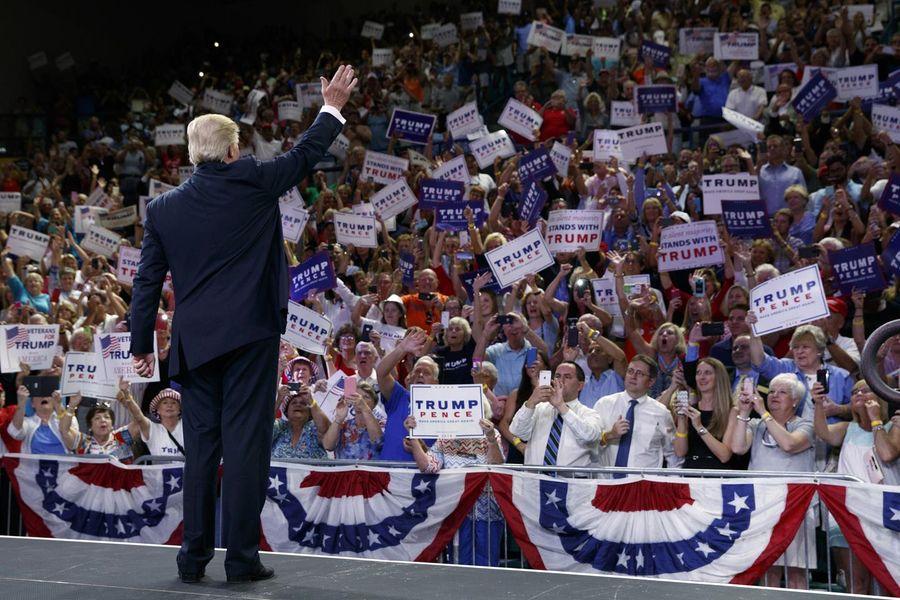
Republican presidential candidate Donald Trump waves to the crowd as he arrives at a campaign rally at the University of North Carolina Wilmington, Tuesday, Aug. 9, 2016, in Wilmington, N.C. (AP Photo/Evan Vucci)
Trump and the Art of the Squander
Published Aug. 10, 2016 • Read time: 8m
Join the Conversation
0Donald Trump's campaign reset was barely 24 hours old when he ventured off script and into the familiar territory of controversy, squandering his chances of changing the political conversation yet again.
The GOP presidential nominee passed up opportunities to capitalize on potentially damaging news for Hillary Clinton. Instead of focusing on the fact that the Orlando nightclub shooter's father attended her rally in Kissimmee, Fla., or that she campaigned for ousted Democratic National Committee Chairwoman Debbie Wasserman Schultz, Trump ignited a new firestorm with a comment that seemed to suggest violence or rebellion by gun rights activists against his political opponent.
"If she gets to pick her judges, nothing you can do, folks,” Trump said at a rally in Wilmington, N.C. “Though the Second Amendment people, maybe there is, I don’t know.”
The remarks fit neatly into Clinton campaign messaging that the GOP nominee lacks the temperament to serve, and Democrats pounced.
“What Trump is saying is dangerous. A person seeking to be the president of the United States should not suggest violence in any way,” Clinton Campaign Manager Robby Mook said in a statement.
Connecticut Sen. Chris Murphy, a strong supporter of gun control, said on Twitter:
— Chris Murphy (@ChrisMurphyCT) August 9, 2016Don't treat this as a political misstep. It's an assassination threat, seriously upping the possibility of a national tragedy & crisis.
The Trump campaign quickly clarified the comments. “It’s called the power of unification – 2nd Amendment people have amazing spirit and are tremendously unified, which gives them great political power,” said Senior Communications Adviser Jason Miller in a statement. “And this year, they will be voting in record numbers, and it won’t be for Hillary Clinton -- it will be for Donald Trump.”
The gaffe was the latest in a series by the nominee since the end of the party conventions: criticizing a Gold Star family, taunting the speaker of the House, and connecting his Democratic opponent to the execution of an Iranian scientist. The errors have helped erode Trump's poll numbers, which show him slipping behind Clinton nationally and in key battleground states.
Lies, Assault and Cover-ups Don't Stop Donald Trump
Trump Stands by His Man; Obama on a Health Scourge; Hayden Interview; Reagan's Courage
Analysis: For Trump, Few Limits to Win-At-Any-Cost Approach
What If Clinton Isn't Indicted?
His attempt to turn a new page with a speech Monday in Detroit about his economic vision was largely eclipsed by continued defections from Republicans, including 50 national security advisers arguing Trump would be the most “reckless president in American history.”
Republican strategists worry the GOP nominee has a lot of ground to make up before Election Day.
And while three months is thought to be an eternity in politics, Trump’s propensity for error and his campaign's sluggishness in mastering fundamental voter-turnout functions doesn’t calm many nerves.
“Primaries are the practice. Now he has to expand his base, turn these numbers around, and go after these coalitional groups that aren’t supporting him. And you can’t just go out and do big rallies or go on Fox and CNN and make that happen,” says Ed Rollins, a veteran GOP aide who is advising a pro-Trump super PAC. “That takes advertising and ground organization -- none of which he has at this point.”
Analysis by NBC News shows the Clinton campaign outspending Trump on ads $52 million to zero, even after a substantial fundraising haul by the GOP nominee last month. Trump won the most contested GOP primary in history without spending much money on campaigning or advertising, but that strategy so far isn’t paying off in the general election. During the Olympics, Clinton is running ads reaching millions of viewers, and they're unanswered by Trump. Even in a new media age, advertising in some way would help Trump alter his course, some analysts say.
“Most people only see him through the rallies, and I think it scares some voters,” says Republican strategist John Feehery. “He’s got to have a different earned-media strategy. He made some progress with the economic speech, but the big issue hanging over his head is his temperament.”
That issue prompted Republican Sen. Susan Collins of Maine to write an op-ed in the Washington Post on Tuesday opposing Trump, saying he “lacks the temperament, self-discipline and judgment required to be president.”
Trump didn’t address the defection by Collins, who isn’t up for re-election, as many of her colleagues are, but he did strike back against the foreign policy experts -- many of whom served in senior security and intelligence roles in past Republican administrations -- who said the GOP nominee “would put at risk our country’s national security and well-being.”
Trump brushed off the criticism. “I don’t want them,” he told supporters in Wilmington, arguing that experts and political professionals helped cause the country's economic and security troubles.
For his part, Trump denies any issue with temperament, and instead characterizes Clinton as unfit for the presidency. In an interview with Fox Business on Tuesday, he argued there was no need to change his tune.
“I’ve always had a good temperament and it’s gotten me here. We beat a lot of people in the primaries and now we have one person left, and we’re actually doing pretty well there, but we’ll see how it all comes out,” he said.
“I certainly don’t think it’s appropriate to start changing all of a sudden when you’ve been winning.”
With just over 90 days until Election Day, Republican officials have tried to save their party by focusing on Clinton and GOP congressional majorities.
A memo sent Tuesday by Republican National Committee Chief Strategist Sean Spicer focused on Clinton.
“A presidential election is not just a decision about who will lead our nation right now, but the country we will be in the future. On both counts, America cannot afford Hillary Clinton in the White House,” Spicer wrote, pointing to the economy, the Iran nuclear deal, increased terrorism at home and abroad, controversy surrounding the Clinton Foundation finances and the candidate’s private email server as examples.
In Speaker Paul Ryan's fundraising appeal to Republicans last week, Trump’s name was nowhere to be found. Instead, the pitch could have been read as a backstop for an impending Trump loss: “If we fail to protect our majority in Congress, we could be handing President Hillary Clinton a blank check.”
Republicans aren’t yet ready to draw analogies between now and 1996, when Bob Dole’s loss was considered a foregone conclusion.
“Republicans can’t just throw in the towel on Trump, because there’s not anything they can do to strengthen themselves legislatively,” says Feehery. “They have to assume the top of the ticket is important. They can’t just run away from Trump. They have to make this an election about Hillary.”
Among the areas of opportunity Republicans see is the economy, an issue on which Trump either leads or runs close to Clinton. On Monday, he made an overture to his party colleagues by pledging to adopt the House Republicans’ tax plan. While Trump spoke of his economic vision during a subsequent rally and railed against Clinton and the politics of the past, he couldn’t help but digress, underscoring the difficulty he has staying on message.
Meanwhile, new rounds of polls continue to signal trouble for the GOP campaign. Surveys last week found Trump’s lead slightly shrinking among non-college educated whites, a core constituency of the GOP nominee's. NBC/Wall Street Journal polls released Tuesday evening found Clinton leading by four points in Iowa, five in Ohio, and 11 in Pennsylvania, a battleground state Trump has hoped to flip in favor of Republicans given his working-class, populist appeal. GOP senators running for re-election in those states, however, ran ahead of their nominee.
A Quinnipiac University poll also released on Tuesday found Clinton leading by four points in Ohio and nine in Pennsylvania. Notably, though, Clinton and Trump are tied in the electorally rich state of Florida, where Democrats hope to take advantage of diverse demographics.
"It is not that her voters are in love with Secretary Clinton -- they just dislike her less than they disdain Trump,” said Peter A. Brown, assistant director of the poll. Roughly 40 percent of Clinton voters in those three battleground states based their support for the Democrat on their opposition to Trump. Among Trump supporters, over half said Clinton was the motivating factor.
Trump has a packed campaign schedule for the rest of the week, traveling to Virginia and Florida for events over the next two days, and Pennsylvania on Friday. Vice presidential nominee Mike Pence spent Tuesday in Pennsylvania and will hit Ohio and Wisconsin over the coming days. Clinton spent the early part of this week in Florida. She will host a rally in Iowa on Wednesday and will deliver a speech on the economy in Michigan on Thursday.

The Danger Before the Attack
Leslie J. Sullivan • RealClearPolitics
Jon Finer’s Old and Dangerous ‘New Approach’ to Israel
Peter Berkowitz • RealClearPolitics
The President Deserves Better
John Ullyot • RealClearPolitics
Congress Doesn’t Need Another Blame Game. It Needs To Find What’s Broken
Jarrod Bernstein • RealClearPolitics
Democrats Won the Midterms. Common Sense Won, Too
Jordanne Kemper • RealClearPolitics
The 120th Congress Shapes Up
Carolina Lumetta • RealClearPolitics
RCP Today
Top stories on RealClearPolitics
The Takeaway
Polling intelligence and analysis delivered to your inbox
World News
Featuring the latest world news
Policy
Featuring the latest policy news
Support Our Mission
As part of RealClearPolitics, authors aim to provide balanced, non-partisan analysis by presenting top reporting and commentary from all sides of the political spectrum.
Trusted by policymakers and citizens alike since 2000