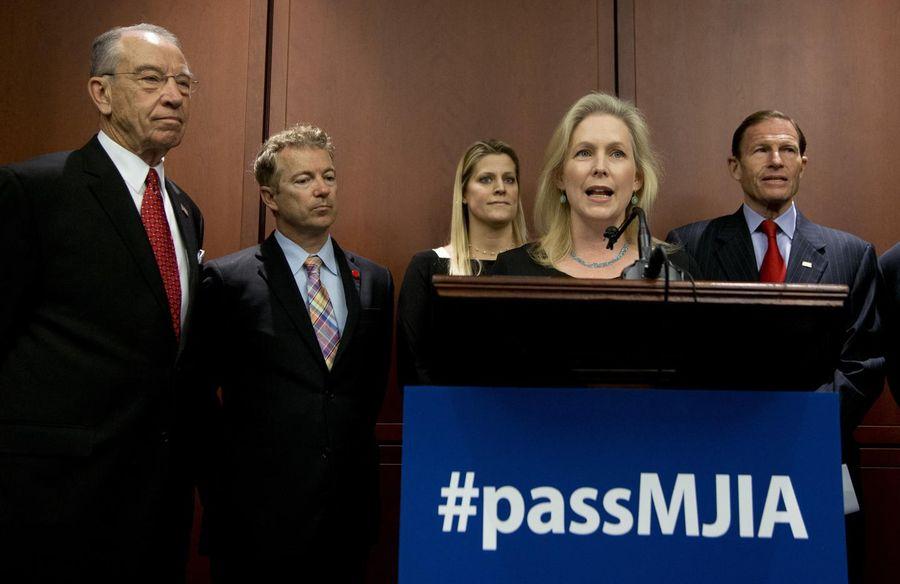
FILE - In this Tuesday, May 24, 2016 file photo, Sen. Kirsten Gillibrand, D-N.Y. front, with, from left, Sen. Charles Grassley, R-Iowa, Sen. Rand Paul, R-Ky., alleged rape victim Samantha Jackson, and Sen. Richard Blumenthal, D-Conn., speaks during a news conference on Capitol Hill in Washington, to urge the Senate to pass the bipartisan Military Justice Improvement Act, an amendment that will be offered to the National Defense Authorization Act that would establish an impartial, fair, and accountable military justice system to address the crisis of sexual assault. The Pentagon opposes the legislation, authored by Sen. Gillibrand, because it would strip military commanders of their power to decide whether sexual assault cases should go to trial. (AP Photo/Manuel Balce Ceneta, File)
Partisan Labels Exaggerate Our Differences
Published July 16, 2016 • Read time: 5m
A continuing survey of public opinion and voter intentions conducted by the Rand Corporation, involving several thousand respondents, made an interesting discovery. In a report released earlier this month titled “Politically Polarized, Ideologically Complicated,” the survey’s architects assert:
“Despite the increasingly polarized tone of American politics, we find that most Americans actually answer similarly on most questions of political belief.”
In responses to various policy questions ranging from single payer health care for every citizen to deploying U.S. combat troops to Iraq and Syria, the survey found that half of the responses were very closely aligned, and other responses were not that far apart, leading to the conclusion that “Americans are … more ideologically similar than different.”
In other words, the increasing polarization of American society and the political gridlock it produces is not so much a product of widening differences on issues among Americans. We suspect it’s more likely at least partly the result of the increasingly tribal quality of our politics, and the ease with which partisans can identify, associate with, acquire information from, and communicate almost strictly with fellow partisans.
This doesn’t really surprise us. After all, the most sharply debated issue difference in the 2012 presidential election was whether we should have a top marginal tax rate of 36 percent or 39.6 percent -- not exactly an ideological clash for the ages.
The most common refrain we hear listening to Americans frustrated with Washington is that so little progress is ever made in addressing national problems, even the most urgent ones. “Why can’t they get something done?” is a far more prevalent complaint than “Why won’t they do something more Democratic or Republican or conservative or liberal?”
Lies, Assault and Cover-ups Don't Stop Donald Trump
Trump Stands by His Man; Obama on a Health Scourge; Hayden Interview; Reagan's Courage
Analysis: For Trump, Few Limits to Win-At-Any-Cost Approach
What If Clinton Isn't Indicted?
Despite that frustration and ignoring the mostly modest differences Americans have on the issues, almost every notable event, crisis or important development that happens in the U.S or overseas is analyzed and debated in a partisan framework that exaggerates our differences.
Take the Orlando nightclub shooting: As the argument mounted about whether the massacre was an act of terrorism influenced by Islamic extremism or another tragedy caused by domestic gun violence, Americans grieving the murder of 49 innocent people were encouraged to hold the policy position of one political party or the other responsible for their loss. Not surprisingly, a Gallup poll found most Republicans agreeing it was terrorism and most Democrats agreeing it was domestic gun violence; independents were evenly split.
Of course, common sense tells you that it was both, an act of terrorism and an incident of domestic gun violence. But the sides had been drawn up again, another zero sum policy debate was launched, with the fight waged in partisan-leaning media. The policy proposals offered were mostly the take-it-or-leave-it variety. Attempts at bipartisan compromise were unsuccessful. Nothing gets done again, and Americans’ frustration with government’s inertia gets a little deeper.
If a lack of ideological purity were really the cause of our unproductive politics, as the most ardent partisans in both profess, why does the public’s alienation from Washington grow worse the more polarized Washington becomes?
At No Labels, we believe problem solving is the antidote, not partisan scorekeeping. We don’t believe policy differences among Americans on our major challenges are irreconcilable, as the loudest partisans insist. We believe most Americans can agree on major goals, and people in both parties can find common ground on innovative proposals to achieve those goals.
Our National Strategic Agenda sets four ambitious objectives that we believe most Americans would endorse and most politicians could work together to advance, and we offer scores of ideas to achieve them.
■ Creating 25 million new jobs over the next 10 years.
■ Securing Social Security for the next 75 years
■ Balancing the federal budget by 2030
■ Making America energy secure by 2024
We’re proud Democrats, Republicans and independents, working to encourage problem solving, not finger pointing. In the month after the election, we are bringing together members of Congress from both parties, and the incoming presidential transition team to collaborate on solutions to our biggest challenges, keeping a pledge to put problem solving before partisanship.
The cynical accuse us of naiveté, but we know there are still people in public life who believe Americans deserve politics as big-hearted and aspirational as they are. Our political debates have been too small-minded for too long, unable lately even to find unity in moments of terrible national tragedy. We’re better than that. Americans aren’t the ideological strangers the partisan purists pretend we are. We are striving, problem-solving, innovative people, with a preference for cooperation and pragmatism.
No Labels is working to see Washington again reflect the values of the American people, who have always had more in common than we have dividing us.
Al Cardenas is a partner at Squire Patton Boggs and former chairman of the Florida Republican Party. Mac McLarty is the president of McLarty Associates and former chief of staff to President Clinton. Both serve as vice-chairs for No Labels.

Newsom Defies Voters, Juries and Lawmakers To Spare Murderers While Defending Abortion
Curtis Hill • RealClearPolitics
The Algorithmic Tilt
Frank Filingeri • RealClearPolitics
A RealClear Thanksgiving: Investing in a Better Future
David DesRosiers • RealClearPolitics
Trump’s Newsom Problem: Antagonist-in-Chief
Carolina Lumetta • RealClearPolitics
America’s Free Spirit
John Maxwell Hamilton • RealClearPolitics
The GOP Majority Should Go Out in Glory
Daniel McCarthy • RealClearPolitics
RCP Today
Top stories on RealClearPolitics
The Takeaway
Polling intelligence and analysis delivered to your inbox
World News
Featuring the latest world news
Policy
Featuring the latest policy news
Support Our Mission
As part of RealClearPolitics, authors aim to provide balanced, non-partisan analysis by presenting top reporting and commentary from all sides of the political spectrum.
Trusted by policymakers and citizens alike since 2000