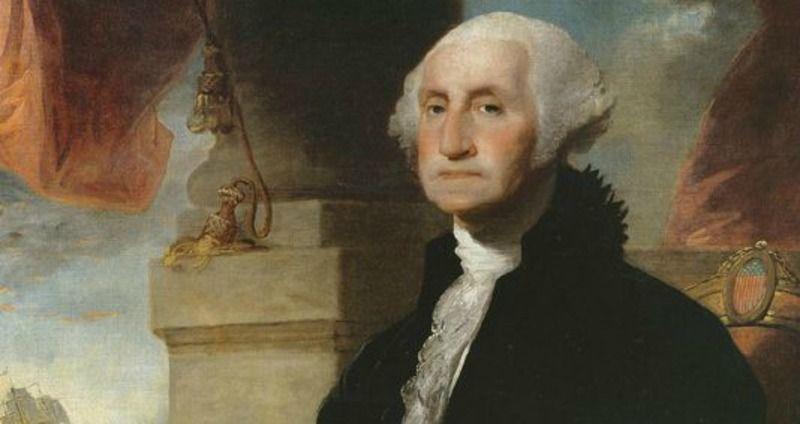
Independence & the Enduring Legacy of George Washington
Published July 3, 2016 • Read time: 4m
JUMONVILLE, Pa. - Rain began pouring that day in the way it does in the hollows here that makes man and beast wonder whether everything atop the mountains will soon find its way into the valley below.
It was July 3, 1754, and George Washington was about to engage in a battle that would change the course of the world. His actions would spark a seven-year war, an event that led to the American Revolution and the country we know today.
He began several months earlier as a volunteer emissary of the British Crown, delivering a letter from Virginia's colonial governor to French occupiers in the Ohio Country. Now he found himself in a vulnerable, hastily built fort, his men drenched by the pounding rain.
Eight hours later, after pummeling Washington's force from every direction, the French called for a meeting — a move Washington found suspicious because he and his men were not exactly winning.
The young Virginian took stock: Nearly half his men were wounded, some drunk; the gun powder was soaked, making it useless; most of their livestock was dead.
He sent his only French-speaking officers to see what the enemy wanted; they returned with a general understanding (his interpreters weren't very good) that he and his men could leave the fort unharmed as long as they returned any prisoners.
All he had to do was sign on the dotted line.
He did, and by the next morning — a Fourth of July much different than one to occur 22 years later — Washington discovered that what he actually signed was a surrender to the French.
Rethinking the Pledge; Trump and Women; One Last Egg Roll; Eulogizing Ike
2016: A Repeat of the 1960s
An Apology, Fashioned for Nancy Reagan
Nancy Reagan, Guardian of a Legacy
He was devastated.
After a respectable couple of months, he retired his military commission and went home. He returned a few months later to lose (not surrender) another battle in Western Pennsylvania along the Monongahela, led by British general Edward Braddock.
Many more battles, losses and attempts to retire would follow for this gentleman-farmer. Eventually, history led him to the incredible burden of commanding American forces during the Revolution.
On the eve of a far more significant July 4 in 1776, Washington sat in his New York headquarters, preparing to defend Manhattan from the British. He contemplated what lay ahead as word circulated that the Continental Congress had formally adopted a Declaration of Independence, a momentous step toward establishing a new nation.
Washington took to his diary to consider the moment.
“The time is now near at hand,” he wrote, “which must probably determine, whether Americans are to be Freemen or Slaves; whether they are to have any property they can call their own; whether their Houses, and Farms, are to be pillaged and destroyed, and they consigned to a State of Wretchedness from which no human efforts will probably deliver them.
“Our own Country's Honor, all call upon us for a vigorous and manly exertion, and if we now shamefully fail, we shall become infamous to the whole world.
“Let us therefore animate and encourage each other, and show the whole world, that a Freeman contending for Liberty on his own ground is superior to any slavish mercenary on earth.”
All Fourths of July are not created equal. Had Washington retired to a gentleman's life in 1754, we likely would be looking at a different world.
The lovely meadow where he fought his first battle is perfectly preserved, down to the poorly conceived moat encircling the fort. Here, at Fort Necessity in the Pennsylvania backwoods, the first worldwide war began.
It was here that a young man had his first taste of treachery, deceit, inexperienced troops and defeat. He never needed to experience it all again; he was a man of privilege and, by 28, was one of the wealthiest men in the country by marriage.
What drives a man to service, leadership, sacrifice, greatness? Whatever it is, Washington possessed it, and every American has benefited.
He wasn't perfect; no man is. Yet his bravery and sacrifices for liberty and nationhood have made his leadership iconic for 240 years.
Still, he was always aware that he could do better.
“I hope I shall possess firmness and virtue enough,” he once said, “to maintain what I consider the most enviable of all titles, the character of an honest man.”

Newsom Defies Voters, Juries and Lawmakers To Spare Murderers While Defending Abortion
Curtis Hill • RealClearPolitics
The Algorithmic Tilt
Frank Filingeri • RealClearPolitics
A RealClear Thanksgiving: Investing in a Better Future
David DesRosiers • RealClearPolitics
Trump’s Newsom Problem: Antagonist-in-Chief
Carolina Lumetta • RealClearPolitics
America’s Free Spirit
John Maxwell Hamilton • RealClearPolitics
The GOP Majority Should Go Out in Glory
Daniel McCarthy • RealClearPolitics
RCP Today
Top stories on RealClearPolitics
The Takeaway
Polling intelligence and analysis delivered to your inbox
World News
Featuring the latest world news
Policy
Featuring the latest policy news
Support Our Mission
As part of RealClearPolitics, authors aim to provide balanced, non-partisan analysis by presenting top reporting and commentary from all sides of the political spectrum.
Trusted by policymakers and citizens alike since 2000