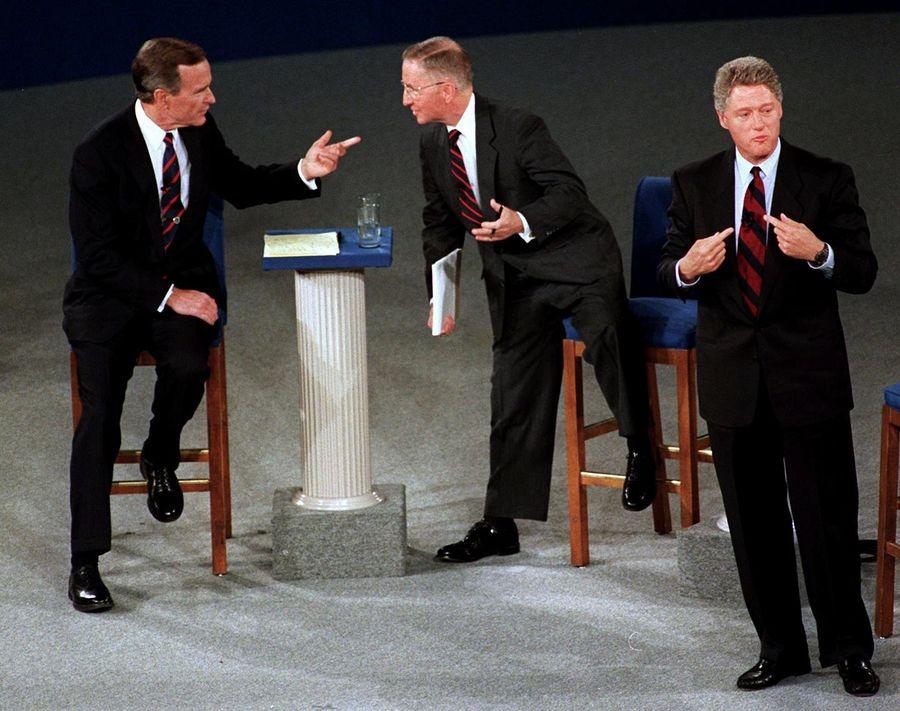
FILE - In this Oct. 15, 1992 file photo, President Bush, left, talks with independent candidate Ross Perot as Democratic candidate Bill Clinton stands aside at the end of their second presidential debate in Richmond, Va. Finally, the fall season delivers the matchup Americans have been waiting for, President Barack Obama goes one-on-one with Republican Mitt Romney in three prime-time debates. With the race a dead heat, the debates take on an oversized role in the few weeks between now and Election Day. One small mistake or impression _ a glance at a watch, repetitive sighing _ could roil the campaign for days and linger in votersâ mind. This is especially true for two polished candidates who will have the soundbites and rhetoric down cool. (AP Photo/Marcy Nighswander, File)
As in '92, This Election Hinges on Pocketbook Issues
Published June 30, 2016 • Read time: 5m
Previously in this series: Part 1, Stagnating wages; Part 2, NAFTA; Part 3, High cost of college.; Part 4, Rising health-care premiums.
The middle class that helped elevate Bill Clinton to the presidency has changed significantly since then – large parts of it have disappeared and been replaced with voting groups that have shifted demographically even more in favor of the Democrats.
But as his wife seeks to return the Clintons to the White House, it’s worth remembering how the 42nd president’s campaign managed to hold its own with middle-class voters in two successive elections: by focusing like a laser—Bill Clinton’s expression—on Americans’ financial fears, a priority epitomized by the 1992 campaign’s famous refrain, “It’s the economy, stupid.”
Today, Americans’ economic distress and frustration are every bit as intense as they were 24 years ago. It is these feelings that have fueled the rise of Donald Trump. And one big question of the 2016 election is whether any establishment political figure can calm the fears of the middle class.
When it comes to the direction of the country, more people think the U.S. is on the wrong track rather than headed the right way, according to the RealClearPolitics polling average. And according to a February survey by the Pew Research Center, 62 percent don’t believe the government is doing enough to help the struggling middle class.
For the past month, RealClearPolitics has been examining the issues causing pain to this key segment of the American electorate. Frustration regarding stagnant wages and trade issues such as NAFTA have fueled the insurgent candidacies of Trump and Bernie Sanders.
Lies, Assault and Cover-ups Don't Stop Donald Trump
Trump Stands by His Man; Obama on a Health Scourge; Hayden Interview; Reagan's Courage
Analysis: For Trump, Few Limits to Win-At-Any-Cost Approach
What If Clinton Isn't Indicted?
In education, the cost of college has increased nearly three-fold over the past four decades and student debt has topped $1.2 trillion. And come December, because of requirements of the Affordable Care Act, health insurance premiums are likely to rise.
“I visited 46 states throughout this campaign,” Sanders said in a recent appearance on CNN. “I talked to the workers who saw their jobs go abroad. I talked to workers who are working longer hours for low wages, people who are worried to death about the future of this country and what happens to their kids.
“So, the question is, with all of the increase in technology and productivity, and all of this great global economy, why is it that the middle class continues to shrink, the gap between the very, very rich and everybody else goes wider and wider, and we got 47 million people in this country living in poverty?”
Hillary Clinton has mentioned the income gap often on the campaign trail, vowing regularly in her stump speeches, “I will not raise taxes on the middle class.”
“Economists have documented how the share of income and wealth going to those at the very top, not just the top 1 percent but the top 0.1 percent, the 0.01 percent of the population, has risen sharply over the last generation,” she said last month in a policy speech. “Some are calling it a throwback to the Gilded Age of the robber barons.”
The middle class of the 2016 election cycle looks favorable to the former secretary of state.
In 1991, 80 percent of adults in middle-class households were white, but by 2011 that number had decreased to 70 percent. In that same 20-year span, Hispanics grew from 8 percent of the middle class to 13 percent and blacks went from 9 to 11 percent. Additionally, 53 percent of women identify as middle class.
Public polls and past election results suggest that it’s Clinton who has the advantage with those groups.
Additionally, a Marketplace-Edison Research poll out this week shows that each group thinks a Democratic president would be better for their pocketbook than a Republican.
Specifically, African-Americans say that their “personal financial situation will be better” under a Democratic president than a GOP one, 55 percent to 11 percent. Hispanics also favor Democrats on this question, 42 percent to 16 percent. And while 43 percent of women say the president’s party makes no difference to their personal finances, 30 percent say a Democrat would be better for them while only 24 percent say a Republican would.
But Trump, too, is working on his appeal to these voters.
“We need to reform our economic system so that, once again, we can all succeed together, and America can become rich again,” he said in a speech in New York last week. “That’s what we mean by America first.”
During the primary, Trump did especially well in areas with higher levels of unemployment, lower levels of education and lower incomes. But whether he can expand that appeal to large portions of the middle class remains to be seen.
The business mogul’s campaign used the recent Brexit vote in Great Britain, where voters elected to leave the European Union, to argue that voters are tired of the establishment and want the kind of change he would bring. In that vote, results indicate it was frustrated, middle-class and lower-class workers who ruled the day.
"It was about a feeling that they are disaffected about the way things are going in this country, whether that's the EU, Westminster or just life in general," Joe Twyman, head of political and social research for Europe at YouGov, told NBC News. "The world has moved on in a way they are not comfortable with and in a way they did not consent to."
Trump campaign chairman Paul Manafort argued on NBC’s “Meet the Press” Sunday that the result spooked the Clinton team. “She is absolutely afraid of the consequences of what Brexit represented and what the Trump phenomenon in the primaries represented, which is historic numbers of people voting for change against the establishment,” Manafort said.
Clinton campaign manager Robby Mook countered that Clinton talked about how the vote would affect the middle class while Trump “talked about his golf course.”
But golf is not just a game for the rich. The sport’s financial success, like a national political candidate’s chances, depends on the middle class.

Newsom Defies Voters, Juries and Lawmakers To Spare Murderers While Defending Abortion
Curtis Hill • RealClearPolitics
The Algorithmic Tilt
Frank Filingeri • RealClearPolitics
A RealClear Thanksgiving: Investing in a Better Future
David DesRosiers • RealClearPolitics
Trump’s Newsom Problem: Antagonist-in-Chief
Carolina Lumetta • RealClearPolitics
America’s Free Spirit
John Maxwell Hamilton • RealClearPolitics
The GOP Majority Should Go Out in Glory
Daniel McCarthy • RealClearPolitics
RCP Today
Top stories on RealClearPolitics
The Takeaway
Polling intelligence and analysis delivered to your inbox
World News
Featuring the latest world news
Policy
Featuring the latest policy news
Support Our Mission
As part of RealClearPolitics, authors aim to provide balanced, non-partisan analysis by presenting top reporting and commentary from all sides of the political spectrum.
Trusted by policymakers and citizens alike since 2000