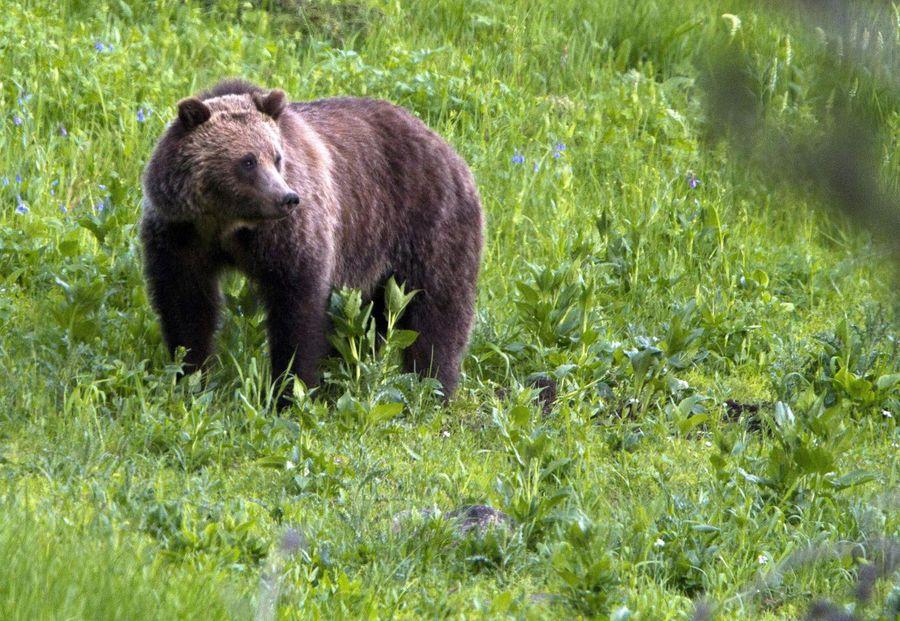
FILE - This July 6, 2011 file photo shows a grizzly bear roaming near Beaver Lake in Yellowstone National Park, Wyo. The state of Wyoming is moving to take over management of grizzly bears from the federal government even as environmental groups increasingly scrutinize whether the bear population in the Yellowstone region of Wyoming, Montana and Idaho could survive under state management that could allow hunting. (AP Photo/Jim Urquhart, File)
Yellowstone Grizzlies Still Need Protecting
Published May 19, 2016 • Read time: 4m
Each year, I head out for a week to enjoy the sights and sounds of Yellowstone National Park. As anyone who has been there knows, Yellowstone has it all: gorgeous and mysterious geysers, Mammoth Hot Springs and an amazing array of wildlife. These include hundreds of species of birds, plants, and mammals—including elk, wolves and grizzly bears.
The historic comeback of the Yellowstone grizzly from the brink of extinction is a remarkable achievement. With the protections afforded by the Endangered Species Act, the population rose from fewer than 200 bears 40 years ago to more than 700 today.
Now, the U.S. Fish and Wildlife Service—the federal agency I used to oversee—is proposing to remove federal protections for these grizzlies. Unfortunately, the necessary state and federal plans governing how this population will be managed after delisting are not complete and some of the provisions in the proposal are inadequate to protect these bears. That’s why I believe the service, the federal agency tasked with managing America’s imperiled wildlife, should withdraw its current proposal and spend the time it needs to get this right.
Let me be clear: This is not about fighting the delisting; it’s about reminding the service that decisions of this magnitude should be thoughtful, well-managed and well-executed. Right now, the delisting proposal looks more like a high-speed train running off the tracks.
The service is proposing to turn grizzly management over to the states and other federal land management agencies before it knows how they plan to manage the bears. While we hope to see these agencies develop and implement management plans that are protective of grizzlies, it’s ludicrous and irresponsible to propose to delist them based on incomplete plans. In short, the service has put the cart before the horse by operating on assumptions of how bears will be managed post-delisting. That’s a big gamble to make on one of the most beloved animals in the American West.
Being Eric Holder
Jack Lew & The Art of the Score
John McCain, Patrick Leahy & Ray LaHood on "State of the Union"
Team of Loyalists
Furthermore, the service’s current proposal doesn’t provide grizzlies with enough protections. Grizzly bears are one of the slowest reproducing land mammals in North America. The Yellowstone population is isolated from other grizzly populations with which they will need to reconnect to ensure long-term genetic diversity and full recovery. The challenges facing grizzly recovery are exacerbated by increased development in the Northern Rockies and an already high rate of human-caused bear deaths in Yellowstone. In its delisting proposal, the service should strengthen habitat protections and reduce the number of bears that can be killed each year.
Finally, if and when states and federal land management agencies do gain responsibility for this population and their habitat, they should manage grizzlies cautiously and conservatively so they continue to thrive. Agencies in charge of our public lands should protect habitat corridors connecting Yellowstone bears with the Northern Continental Divide population in western Montana and Canada as well as with Idaho’s Bitterroot ecosystem. And states must realize that authorizing a hunting season for grizzlies immediately upon delisting is completely inappropriate. These animals have been protected under the ESA for decades and we can’t flip a switch and go from zero to 60—from federally protected one day to sport hunting the next—without undermining the bear’s recovery.
By maintaining strong core protections, securing habitat between other populations, and minimizing grizzly bear deaths, we can work towards true recovery of Yellowstone grizzlies and eventually look towards a day when they can safely and successfully be removed from the Endangered Species Act and passed over to states and federal agencies to manage.
That time is not now. As the primary steward of our nation’s treasured wildlife, the service has a responsibility to secure a larger, interconnected grizzly bear population in the Northern Rockies. The best way to do that is to withdraw the current proposal, giving the service, the states and federal land management agencies more time to get it right.
There’s no reason to rush this process and we can’t afford to be careless with this species. Generations to come should continue to have the opportunity we have today to enjoy the thrill of seeing a grizzly bear in the wilds of Yellowstone.

Newsom Defies Voters, Juries and Lawmakers To Spare Murderers While Defending Abortion
Curtis Hill • RealClearPolitics
The Algorithmic Tilt
Frank Filingeri • RealClearPolitics
A RealClear Thanksgiving: Investing in a Better Future
David DesRosiers • RealClearPolitics
Trump’s Newsom Problem: Antagonist-in-Chief
Carolina Lumetta • RealClearPolitics
America’s Free Spirit
John Maxwell Hamilton • RealClearPolitics
The GOP Majority Should Go Out in Glory
Daniel McCarthy • RealClearPolitics
RCP Today
Top stories on RealClearPolitics
The Takeaway
Polling intelligence and analysis delivered to your inbox
World News
Featuring the latest world news
Policy
Featuring the latest policy news
Support Our Mission
As part of RealClearPolitics, authors aim to provide balanced, non-partisan analysis by presenting top reporting and commentary from all sides of the political spectrum.
Trusted by policymakers and citizens alike since 2000