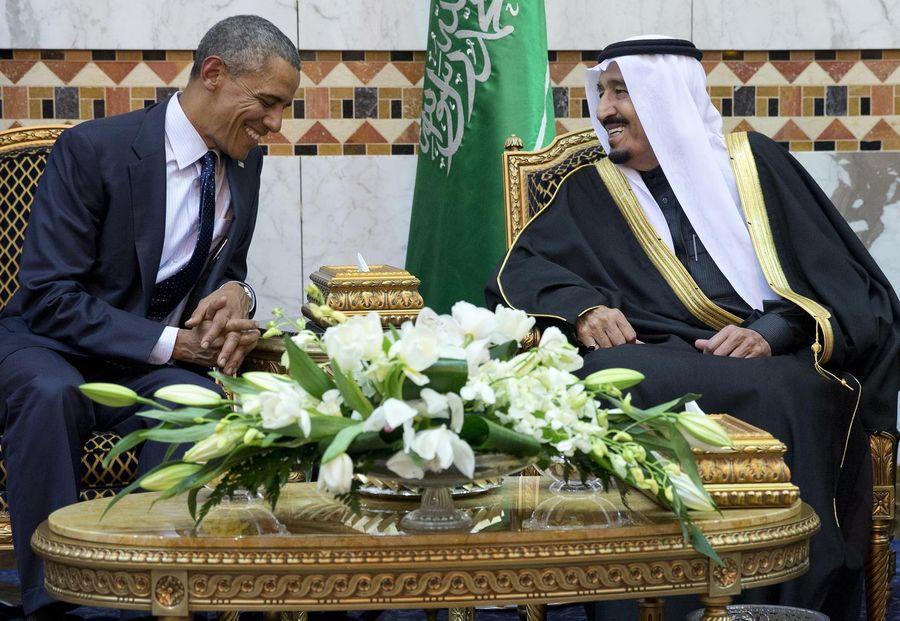
FILE - In this Jan. 27, 2015 file photo, President Barack Obama meets Saudi Arabia King Salman bin Abdul Aziz in Riyadh, Saudi Arabia. When Obama arrives in the Saudi capital on Wednesday, April, 20, 2016, heâll face an increasingly assertive Saudi leadership still heavily dependent on U.S. weapons and military might that nonetheless has little trust in him and essentially believes theyâve been thrown a curveball. The president is also expected to push Saudi Arabia and other Gulf allies for greater cooperation and military backing in the fight against the Islamic State group in Iraq and Syria. (AP Photo/Carolyn Kaster, File)
Don't Give Up on the Saudis
Published April 20, 2016 • Read time: 4m
WASHINGTON -- As President Obama travels this week to Saudi Arabia, here's a surprising snapshot of what young Arabs think: They're scared about the Islamic State and terrorism; they yearn for more freedom and gender equality; they fear that the Arab Spring has made life worse; and they're increasingly skeptical about the role of traditional religious values.
If these Arab reactions seem similar to what people would say in the West, maybe that's the real takeaway. Despite all the violence and extremism that plague the region, most young Arabs have sensible modern reactions. This isn't a world apart: Arab youths hate the turmoil that's wrecking their countries and want a better, more stable life.
This portrait of the Arab world emerges in a remarkable survey by the public-relations company ASDA'A Burson-Marsteller and the polling firm Penn Schoen Berland. It's actually a time-lapse photo, because this "Arab Youth Survey" has been conducted annually for the past eight years. By reading the back issues, you can see hopes rising with the Arab Spring in 2011, and then crashing against the reality of violence and disarray.
Let's start with this year's headlines: In face-to-face interviews with 3,500 youths in 16 countries, 77 percent of participants said they were concerned about the rise of the Islamic State and 76 percent said the group would fail in its ultimate goal of establishing a caliphate. Asked to explain why young people were attracted to the group, 24 percent cited lack of jobs, but a larger 25 percent chose the answer: "I can't explain it -- I don't understand why anybody would want to join."
Nuclear Jihad: The Threats Are Inside Our Tent
Israel's "Sorrow of the Left"
Signs of Progress Against Extremists in Syria
The World Is Getting Worse, But This Time America Won't Save It
One intriguing finding of this study is that Arab youths are increasingly dubious about the role of religion and traditional values. Asked if they agreed with the statement "Religion plays too big of a role in the Middle East," 52 percent said yes this year, with 61 percent of those in Arab Gulf countries, including Saudi Arabia, sharing that view.
Women's rights also get strong support: 67 percent of young Arabs said their leaders should improve the personal freedom and human rights of women. This progressive view had roughly equal support from young Arab men (66 percent) as women (68 percent). By the way, an even number of men and women were surveyed.
What kind of country do these young Arabs want to live in? The overwhelming answer in 2016, for the fifth year running, was the United Arab Emirates -- a Muslim country that is increasingly open, tolerant, prosperous and adapting to the modern world.
The previous installments show how far the region has traveled over the past decade. In the 2009 and 2010 surveys, there was a yearning for democracy, with at least 90 percent of the respondents in most countries saying that "living in a democratic country" was important to them. But they still embraced a traditional world: 68 percent said their religion defined them as a person, and men were far less likely than women to support equal opportunity in the workplace. This Arab conservatism had eroded by 2014, when the percentage who agreed that "traditional values mean a lot to me" had fallen to just 54 percent from 83 percent in 2011.
The hurricane of the Tahrir Square uprising that toppled Egyptian President Hosni Mubarak in February 2011 was vividly captured by the survey. In January that year, 82 percent of Arab youth supported "traditional values." A month later, that number had fallen 11 points. Those describing their political views as liberal jumped from 20 percent in January to 51 percent the next month. Young people overwhelmingly supported the overthrow of Mubarak in Egypt and the autocratic rulers of Libya and Yemen.
The optimism and idealism of the Arab Spring were real. But so was the disillusionment that followed. The share who agreed that "Following the Arab spring, I feel the Arab world is better off" collapsed from 72 percent in 2012 to just 36 percent in 2016. Egyptians bucked that pessimistic trend, with 61 percent still positive this year about their revolution.
Here's what I draw from this survey: Young Arabs are sadder but wiser; they want a freer, more modern life; and they're skeptical about easy answers from religion or democratic elections. They know they're in a long transition, and they've become more pessimistic, but they still affirm in each survey, "Our best days are ahead of us."
A simple summary: Don't give up on the Arabs. They're living through hell, but they want the same modern, secure world that most people do.
(c) 2016, Washington Post Writers Group

A RealClear Thanksgiving: Investing in a Better Future
David DesRosiers • RealClearPolitics
Trump’s Newsom Problem: Antagonist-in-Chief
Carolina Lumetta • RealClearPolitics
America’s Free Spirit
John Maxwell Hamilton • RealClearPolitics
The GOP Majority Should Go Out in Glory
Daniel McCarthy • RealClearPolitics
Republican Majorities Could Return Sooner Than Expected
J.T. Young • RealClearPolitics
The Danger Before the Attack
Leslie J. Sullivan • RealClearPolitics
RCP Today
Top stories on RealClearPolitics
The Takeaway
Polling intelligence and analysis delivered to your inbox
World News
Featuring the latest world news
Policy
Featuring the latest policy news
Support Our Mission
As part of RealClearPolitics, authors aim to provide balanced, non-partisan analysis by presenting top reporting and commentary from all sides of the political spectrum.
Trusted by policymakers and citizens alike since 2000