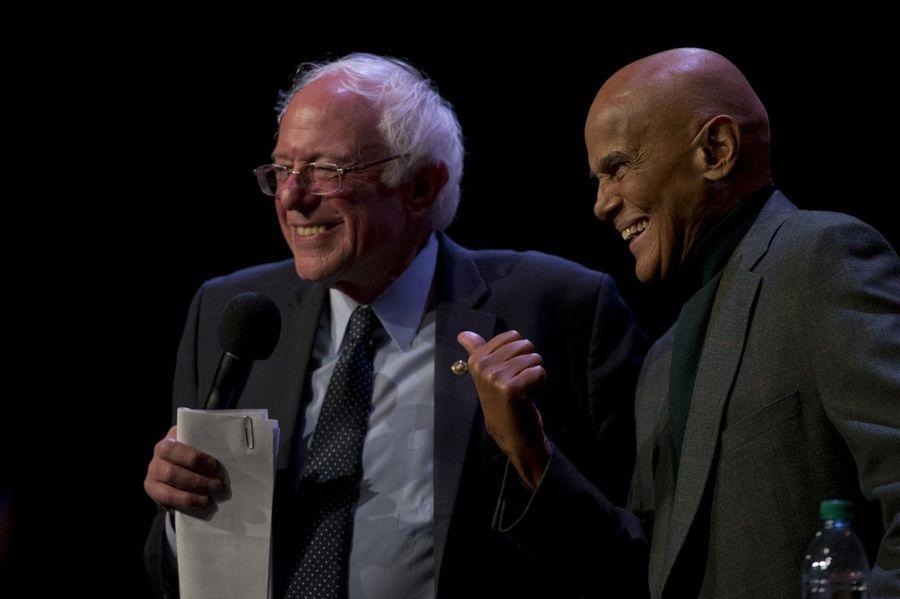
Democratic presidential candidate, Sen. Bernie Sanders, I-Vt., is joined on stage by Harry Belafonte as he speaks at a campaign event at the Apollo Theatre, Saturday, April 9, 2016, in the Harlem neighborhood of Manhattan. (AP Photo/Mary Altaffer)
Bernie and the Big Banks
Published April 11, 2016 • Read time: 4m
The recent kerfluffle about Bernie Sanders purportedly not knowing how to bust up the big banks says far more about the threat Sanders poses to the Democratic establishment and its Wall Street wing than it does about the candidate himself.
Of course Sanders knows how to bust up the big banks. He’s already introduced legislation to do just that. And even without new legislation a president has the power under the Dodd-Frank reform act to initiate such a breakup.
But Sanders threatens the Democratic establishment and Wall Street, not least because he’s intent on doing exactly what he says he’ll do: breaking up the biggest banks.
The biggest are far larger today than they were in 2008 when they were deemed “too big to fail.” Then, the five largest held around 30 percent of all U.S. banking assets. Today they have 44 percent.
According to a recent analysis by Thomas Hoenig, vice chairman of the Federal Deposit Insurance Corporation, the assets of just four giant banks – JPMorgan Chase, Citibank, Bank of America, and Wells Fargo – amount to 97 percent of our the nation’s entire gross domestic product in 2012.
Which means they’re now way too big to fail. The danger to the economy isn’t just their indebtedness. It’s their dominance over the entire financial and economic system.
Bernie Sanders isn’t the only one urging the big banks be broken up. Neel Kashkari, the new president of the Federal Reserve bank of Minneapolis – a Republican who used to be at Goldman Sachs – is also pushing to break them up, as has the former head of the Dallas Federal Reserve, among others.
Where's the $3 trillion?
The Growth Imperative
The Economy's Achilles' Heel
Commonsense Economics: Capital = Consumer Spending
Recall that just eight years ago the biggest banks were up to their ears in fraudulent practices – lending money to mortgage originators to make risky home loans laced with false claims, buying back those loans and repackaging them for investors without revealing their risks, and then participating in a wave of fraudulent foreclosures.
Dodd-Frank addressed these sorts of abuses in broad strokes but left the most important decisions to regulatory agencies.
Since then, platoons of Wall Street lobbyists, lawyers and litigators have been watering down and delaying those regulations.
For example, Dodd-Frank instructed the Commodity Futures Trading Commission to reduce certain risks, but the Street has sabotaged the process.
In its first major rule under Dodd-Frank, the CFTC considered 1,500 comments, largely generated by and from the Street. After several years the commission issued a proposed rule, including some of the loopholes and exceptions the Street sought.
Wall Street still wasn’t satisfied. So the CFTC agreed to delay enforcement of the rule, allowing the Street more time to voice its objections. Even this wasn’t enough for the big banks, whose lawyers then filed a lawsuit in the federal courts, arguing that the commission’s cost-benefit analysis wasn’t adequate.
As of now, only 155 of the 398 regulations required by Dodd-Frank have been finalized. And those final versions are shot through with loopholes big enough for Wall Street’s top brass to drive their Ferrari’s through.
The biggest banks still haven’t even come up with acceptable “living wills,” required under Dodd-Frank to show how they’d maintain important functions while going through bankruptcy.
Meanwhile they continue to gamble with depositor’s money. Many of their operations are global, making it even harder for U.S. regulators to rein them in – as evidenced by JPMorgan Chase’s $6.2 billion loss in its “London Whale” operation in 2012. Citigroup alone has over 2,000 foreign subsidies.
The bottom line: Regulation won’t end the Street’s abuses. The Street has too much firepower. And because it continues to be a major source of campaign funding, no set of regulations will be tough enough.
So the biggest banks must be busted up.
When I debated former Rep. Barney Frank about this on television recently, he kept asking, rhetorically, what limit I’d put on their size.
A good rule of thumb might be to cap the assets of any bank at about 2 percent of the nation’s Gross Domestic Product – or roughly $330 billion. (To put this in perspective, by the end of 2015, Goldman Sachs’s assets exceeded $860 billion.)
That cap wouldn’t harm America’s financial competitiveness and it wouldn’t cause bank employees to lose their jobs (at worst, they’ll just become employees of a smaller bank).
But it would ensure the safety of the American economy. Extra bonus: It would also reduce the power of Wall Street over our democracy.

Newsom Defies Voters, Juries and Lawmakers To Spare Murderers While Defending Abortion
Curtis Hill • RealClearPolitics
The Algorithmic Tilt
Frank Filingeri • RealClearPolitics
A RealClear Thanksgiving: Investing in a Better Future
David DesRosiers • RealClearPolitics
Trump’s Newsom Problem: Antagonist-in-Chief
Carolina Lumetta • RealClearPolitics
America’s Free Spirit
John Maxwell Hamilton • RealClearPolitics
The GOP Majority Should Go Out in Glory
Daniel McCarthy • RealClearPolitics
RCP Today
Top stories on RealClearPolitics
The Takeaway
Polling intelligence and analysis delivered to your inbox
World News
Featuring the latest world news
Policy
Featuring the latest policy news
Support Our Mission
As part of RealClearPolitics, authors aim to provide balanced, non-partisan analysis by presenting top reporting and commentary from all sides of the political spectrum.
Trusted by policymakers and citizens alike since 2000