
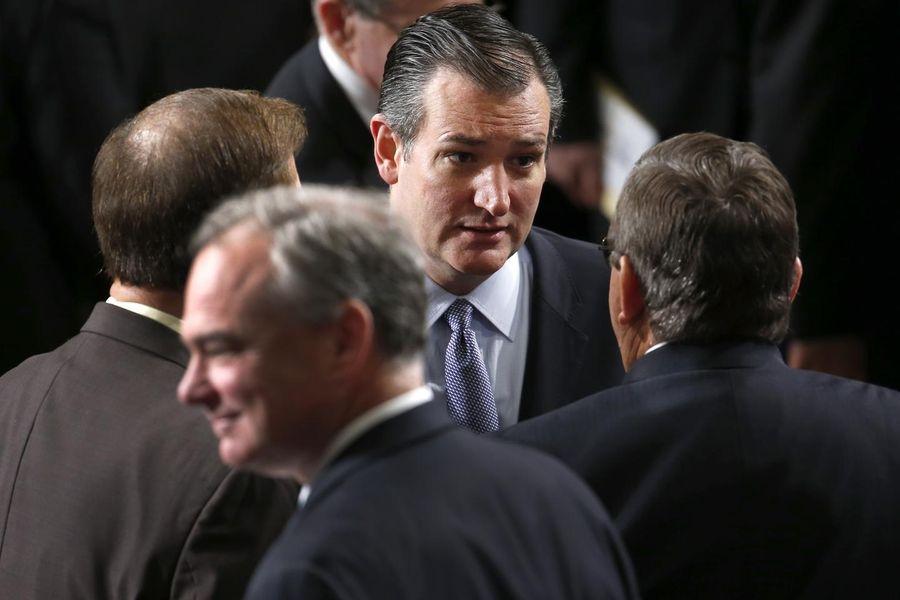
Republican Presidential candidate Sen. Ted Cruz, R-Tex. talks with fellow members on Capitol Hill in Washington, Thursday, Sept. 24, 2015, before Pope Francis address to a joint meeting of Congress. (AP Photo/Evan Vucci)
GOP Senators Still Not Flocking to Cruz
Published April 8, 2016 • Read time: 6m
Join the Conversation
0In the topsy-turvy race for president, Ted Cruz has emerged as the clear GOP alternative to Donald Trump, but even if he’s won his Senate colleagues’ grudging respect, he isn’t exactly winning them over by the dozens.
“We’re winning because we are uniting the Republican Party,” Cruz insisted after his Wisconsin primary victory Tuesday.
That might be increasingly true among GOP voters, especially with Sen. Marco Rubio no longer in the race, but the dynamic hasn’t translated into widespread support among elected officials, even those who desperately hope to see Trump defeated.
The worst-kept secret in Washington, D.C., of course, is that Cruz is genuinely despised by many Republicans and his Senate colleagues in particular. The qualms have more to do with personality than policy disagreements, but the effect has been potent. To date, only two senators have endorsed Cruz: his close friend Mike Lee, and Lindsey Graham, who by his own admission offered Cruz his support as a last resort.
“It’s going to be up to him [Cruz] to repair some relationships,” Graham told RealClearPolitics in an interview. But, he added, “If Ted and I are working together, anything is possible.”
Even after the Texas senator won decisively in Wisconsin and has shown he has a powerful campaign organization and a sizable cache of delegates behind him, few former or current officials appear eager to follow Graham’s lead — even those who see Cruz as the party’s only hope to force an open convention and take down Trump.
Cruz's Path to Nomination
Trump Stands by His Manager
With Tweets on Heidi Cruz, Trump Sinks to New Depths
A Vote for Kasich Is a Vote for Trump
This cognitive dissonance has caused some awkwardness. In an interview on CNN on Wednesday, Idaho Sen. Jim Risch said he now prefers Cruz to win the party’s nomination, the result of a “process of elimination.”
“At this point, there’s no choice,” reasoned Risch, who previously supported Rubio.
But Risch balked when host Wolf Blitzer called his remarks an “endorsement.” "That sounds like an endorsement, doesn't it?" Blitzer pressed him.
"I guess," Risch shrugged. "It depends on your definition."
Cruz has won a few notable endorsements recently, including from Wisconsin Gov. Scott Walker. But the pained silence from most of his party reflects stubborn angst about his style and his candidacy. Even as Cruz aims to defeat Trump and is well positioned to do so, he is more antihero than hero.
When former Sen. Rick Santorum paid a visit to the Capitol on Thursday, he told reporters he was "helping out a friend."
"Not Ted Cruz," Santorum added quickly. Having earlier endorsed Rubio, Santorum plans to remain neutral in the race, a source in the former senator’s orbit confirmed.
One former Rubio supporter, Rep. Peter King of New York, has outright rejected shifting his support to Cruz. In a radio interview Thursday, King characterized Cruz as a “phony” and advised New Yorkers against supporting him.
“Any New Yorker who even thinks of voting for Ted Cruz should have their head examined,” King said.
Mounting a charm offensive under these circumstances is no easy task, in spite of the dire state of play in the Republican primary. But that task has been left in part to Sen. Lee of Utah, one of Cruz’s closest colleagues, who has been speaking with GOP senators on behalf of Cruz and trying to build more support for his campaign. Lee said the pitch is a simple one: it’s either Cruz or Trump.
“That by itself is a very compelling argument to nearly all of my colleagues, and so it’s one of the many reasons why I expect we’re going to have a number of Republican senators getting behind him,” Lee told RCP in an interview.
Still, that flood of support has yet to materialize. The lack of love for Cruz in the Senate stems from a number of incidents over the years, such as when he called Majority Leader Mitch McConnell a liar on the Senate floor last year, his leading role in the 2013 government shutdown over Obamacare, and his campaign-trail rebukes of the “Washington cartel.” It is perhaps a small victory for Cruz that most of his colleagues at this point are neither praising nor criticizing him, but simply keeping quiet.
Lee said he thinks Cruz is genuinely interested in rebuilding burned bridges with his colleagues, and that some Republican senators are likewise open to repairing the relationship. Still, Lee emphasized, some senators would ordinarily forego an endorsement; others who have already endorsed candidates, only to watch them drop from the race, are “reluctant” to jump back in.
Still, Lee said he has spoken with senators whose states have already voted as well as with those whose states have primaries yet to come, and he expects more endorsements for Cruz in the weeks ahead.
Several GOP senators from crucial states with upcoming votes, however, are staying out of the primary for now. Sen. Shelley Moore Capito of West Virginia, which holds its contest in May with 34 delegates at stake, said someone associated with the Cruz campaign reached out to her, but she has not spoken with Cruz directly. No one from Trump’s campaign has been in contact, an aide said, and Capito said she has no plans to endorse a candidate.
Sen. Dan Coats of Indiana, which holds its primary the first week of May and has 57 delegates at stake, said, “We’ll just see how it plays out."
Sen. Steve Daines of Montana, which votes in June on the last day of the primary season and has 27 delegates at stake, said he has traded voicemails with Cruz but has yet to connect. Daines, one of the first senators to endorse Rubio, said he is “kicking the tires” on the race now.
And Sen. Mike Rounds of South Dakota, which also votes in June with 29 delegates in play, said he had no plans to endorse and that Cruz’s campaign hasn’t reached out to him.
“We’re part of this so-called establishment up here, so we’re kind of off-limits,” Rounds laughed. “Apparently if you don’t have recommendations from the establishment up here you’re in better shape this year than if you do."
Even Cruz’s fellow Texan, Sen. John Cornyn, has yet to endorse his campaign. Cornyn called Cruz to congratulate him after winning their home state primary in March, according to an aide, but has declined to back any candidate.
“My position is just that I don’t think it’s appropriate for a United States senator to be picking the nominee,” he said on a call with Texas reporters earlier this week. “I think it’s the vote of the voters and of the delegates, and I’m more than happy to support the nominee that they choose."
Cruz’s two-person Senate posse, at least, remains hopeful that its fellow Republicans will at some point come around to the idea of Cruz as the best choice for the party. Or at least as the lesser of two evils.
“I think it’s becoming increasingly clear that Trump would be a disaster at multiple levels for generations. Cruz is part of the party,” said Graham. “The more obvious that becomes, the more likely you’ll see support for Ted.”

Congress Doesn’t Need Another Blame Game. It Needs To Find What’s Broken
Jarrod Bernstein • RealClearPolitics
Democrats Won the Midterms. Common Sense Won, Too
Jordanne Kemper • RealClearPolitics
The 120th Congress Shapes Up
Carolina Lumetta • RealClearPolitics
Flooding GOP Primaries With Democrats
Robert Natelson • RealClearPolitics
Washington Keeps Rewarding Oracle—Veterans Keep Paying the Price
Darin Gaub • RealClearPolitics
The Seeds of Unrestricted Warfare
John Teichert • RealClearPolitics
RCP Today
Top stories on RealClearPolitics
The Takeaway
Polling intelligence and analysis delivered to your inbox
World News
Featuring the latest world news
Policy
Featuring the latest policy news
Support Our Mission
As part of RealClearPolitics, authors aim to provide balanced, non-partisan analysis by presenting top reporting and commentary from all sides of the political spectrum.
Trusted by policymakers and citizens alike since 2000