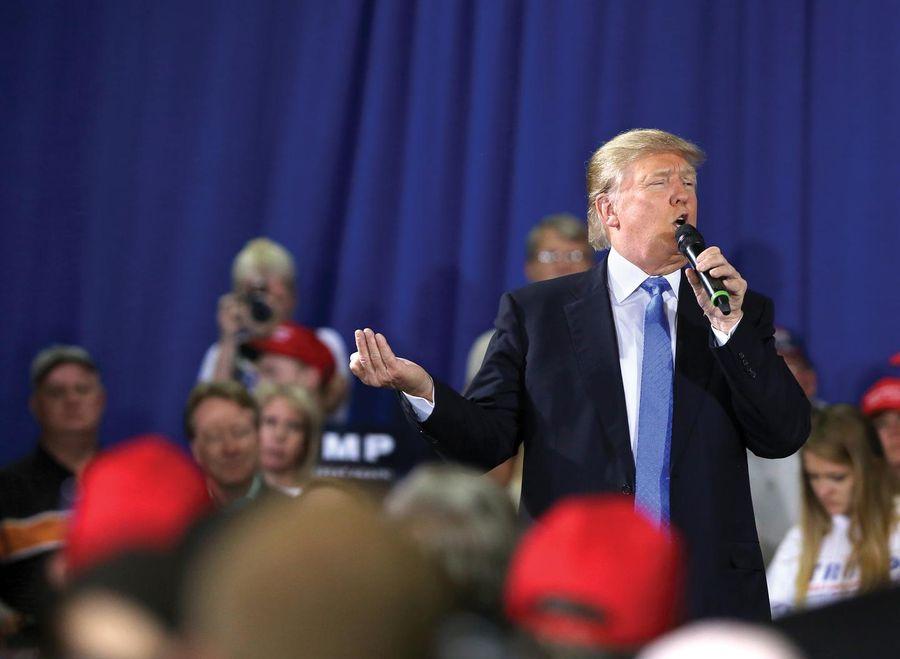
Republican Presidential candidate Donald Trump speaks during a rally in Janesville, Wis., Tuesday, March 29, 2016. (Anthony Wahl/The Janesville Gazette via AP) MANDATORY CREDIT
GOP Senate Hopefuls Grapple With Trump Impact
Published March 31, 2016 • Read time: 8m
Republicans already face tough odds in defending their slim four-seat majority in Senate this year, in part because several races are in purple states that Barack Obama carried in both 2008 and 2012. GOP candidates in more safely Democratic states face an even steeper uphill battle.
Now, Donald Trump has turned those blue-state races into a mountain climb.
When the campaigns heat up in Democratic strongholds in the summer and fall, Democrats are sure to employ the same strategy they’ve been using for months: tie the Republican candidates to Trump in every way possible. This leaves them in the difficult position of deciding whether to embrace the GOP front-runner, fully disavow him, or hold him at arm’s length.
GOP candidates are doing all three as they navigate the rocky terrain.
Wendy Long, an attorney challenging Sen. Chuck Schumer in New York, fully embraced Trump as the GOP front-runner. Long lost a landslide election by more than 40 points to Sen. Kirsten Gillibrand four years ago, and Schumer won his last two elections by more than 30 points. But Long said she decided to mount another bid because of Trump and the political environment that facilitated his success.
“I think he’s bringing in new people and a lot of excitement and I think it would be good for the whole party,” Long said in an interview with RealClearPolitics. “This year I think people see the prospect of kicking over the tables in Washington and taking their government back.”
The New York seat is among 10 that Democrats are defending, compared to the Republicans’ 24 seats. Eight of the 10 Democratic seats are considered safe. In most of these states – New York, Oregon, Washington, Maryland, California and Vermont – Republicans are facing incumbents with decades of experience in the Senate or running to replace Democrats in states that haven’t had Republican senators since the Reagan administration.
Portman-Strickland Senate Race Finally Set in Ohio
Portman Wastes No Time Attacking Strickland
Strickland Skirts Primary Debates in Ohio Senate Race
Senate Says Climate Change Is Real
Unlike Long, some GOP challengers don’t view Trump as a positive in their race. Chris Vance, a former state legislator and state party chair in Washington, is running against Sen. Patty Murray, a member of Democratic leadership who won re-election in 2010 by 5 percentage points and won her two previous re-elections by double digits. Vance didn’t outright disavow Trump in an interview with RCP, but didn’t agree to support him either.
“I said I would answer that question on the day he became the nominee, if he ever becomes the nominee, and that’s still my answer,” Vance said.
Vance, however, has previously suggested the party rally around the eventual nominee. In December, after Trump’s proposed ban on Muslims, Vance shared a video of House Speaker Paul Ryan denouncing the front-runner’s proposal, and added, "In less than 6 months Republicans will need to unite behind our nominee for President, whoever that is. But today this needed to be said.”
While Vance wasn’t part of the “Never Trump” movement, he did point to a number of things the candidate has said he disagreed with, including his call to ban Muslims from the country and his failure to immediately denounce David Duke, former grand wizard of the Ku Klux Klan. Vance also said he strongly disagrees with Trump on certain policy issues, from U.S. support of NATO to Trump’s trade agenda.
“Domestically, his anti-trade agenda is bad for America; it’s devastating for the state of Washington,” Vance said. “When I hear Mr. Trump or anyone talk about protecting American manufacturing jobs, I want to scream at the television, ‘Do you know who the largest manufacturer in the United States is? The Boeing company, here in Seattle.’”
Long, on the other hand, said Republicans who think Trump’s controversial statements are bad for the party are just the “consultant class and the political pundit class” who are afraid of ceding power to him. She admitted that many Republicans were “uncomfortable” with the developments of the last week, when Trump attacked the wife of his opponent, Sen. Ted Cruz, but said, “They’re still with him -- they just wish he would keep talking about the issues."
While Vance disavowed Trump’s comments on banning Muslims, Long said she could support closing the borders temporarily, though she emphasized that Trump was speaking in “broad strokes” rather than “policy particulars” on a ban, which she said would be a difficult and ineffective way to provide security.
“People who don’t like what he’s saying say, 'Oh it’s xenophobic, it’s racist, it’s religious bigotry.' No, it’s not any of those things,” Long said. “It’s keeping the people of America safe and controlling our borders. The elite political class don’t understand that, but the people understand it, and they want to be safe."
While other GOP candidates in blue states haven’t fully embraced Trump, they are hoping the environment that led to his rise will potentially boost their chances in races that are normally relatively easy wins for Democrats. While anti-establishment pressure and calls to oust “career politicians” are common election-year refrains, these candidates hope Trump’s success shows voters are serious this time.
Sam Carpenter is a businessman running in a four-way primary to challenge Oregon Democratic Sen. Ron Wyden, who won all three of his previous re-elections by comfortable double-digit margins. Carpenter called himself a “Trump-ish kind of guy” and said that while some have agonized over the billionaire’s rise, many have missed the reasons that precipitated it.
“He has a muscular stance on foreign policy, on immigration, trade, the whole thing, and it seems to me that what people are looking for our there in this cycle is something different than what they’ve had in the last three cycles,” Carpenter said.
Carpenter said he’s concerned for the future of the Republican Party if there is a “coronation” of a nominee other than Trump or Cruz at the convention. And while he admitted Trump has said many things viewed as controversial and offensive, he would still want the billionaire out on the campaign trail with him in Oregon in the fall.
“The people here in Oregon I talk to think if he gets the nomination, he’ll kind of, how can I say, calm down and start to act presidential and relax a little more and get a little more knowledgeable on the issues,” Carpenter said.
One of Carpenter’s primary opponents, businessman Dan Laschober, said he would support Trump, or support a “Donald Trump mini me for vice president” before supporting Hillary Clinton, the Democratic front-runner. While he said he would distance himself from some of the more controversial statements, he thinks Trump’s overall message still resonates with Oregon voters.
“When I hear his speeches, it boils down to immigration is a problem and we’ve lost jobs, and that resonates,” Laschober said. “No matter how clumsily he says it, it seems to get through to people.”
In Maryland, a Republican wouldn’t face a long-time incumbent, but rather Rep. Donna Edwards or Rep. Chris Van Hollen. Kathy Szeliga, a Maryland state delegate and small business owner who holds a minor lead in primary polls, didn’t directly criticize or praise Trump. In fact, in a 15-minute interview with RCP, she didn’t mention him by name once, though she said she would support whomever the voters select to be the Republican nominee.
Yet she still said she hopes to take advantage of the anti-establishment rancor that has manifested in the presidential primaries to boost her own race.
“People today are looking for someone who’s not part of the problem, and Maryland is really ripe for ‘Throw out all the bums,’” Szeliga said. As to how Trump’s success might affect her race, Szeliga pointed out that she and her husband started a construction company and said she appeals to blue-collar voters, many of them Democrats who Republicans believe might cross over to support Trump.
While the candidates took a variety stances on Trump, there can be no question his presence will have a significant effect come fall. Whether Trump does attract new voters to the GOP and boosts Republicans facing tough campaigns in Democratic states, or whether his controversial statements turn off potential supporters, remains to be seen.
Vance, the candidate in Washington, said he thought this year would be ripe for an outsider candidate against an establishment Democrat.
“The president’s party never does well three elections in a row, and the voters believe the country’s on the wrong track,” he told RCP. “Obama’s approval rating is under 50 percent, Hillary Clinton is viewed as weak,” he added. “This should be a good year, the kind of year I could beat Patty Murray. Enter Donald Trump. And now I don’t know what to think."
This article was updated at 2:15 p.m. March 31, 2016.

Newsom Defies Voters, Juries and Lawmakers To Spare Murderers While Defending Abortion
Curtis Hill • RealClearPolitics
The Algorithmic Tilt
Frank Filingeri • RealClearPolitics
A RealClear Thanksgiving: Investing in a Better Future
David DesRosiers • RealClearPolitics
Trump’s Newsom Problem: Antagonist-in-Chief
Carolina Lumetta • RealClearPolitics
America’s Free Spirit
John Maxwell Hamilton • RealClearPolitics
The GOP Majority Should Go Out in Glory
Daniel McCarthy • RealClearPolitics
RCP Today
Top stories on RealClearPolitics
The Takeaway
Polling intelligence and analysis delivered to your inbox
World News
Featuring the latest world news
Policy
Featuring the latest policy news
Support Our Mission
As part of RealClearPolitics, authors aim to provide balanced, non-partisan analysis by presenting top reporting and commentary from all sides of the political spectrum.
Trusted by policymakers and citizens alike since 2000