
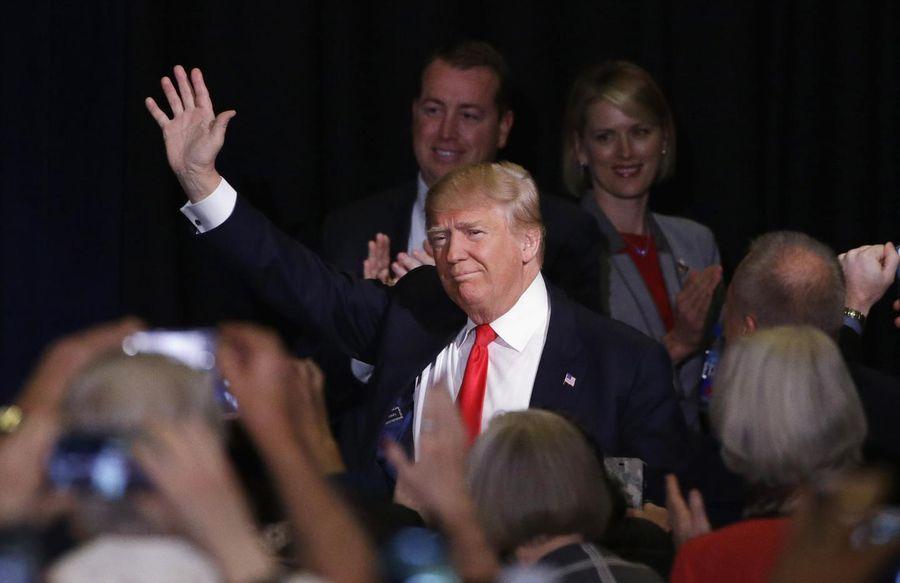
Why Trump Is Winning on Jobs and the Economy
Published Feb. 24, 2016 • Read time: 4m
Jobs and the economy are top of mind for voters from both parties this election cycle according to a recent Gallup poll. This is hardly a surprise. But what was a surprise to many is the importance of immigration and free trade as economic issues for working class voters and the level of betrayal they feel with respect to their government’s handling of these issues.
These voters feel stuck between free trade policies that encourage companies to move good paying jobs outside the U.S. and the failure to enforce our immigration laws allowing people here illegally to take jobs that remain. While the economic wisdom of legal immigration and free trade policies is compelling, politicians would be well advised not to minimize these voters’ concerns.
According to the Bureau of Labor Statistics, over the past thirty years the number of people employed in U.S.-based manufacturing has dropped dramatically by 5 million. When people are living in towns where the local plant closed because a big company moved jobs to Mexico or China, it's extremely difficult to convince them that free trade policies are working to their benefit. Recent announcements by companies like Ford and Carrier Air Conditioning that they're sending jobs to Mexico only reinforce their frustration.
Arguments on the benefits of liberal immigration policies also have little appeal when employers are hiring illegal immigrants for good paying jobs--such as those in construction--because they’ll work for less. Lacking higher paying jobs in sectors such as construction and manufacturing, working class Americans are often left to compete for lower paying retail positions and again find themselves competing with immigrants willing to work for less.
The Empty Promises of Trump and Sanders
Good News for Discouraged Workers
A Vote for Trump Is a Vote Against American Consumers
First Lady Honors Pioneering Female Air Force Officer
While free trade is unambiguously good for the worldwide economy and for each individual nation, including ours, there are adjustment costs. Working class Americans of all racial and ethnic backgrounds have borne a disproportionate share of those costs, made worse by inexcusably lax enforcement of our immigration laws.
Scapegoating immigrants won’t solve these problems any more than the Democrats' efforts to scapegoat the rich. But these voters have little interest in complex arguments on how free trade or immigration will improve the economy overall. Rather, they want to hear specifically how candidates are going to protect their jobs, their families and their children’s futures.
When Donald Trump talks about punishing China, building a wall, and restricting immigration--rightly or wrongly--he hits these voters where they live. Their level of betrayal with what has come to be called “Establishment” politicians is so great that they’re apparently willing to ignore any political and ideological differences they may have with Mr. Trump.
These working class voters are essential to a Republican victory in 2016. While much has been said about Mitt Romney getting a mere 27% of the Hispanic vote in 2012, Nate Silver’s “Swing the Vote” web site shows that even if he had gotten 67% he would still have lost the Electoral College vote and the election. However, with an increase of just a few percentage points in the college and non-college educated white vote, Romney would have won the presidency despite getting only 27% of the Hispanic vote.
With respect to the popular vote, the Census Bureau’s Center for Immigration Studies found that Romney would have had to increase his share of the Hispanic vote by 23 percentage points--from the 27 percent he actually received to 50 percent--to win it. However, he could also have won it by increasing his share of the white vote by only three percentage points, from the 59 percent he actually received to 62 percent.
And this assumes stagnant turnout. According to the Census Bureau, between 2008 and 2012, voter turnout for white voters without a college degree declined a disconcerting 3.7% (from 48% to 44.3%), or nearly 4 million fewer voters.
These voters are a proxy for all working class voters whose concerns cut across racial and ethnic barriers. Any candidate seriously intent on winning the presidency in 2016 must understand why they didn’t show up in 2012 and, more importantly, how to get them to show up in 2016. That will require solutions on how working class voters (white, Hispanics, black or Asian) can build a better life, pursue a career, find a path to the middle class, send their kids to college and retire with dignity.
Republican candidates should proclaim at every opportunity a simple, relatable and heartfelt economic message that allows working class Americans to believe their candidate is protecting their interests. In different times, they believed it about Ronald Reagan and Bill Clinton. Today they believe it about Donald Trump. The question for the rest of the Republican field is whether they will believe it about anyone else.
The GOP Majority Should Go Out in Glory
Daniel McCarthy • RealClearPolitics
Republican Majorities Could Return Sooner Than Expected
J.T. Young • RealClearPolitics
The Danger Before the Attack
Leslie J. Sullivan • RealClearPolitics
Jon Finer’s Old and Dangerous ‘New Approach’ to Israel
Peter Berkowitz • RealClearPolitics
The President Deserves Better
John Ullyot • RealClearPolitics
Congress Doesn’t Need Another Blame Game. It Needs To Find What’s Broken
Jarrod Bernstein • RealClearPolitics
RCP Today
Top stories on RealClearPolitics
The Takeaway
Polling intelligence and analysis delivered to your inbox
World News
Featuring the latest world news
Policy
Featuring the latest policy news
Support Our Mission
As part of RealClearPolitics, authors aim to provide balanced, non-partisan analysis by presenting top reporting and commentary from all sides of the political spectrum.
Trusted by policymakers and citizens alike since 2000