
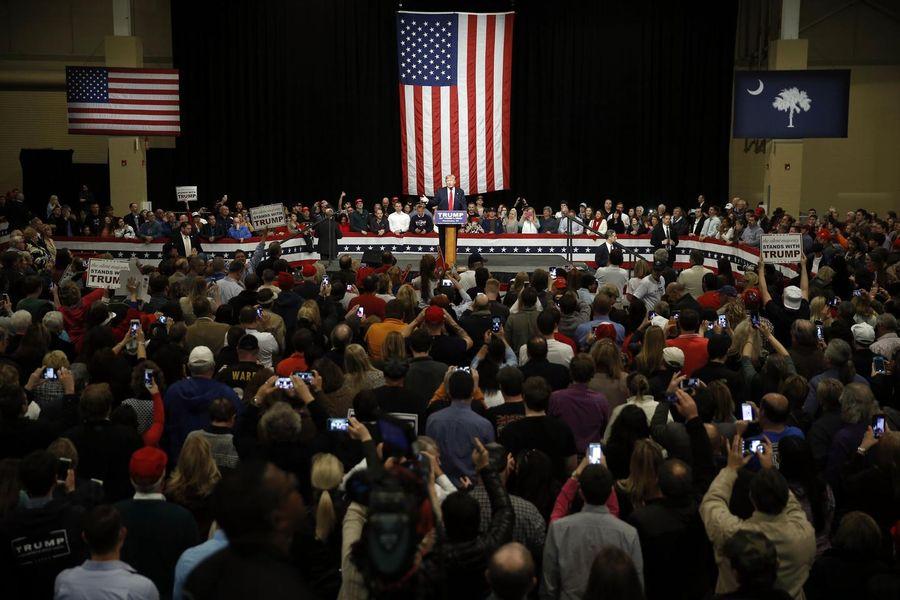
Donald Trump Wins Big in South Carolina Republican Primary
Published Feb. 20, 2016 • Read time: 5m
COLUMBIA, S.C. (AP) -- Donald Trump claimed victory in South Carolina's Republican primary Saturday, deepening his hold on the GOP presidential field as the contest moves into the South. Out West, Hillary Clinton pulled out a crucial win in Nevada's Democratic caucuses.
Clinton's win eased the rising anxieties of her backers, who feared a growing challenge from Bernie Sanders. At a raucous victory rally in Las Vegas, she lavished praise on her supporters and declared, "This one is for you."
Trump's strong showing in South Carolina marked his second straight victory in the Republican primaries and strengthened his unexpected claim on the Republican nomination. Underscoring the electorate's frustration with Washington, he was backed by nearly 4 in 10 of those who were angry at the federal government, and a third of those who felt betrayed by politicians in the Republican Party.
Ted Cruz and Marco Rubio, a pair of freshman senators, were locked in a race for second place. Jeb Bush and other candidates lagged behind.
For both parties, the 2016 election has laid bare voters' anger with the political establishment and the influence of big money in the political system. The public mood has upended the usual political order, giving Sanders and Trump openings while leaving more traditional candidates scrambling to find their footing.
Trump's victory comes after a week in which he threatened to sue one rival, accused former President George W. Bush of lying about the Iraq war and even tussled with Pope Francis on immigration. His victory was another sign that the conventional rules of politics often don't apply to the brash billionaire.
Cruz's Path to Nomination
Trump Stands by His Manager
With Tweets on Heidi Cruz, Trump Sinks to New Depths
A Vote for Kasich Is a Vote for Trump
For Cruz, even a second-place finish in South Carolina would be something of a disappointment. The state was his first test of whether his expensive, sophisticated get-out-the-vote operation could overtake Trump in a Southern state, where the electorate is tailor-made for the conservative Texas senator.
Florida's Rubio was hoping a top-tier finish in South Carolina could help establish him as the mainstream alternative to Trump and Cruz. Many GOP leaders believe neither Trump nor Cruz could win in the general election.
Rubio scored the endorsements of several prominent South Carolina politicians, including Gov. Nikki Haley, and seemed to have rebounded after a dismal debate performance two weeks ago.
Bush hoped his deep family ties to South Carolina - his brother and father each won two primaries here - would be a lifeline for his struggling campaign. But if Bush was unable to stay close to the leaders, he was sure to face pressure to end his campaign.
Also in the mix was Ohio Gov. John Kasich, who had low expectations in South Carolina. He was looking toward more moderate states that vote later in March. Retired neurosurgeon Ben Carson had a small but loyal cadre of followers.
The crowded Republican contest was a contrast to the head-to-head face-off among Democrats. Sanders, backed by a powerful network of small financial donors, has plenty of money to stay in the race for months.
Clinton's victory came as a relief to her campaign, particularly after her blowout loss to Sanders in the previous New Hampshire contest.
"Some may have doubted us, but we never doubted each other," Clinton said during her victory rally.
The former secretary of state captured the backing of voters who said electability and experience were important in their vote. But in a continuing sign of her vulnerability, Sanders did best with voters looking for a candidate who is caring and honest.
Sanders congratulated Clinton on her victory, but then declared that "the wind is at our backs. We have the momentum."
Clinton and Sanders split the first two voting contests, revealing the Vermont senator's appeal with young people drawn to his impassioned calls for breaking up Wall Street banks and providing free tuition at public colleges and universities.
According to the entrance polls of voters, Clinton was backed by a majority of women, college-educated voters, those with annual incomes over $100,000, moderates, voters aged 45 and older and non-white voters. Sanders did best with men, voters under 45 and those less affluent and educated.
Clinton's win means she will pick up at least 19 of Nevada's 35 delegates. She already holds a sizeable lead in the delegate count based largely on her support from superdelegates - the party leaders who can support the candidate of their choice, no matter the outcome of primaries and caucuses.
Democrats and Republicans will swap locations in the coming days. The GOP holds its caucus in Nevada on Tuesday, while Democrats face off in South Carolina on Feb. 27.
The polling of voters in Nevada and South Carolina was conducted for The Associated Press and the television networks by Edison Research as voters arrived at 25 randomly selected caucus sites.
---
Pace reported from Washington. Associated Press writers Ken Thomas in Las Vegas, Alex Sanz in Greenville, Hope Yen in Washington and AP News Survey Specialist Emily Swan contributed to this report.
© 2016 The Associated Press. All rights reserved.

Democrats Won the Midterms. Common Sense Won, Too
Jordanne Kemper • RealClearPolitics
The 120th Congress Shapes Up
Carolina Lumetta • RealClearPolitics
Flooding GOP Primaries With Democrats
Robert Natelson • RealClearPolitics
Washington Keeps Rewarding Oracle—Veterans Keep Paying the Price
Darin Gaub • RealClearPolitics
The Seeds of Unrestricted Warfare
John Teichert • RealClearPolitics
The Primary System Is Losing the Next Generation
Sean Trende • RealClearPolitics
RCP Today
Top stories on RealClearPolitics
The Takeaway
Polling intelligence and analysis delivered to your inbox
World News
Featuring the latest world news
Policy
Featuring the latest policy news
Support Our Mission
As part of RealClearPolitics, authors aim to provide balanced, non-partisan analysis by presenting top reporting and commentary from all sides of the political spectrum.
Trusted by policymakers and citizens alike since 2000