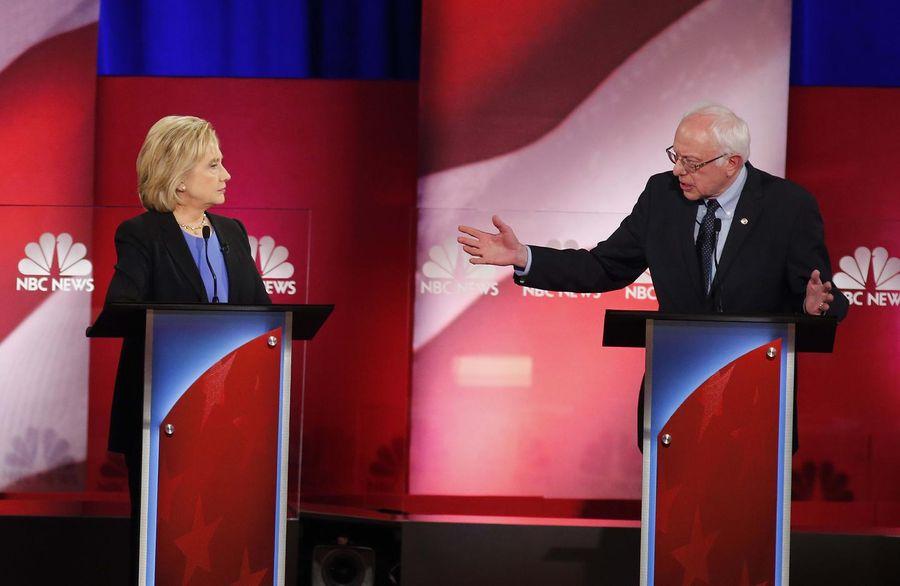
Nevada Caucuses Put Clinton, Sanders to New Test
Published Feb. 19, 2016 • Read time: 5m
Join the Conversation
0Bernie Sanders has a path to the Democratic nomination, but the results of the Nevada caucuses Saturday will foreshadow whether that path is mostly magical thinking.
In the wake of his near-victory in the Iowa caucuses and 22-point triumph over Hillary Clinton in the New Hampshire primary, Sanders would like to make inroads with minorities, moderates, older voters and upper-middle-class Democrats to demonstrate an appeal beyond the base he’s developed of younger people, liberals and white voters.
At a Democratic town hall in Las Vegas Thursday evening, Sanders predicted he would succeed. “I chose to run, proudly, in the Democratic primary and caucus process, and I look forward to winning that process.”
Clinton was equally bullish on her own prospects. "He's won one. I've won one. We've got 48 to go,” she said, referring to Sanders’ victory in New Hampshire. “I'm not going to waste a minute. That's why I want to get this nomination as quickly as possible so I can get to work on being your president,” she said at the event, broadcast by MSNBC and Telemundo.
In Nevada, where the Democratic socialist from Vermont is polling about even with Clinton, Sanders thinks he’s identified a more receptive electorate than he’s encountered in South Carolina, where he trailed the former secretary of state by more than 20 points in the RealClearPolitics average on Thursday. But Clinton’s lead in the Palmetto State a week ago was close to 30 points. The South Carolina Democratic primary takes place Feb. 27, a week after the Republican contest.
Lies, Assault and Cover-ups Don't Stop Donald Trump
Trump Stands by His Man; Obama on a Health Scourge; Hayden Interview; Reagan's Courage
Analysis: For Trump, Few Limits to Win-At-Any-Cost Approach
What If Clinton Isn't Indicted?
To win the nomination, Sanders must lock up votes from Latinos and African-Americans in large, diverse states where the pace of campaigning will soon escalate and the costs in organization and advertising will surge for both campaigns in March and beyond.
“I'd give Sanders less than one-in-three chances of winning the nomination, but I expect the contest to continue to June, and for Sanders to win a number of additional primaries and caucuses,” said Thomas Mann, Brookings Institution senior fellow in governance studies. “Unlike the Republican race, the two-person contest limits his potential.”
Sanders outspent Clinton in South Carolina advertising as of this week ($878,000 to $712,000), while each campaign racked up more than $3 million in advertising in the Silver State, according to data from tracking company SMG Delta, reported by NBC News.
Nevada, Sanders campaign senior adviser Tad Devine said during an MSNBC interview Thursday, “is a test.”
Devine has been upbeat about Sanders’ chances in Nevada for weeks, pointing to the matchup between the candidate’s income-inequality message and the devastating repercussions Nevadans experienced after the Great Recession. “We’ve been on TV there longer,” Devine told RCP last week. “We’ve had a very substantial presence there.”
The state’s 6.4 percent unemployment rate in December remained among the highest in the nation, and many workers in Nevada hold down multiple jobs or are underemployed. More than half the population is white, according to the latest U.S. Census data, while 28 percent of Nevadans are Latino and more than 9 percent are African-American. About half the state’s population is female.
To become their party’s standard-bearer by summer, Clinton or Sanders must capture 2,382 delegates. Winning states outright is important, but even the loser in a two-person Democratic race can collect delegates in proportional allocations. Within the total up for grabs, 712 are super delegates, meaning they are Democratic politicians, members of Congress, and party VIPs who are permitted to back any candidate, regardless of the state-by-state primary and caucus results.
With just two contests behind them, Clinton leads Sanders in the delegate count because of her backing from super delegates. The Sanders campaign team says it remains focused on expanding support from a wide demographic array of voters, demonstrating momentum state-by-state, and stoking his online fundraising haul, which has proven impressive for a candidate who does not host big-dollar fundraisers. The super delegates, they insist, are not their immediate concern.
But the math matters most, and while Sanders has a 36-32 lead among delegates after Iowa and New Hampshire, Clinton remains far ahead (481-55) because of the super delegates, according to an Associated Press tally. Super delegates, of course, can change their minds, while pledged delegates are committed to back candidates during balloting in July at the Democratic National Convention in Philadelphia.
As part of his examination to identify a path for Sanders to the nomination, if there is one, Nate Silver, writing in the blog FiveThirtyEight, looked at data and tallied potential state outcomes if Sanders and Clinton were tied in national polling. The models suggested that if Sanders wins in Nevada, it would signal he has “staying power.”
But after Nevada, voters in 11 states fill out ballots March 1, known as Super Tuesday. The states are diverse in population and geographical locations. Another 857 pledged delegates – or more than 20 percent of the total – are up for grabs in the March 8 and March 15 contests among seven states, where Clinton has leads in polls. Later states in the West could favor Sanders.
A loss for Clinton in Nevada could erode the sizeable lead she has built in South Carolina, thanks to her appeal among older African-American voters. If that occurs, establishment Democrats will begin to screech that the shape of the race for president, and openings for Democrats down-ballot, are in jeopardy.
It’s why political analysts, including Mann, believe Sanders’ path to the nomination could be blocked any number of ways, including by super delegates who back the former first lady.
“If he proves to be more of a threat to Clinton, the full Democratic Party network will gear up to help defeat him,” Mann predicted. Why?
Because the establishment party power brokers fear Sanders “would be a disaster in November.”
For many reasons, Nevada’s caucuses could indeed prove to be a test.

Newsom Defies Voters, Juries and Lawmakers To Spare Murderers While Defending Abortion
Curtis Hill • RealClearPolitics
The Algorithmic Tilt
Frank Filingeri • RealClearPolitics
A RealClear Thanksgiving: Investing in a Better Future
David DesRosiers • RealClearPolitics
Trump’s Newsom Problem: Antagonist-in-Chief
Carolina Lumetta • RealClearPolitics
America’s Free Spirit
John Maxwell Hamilton • RealClearPolitics
The GOP Majority Should Go Out in Glory
Daniel McCarthy • RealClearPolitics
RCP Today
Top stories on RealClearPolitics
The Takeaway
Polling intelligence and analysis delivered to your inbox
World News
Featuring the latest world news
Policy
Featuring the latest policy news
Support Our Mission
As part of RealClearPolitics, authors aim to provide balanced, non-partisan analysis by presenting top reporting and commentary from all sides of the political spectrum.
Trusted by policymakers and citizens alike since 2000