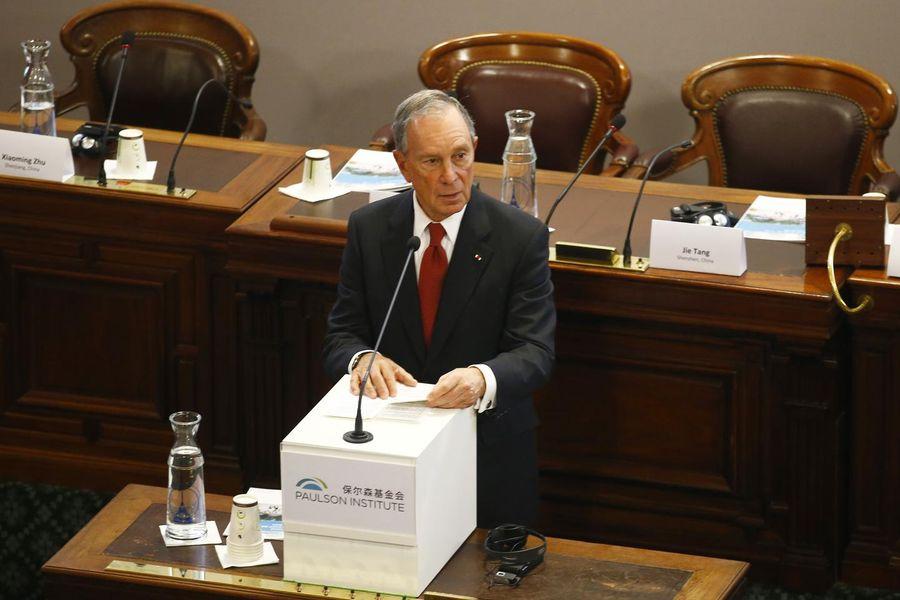
What a Bloomberg Run Might Look Like
Published Feb. 14, 2016 • Read time: 5m
This is what people who want Michael Bloomberg to run for president—including, perhaps, Bloomberg himself—were waiting for: a decisive win in the New Hampshire primary by a loose cannon and an avowed socialist. If it feels to the Democratic and Republican Party establishments that events are spinning out of control, there’s a reason for that, but things could get worse in a hurry.
Bloomberg is apparently considering an independent run for the White House. The big question involves what would that run look like. It’s been 24 years since the last self-made billionaire, Ross Perot, decided to take on then-President George H.W. Bush and Bill Clinton. What are the lessons that apply today?
For starters, can an independent be given a fair shake? Although America’s political environment includes more than just elephants and donkeys, Republicans and Democrats (the only major parties since the Whigs died out in the mid-1800s) control every aspect of elections at the national, state and local level. Each of the 50 states has its own, unique process for accepting independent candidates on the ballot. Many of them are inherently designed to make it extremely difficult for anyone without an “R” or a “D” behind their names. Even in 2016, little has changed.
There is an old trope in politics: There are only two finite commodities in a campaign – the candidate’s time and money, and they’re directly related to one another. For Bloomberg, money may not be finite, but time is the precious resource in his case. Qualifying as an independent candidate in all 50 states is an arcane, expensive and time-consuming process. Texas is the first state that requires a candidate to submit an application for independent status on the presidential ballot. Here, for example, are the parameters for the Lone Star State:
Lies, Assault and Cover-ups Don't Stop Donald Trump
Trump Stands by His Man; Obama on a Health Scourge; Hayden Interview; Reagan's Courage
Analysis: For Trump, Few Limits to Win-At-Any-Cost Approach
What If Clinton Isn't Indicted?
--A general election candidate must submit 80,000 valid signatures of independent voters who did not participate in Texas’ March 1 presidential primary.
--That candidate cannot begin collecting those signatures until March 2.
--The signatures, filing fees and the name and written assent of the running mate must be submitted by May 9—months before the Republicans and Democrats have to do the same thing.
--The names of 38 qualified presidential electors must be submitted by May 9 as well. (These Electoral College voters are typically selected by the state party central committee or at the state party convention, so the independent is on his or her own to round up qualified voters to fill this role.)
In 1992, Ross Perot used a combination of petition drives to qualify as the nominee of a “minor party” in most states. Bloomberg used that option, after a fashion, when first running for office in New York: Although he’d not been a Republican, he ran in the mayoral primary in the GOP, which is equivalent to a minor party in the Big Apple.
While most candidates and campaigns spend a great deal of time and money on raising the resources a campaign needs to simply operate, Bloomberg will not have those requirements. If he is truly willing to spend $1 billion on his White House bid, as has been suggested, that money is all net to the campaign—meaning that no fundraising costs need be deducted and that Bloomberg gets, in essence, a premium on his money.
Moreover, like Trump, Bloomberg is a nationally known politician and business leader who knows how to garner free media attention to drive his messaging. Unlike Trump, however (if The Donald ends up as the Republican nominee), Bloomberg would have no infrastructure and would have to build it from scratch in every state in which he chose to compete. Would that be a 50-state campaign? Perhaps not. The traditional presidential electoral map shows that only a dozen states are actually in play in a binary race between a Republican and Democrat. An independent would have to stretch that number—but he wouldn’t have to compete everywhere.
If Bloomberg is actually willing to commit 10 figures to a presidential run, he can compete on turf that has not been up for grabs in decades. That’s not to say it would be an easy fight, but the GOP nominee or Hillary Clinton could not ignore him in California, New York, Florida or Texas. If a “silent majority” truly exists, and they are disgusted with their options for the general election, Bloomberg could find his path down the middle.
For the two parties, the question would be: How does Bloomberg’s candidacy affect the major party nominees? He is seen as fiscally conservative and is clearly successful in business. Those traits may appeal to Republicans. He is also pro-choice, chairs an international group that works to protect the environment and spent his own money attacking candidates who didn’t support gun control. Those positions make him popular with Democrats. For sure, swing voters who make up that valuable, golden tranche of the electorate might well agree with him – and might choose him over any GOP nominee—and either Bernie Sanders or Hillary Clinton.
Depending on what happens in South Carolina and Nevada later this month, Mike Bloomberg has a tight timeline to make a decision whether to run or not. His campaign would add radical uncertainty to a race that already feels unpredictable. He’s just the latest harbinger of the coming end of America’s devotion to its two-party heritage. He might just be the disrupter the system needs.

A RealClear Thanksgiving: Investing in a Better Future
David DesRosiers • RealClearPolitics
Trump’s Newsom Problem: Antagonist-in-Chief
Carolina Lumetta • RealClearPolitics
America’s Free Spirit
John Maxwell Hamilton • RealClearPolitics
The GOP Majority Should Go Out in Glory
Daniel McCarthy • RealClearPolitics
Republican Majorities Could Return Sooner Than Expected
J.T. Young • RealClearPolitics
The Danger Before the Attack
Leslie J. Sullivan • RealClearPolitics
RCP Today
Top stories on RealClearPolitics
The Takeaway
Polling intelligence and analysis delivered to your inbox
World News
Featuring the latest world news
Policy
Featuring the latest policy news
Support Our Mission
As part of RealClearPolitics, authors aim to provide balanced, non-partisan analysis by presenting top reporting and commentary from all sides of the political spectrum.
Trusted by policymakers and citizens alike since 2000