
GOP Hopefuls Mix Super Bowl, Campaign Messaging
Published Feb. 8, 2016 • Read time: 4m
Join the Conversation
0MANCHESTER, N.H. — With their own big game less than two days away, presidential candidates turned their attention briefly Sunday to another marquee matchup: Super Bowl 50.
There are few events so large or important that they could pry candidates from the campaign trail with the New Hampshire primary so near. And, indeed, this was not such a thing. Instead, campaigns incorporated the game into their speeches, engineered events around it, and targeted their advertising toward the show’s astronomical audiences.
Only a few campaigns ponied up the money to air local ads during the game between the Denver Broncos and Carolina Panthers: groups supporting Jeb Bush, Marco Rubio and Ted Cruz, along with Marco Rubio’s campaign. The spots aired in New Hampshire and South Carolina, the next state on the primary calendar.
The ads themselves were not on the scale of typical Super Bowl commercials, which tend to be flashy, memorable or moving.
“Whereas the corporate campaign is much more long-term, obviously we’re on a much more condensed timeline than they are,” said Paul Lindsay, a spokesman for Right to Rise, the pro-Bush super PAC. “That changes the content.”
Right to Rise supplemented its television buy with complementary digital advertising, including ads on sports websites and tied to Google search terms. Among those terms were phrases related to Rubio, intended as a counterweight to his campaign’s Super Bowl advertising.
“We wanted to make sure we supplemented what’s going on on TV with the Internet,” said Sheena Arora, a senior vice president at Revolution Agency and a consultant to Right to Rise. Arora estimated that 80 percent of Super Bowl viewers would use a second screen while watching the game on their computers. “During any live moment, there is always a dramatic peak in searches.”
Lies, Assault and Cover-ups Don't Stop Donald Trump
Trump Stands by His Man; Obama on a Health Scourge; Hayden Interview; Reagan's Courage
Analysis: For Trump, Few Limits to Win-At-Any-Cost Approach
What If Clinton Isn't Indicted?
It is unusual for this ultimate cultural moment, the Super Bowl, to coincide with the New Hampshire primary, which in recent election cycles has fallen earlier, in January. The timing this year afforded an opportunity for campaigns to reach vast audiences. But campaigns were also compelled to adapt their schedules and voter contact strategies to the event, creating an added challenge in the final days before the primary.
Campaigns narrowly averted an even more daunting challenge: working around a title game featuring the New England Patriots, who were eliminated in the AFC championship and boast an extensive, impassioned fan base in the Granite State.
Even without the Patriots on the field, there was still plenty of political calculation in play. When they were asked during the debate Saturday for their pick to win the game, most candidates chose the Carolina Panthers — whose home state, North Carolina, will vote March 15 but which borders South Carolina, the next voting state on the GOP calendar.
"With an eye to February 20th, Carolina," Ted Cruz acknowledged in his response.
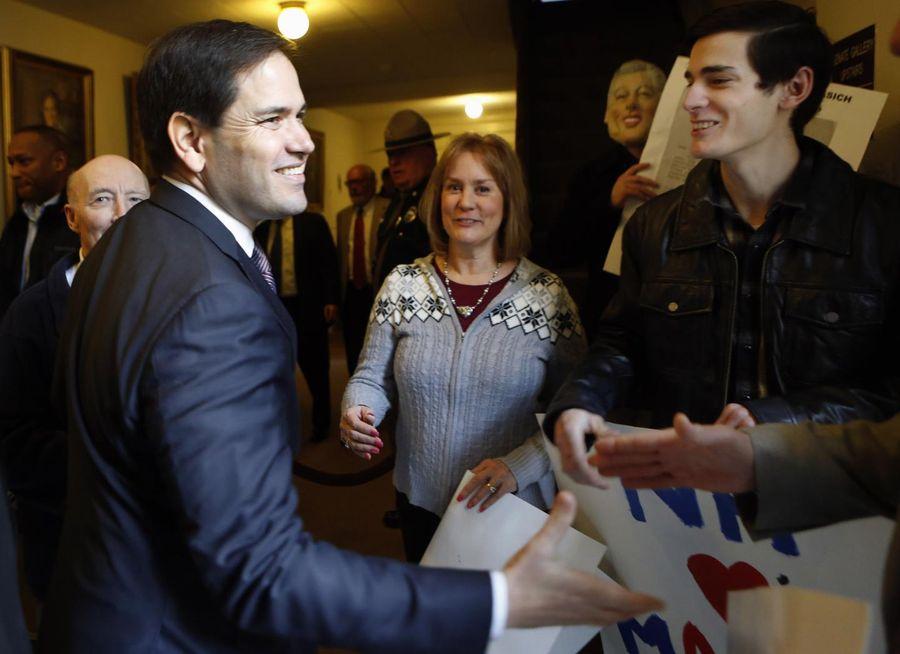
During the game, Rubio hosted a watch party in Manchester, where his campaign served food and soft drinks — but no beer, in spite of that drink’s status as a Super Bowl favorite. But his supporters likely sought adult beverages elsewhere: A photo tweeted by a reporter showed a thin crowd remaining for the start of the game, after Rubio had already come and gone.
Also in Manchester, Donald Trump’s sons, Donald Jr. and Eric, hosted a watch party at a Buffalo Wild Wings, to which press was invited, although apparently grudgingly. “Nothing like trying to enjoy the #SuperBowl with friends & having the @nytimes come up as start asking questions,” Donald Jr. tweeted.
Bush did not hold a formal watch party, although he convened with some aides and volunteers at a bar to watch the game. Earlier, at a rally in Nashua, he had thanked Sen. Susan Collins for canceling a Super Bowl party of her own in Maine to join him on the campaign trail.
But if football was a lighthearted distraction from the blocking and tackling on the campaign trail, the real big game did not stray far from the campaigns’ minds.
“You all ready for the Super Bowl?” Sen. Lindsey Graham asked the crowd at Bush’s rally. “Don’t miss the game tonight, but the Super Bowl is Tuesday.”
Indeed, by the end of the game Sunday, even Trump projected eagerness to return to the campaign trail: “So far the Super Bowl is very boring - not nearly as exciting as politics - MAKE AMERICA GREAT AGAIN!”

Congress Doesn’t Need Another Blame Game. It Needs To Find What’s Broken
Jarrod Bernstein • RealClearPolitics
Democrats Won the Midterms. Common Sense Won, Too
Jordanne Kemper • RealClearPolitics
The 120th Congress Shapes Up
Carolina Lumetta • RealClearPolitics
Flooding GOP Primaries With Democrats
Robert Natelson • RealClearPolitics
Washington Keeps Rewarding Oracle—Veterans Keep Paying the Price
Darin Gaub • RealClearPolitics
The Seeds of Unrestricted Warfare
John Teichert • RealClearPolitics
RCP Today
Top stories on RealClearPolitics
The Takeaway
Polling intelligence and analysis delivered to your inbox
World News
Featuring the latest world news
Policy
Featuring the latest policy news
Support Our Mission
As part of RealClearPolitics, authors aim to provide balanced, non-partisan analysis by presenting top reporting and commentary from all sides of the political spectrum.
Trusted by policymakers and citizens alike since 2000