
GOP Candidates Track Voter TV Preferences to Target Ads
Published Feb. 1, 2016 • Read time: 9m
Join the Conversation
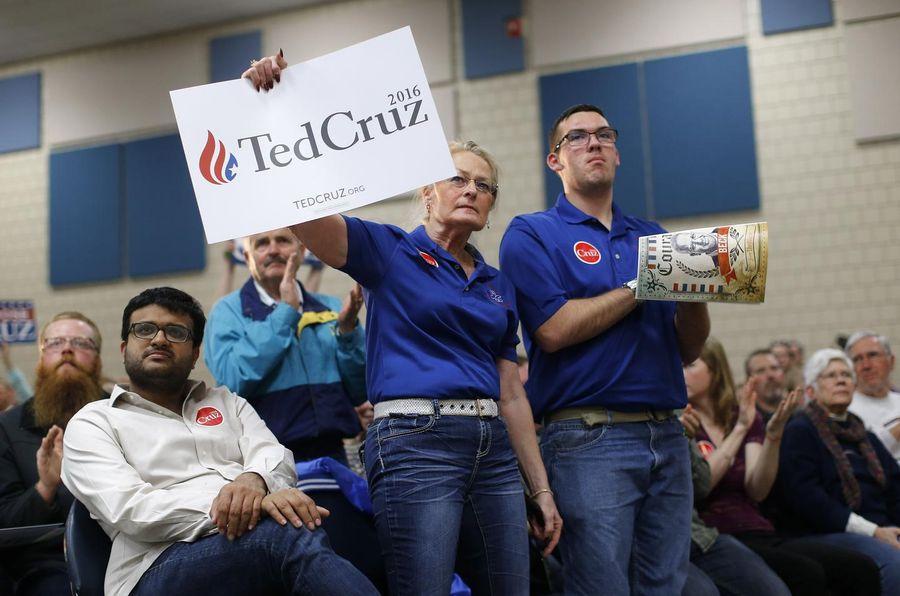
0An Iowan settling down to watch “Wheel of Fortune” this past month likely has seen as much of Ted Cruz and Marco Rubio as Vanna White. A Granite Stater watching “Family Feud” during the same period has almost certainly stumbled upon a feud of a different kind, between Jeb Bush and John Kasich.
As television advertising has swelled in the final weeks before voting begins in the Republican primary, such run-ins have become increasingly common. “I spend most of my time in New Hampshire, so I get to see everybody’s TV ads,” Bush said recently in Nashua. “There are a lot of them.”
But seeing a television ad is less random than ever before.
Iowa, N.H. Ad Buy Lists at Story's End
Television audiences in the first two voting states have unwittingly been watching something else: the first test for Republicans at the presidential level of micro-targeted TV buying. Rather than carpet-bomb the airwaves by buying up time on the most expensive networks with the largest audiences, campaigns for Bush, Rubio, Cruz and others are now taking a sniper’s approach, hoping to hit customized universes of persuadable voters wherever they are.
“There are two reasons you would do this: efficiency and effectiveness,” said Alex Lundry, director of data analytics for Bush. “We've found that we’re saving millions of dollars by using this data. We can be smarter about what we buy.”
This is of particular importance because campaigns still spend most of their budgets on television ads in spite of growing hype about digital advertising.
President Obama’s 2012 re-election campaign famously pioneered a data-driven approach to TV ad purchases by marrying its unique list of persuadable voters with set-top box data collected by cable providers, which documented each person’s complete viewing history. Whereas campaigns had previously made television advertising decisions based on vague demographic information, the Obama team could target viewers with a precision equal to other, more direct forms of voter contact, such as mail or phone calls.
Meanwhile, Mitt Romney’s campaign was buying its television time in the traditional manner: advertising to an overly broad swath of the electorate, and wasting money in the process. After the election, the Republican Party’s published an autopsy of sorts, its “Growth and Opportunity Project,” that pointed to faulty media buying among the GOP’s failures.
“Campaigns must be willing to pay the cost in order to get the payoff of data-driven media buying,” the report noted. “Media data can improve efficiencies by 10 to 25 percent, but it is not free.”
Now, the party’s course correction is bearing fruit.
Last month, RealClearPolitics paid a visit to the Arlington, Va., offices of Deep Root Analytics, one of the firms that has led the shift and counts Bush among its clients. Co-founded in 2013 by Lundry as a response to the Romney campaign’s shortcomings, it is the only Republican firm that focuses solely on using data to steer television buying. In the 2014 midterm elections, it directed more than $100 million worth of advertising; reflecting the broader adoption within the party of this technology, it expects to do even more than that this election cycle.
“There are people that would say that TV exists to talk to everybody,” said David Seawright, director of analytics. “And then there are people like me who would say there are only a certain number of people who are going to vote, [and] of those only a certain number of them are likely to support me, and I should be talking to them specifically. It’s a fundamental difference.”
Rather than rely on traditional Nielsen ratings, which estimate the share of all adults who watch a show, television micro-targeting matches a campaign’s list of targeted voters with data from millions TV set-top boxes, enabling customized ratings that reflect only the share of target voters that will watch a particular show.
These ratings often diverge from Nielsen’s, which typically dictate the price of advertising. In one market, “The Big Bang Theory” might have a significantly lower adult rating than its target voter rating — meaning a campaign can get more bang for its buck by placing an ad on a show that a high proportion of target voters are watching.
Often, the customized ratings point to cheaper, obscure cable channels that campaigns have traditionally bypassed. “Every single campaign is buying Fox News,” Seawright said. “So, the smart campaigns are saying, 'OK, where else can I go to reach those same people at a lesser cost?’”
In Iowa and New Hampshire this month, Chris Christie’s camp has aired ads on 29 cable channels, according to data shared with RCP by Kantar Media/CMAG, which tracks political advertising; Bush and Cruz ads have appeared on 26, and pro-Rubio groups have aired ads across 25. Donald Trump, who appears not to be using the sophisticated ad-buying approach of many of his challengers, has aired ads on just 15 channels. Other candidates have had an even narrower reach.
Seawright jokes that if a swing voter in Des Moines might have been able, in previous election cycles, to escape political ads by watching a niche channel like The Food Network, “that’s just not going to be true anymore.”
“We’ve found you, and we’re going to put ads there,” he said.
For many campaigns, the cost of working with a firm like Deep Root is prohibitive, as some companies charge up to seven figures for their services -- although lower price points are being introduced as the technology goes more mainstream (Deep Root offers now offers one plan for five figures).
. For others that might have been interested in using the technology, there simply are not enough Republican consulting firms offering this service to go around: The party still lags behind Democrats in talent in this sphere. Aside from Bush, Rubio’s campaign has hired Optimus, a firm that applies micro-targeting to television ad buying as well as other areas; Cruz is working with Cambridge Analytica, a company that uses “psychographic” targeting.
“In a Republican primary with 14 candidates, it’s achieving targeting parity with some and a competitive advantage against others,” said a top consultant for one Republican presidential campaign. Looking ahead, however, data-driven media buying will become even more essential, the consultant added. “In the general election, having this targeting technology is needed to be at parity with the Democrats.”
Republicans’ first major test of its technology came during the 2014 midterms, when Deep Root’s clients included Sen. Mitch McConnell, who was running for re-election in Kentucky, and Greg Abbott, who successfully ran for governor of Texas.
In Houston, Deep Root recommended an unthinkable strategy: decreasing the share of advertising on CBS, for many years thought of as the gold standard among campaigns for reaching seniors, who are often high-turnout voters, to instead target ads on several networks.
CBS salespeople called the campaign and its media buyers, thinking they had made a mistake. “They were livid,” recalled Dave Carney, who served as Abbott’s top strategist on the campaign.
“But we held our nerve and closed our eyes and hoped we were right,” Carney said, “and it worked out.”
Back in Deep Root’s conference room, Seawright projected an image of the firm’s user platform, which the company built from scratch. This is where a campaign sees what shows and “dayparts” (the unit of cable purchases, based on the time of day) rank highest among its target audience, and which are the most efficient buys. With a few clicks, a campaign aide can create a list of programs to send to a media buyer.
Meanwhile, the platform reports day-by-day feedback on how the campaign’s ads have performed among its target audience, and what share of target voters have also been reached by opposing campaigns during the same period.
At this moment, the screen depicts the final two weeks of the 2015 Kentucky gubernatorial race, which Deep Root tracked for research purposes but did not work on. On one day in Lexington, Democrats made 1 million more impressions with the target audience than Republicans, a graphic shows. On another day toward the end of the campaign, Republican ads made 550,000 more impressions relative to those by Democrats.
“This is ad intelligence at the next level,” Seawright said, “and this has never really been done before.”
The information can be narrowed by market, by daypart, even by the specific ad. If an opposing campaign begins airing an attack ad, the target campaign can know exactly how many impressions it is making on target voters and where — and decide how to place response ads accordingly.
Among Republican candidates for president in this election cycle, this technology has not yet reached critical mass. Elizabeth Wilner, a senior vice president for Kantar/CMAG, said she has observed “a broader spectrum, ranging from quite sophisticated to the very traditional.”
Data provided to RCP by CMAG illustrates the difference. As candidates like Bush have diversified their ad buys across many networks, others like Ben Carson have loaded their advertisements in more traditional places. In Iowa, Carson ads ran 109 times on the “Today” show in January and 108 times on “CBS This Morning.” In New Hampshire, Bush, who has spent more money than Carson on advertising, ran ads just 60 times on his campaign’s most saturated show, a local news program.
Just as Trump has upended many facets of the Republican Party’s comeback plan, the arc of his candidacy has also called into question the importance of the savvier ad strategies of other candidates. Although Trump has spent relatively little on television ads and has not used a data-driven method of media buying, he remains the Republican front-runner.
But, as with other elements of his candidacy, the rules seem not to apply to Trump.
"A person like Donald Trump, who can command the attention of the media, very likely does not have to rely on TV advertising,” Lundry said. “For everybody else, TV advertising is still an extremely important tool."
CMAG
CMAG



RCP Today
Top stories on RealClearPolitics
The Takeaway
Polling intelligence and analysis delivered to your inbox
World News
Featuring the latest world news
Policy
Featuring the latest policy news
Support Our Mission
As part of RealClearPolitics, authors aim to provide balanced, non-partisan analysis by presenting top reporting and commentary from all sides of the political spectrum.
Trusted by policymakers and citizens alike since 2000