The Gloves Come Off in Iowa
Published Jan. 31, 2016 • Read time: 6m
NEWTON, Iowa — In these last hours before the Iowa caucuses, we are walking along what Hamlin Garland, perhaps the most prominent of the regional novelists of the pioneer prairies called, in the title of his 1890 book, “Main-Travelled Roads.”
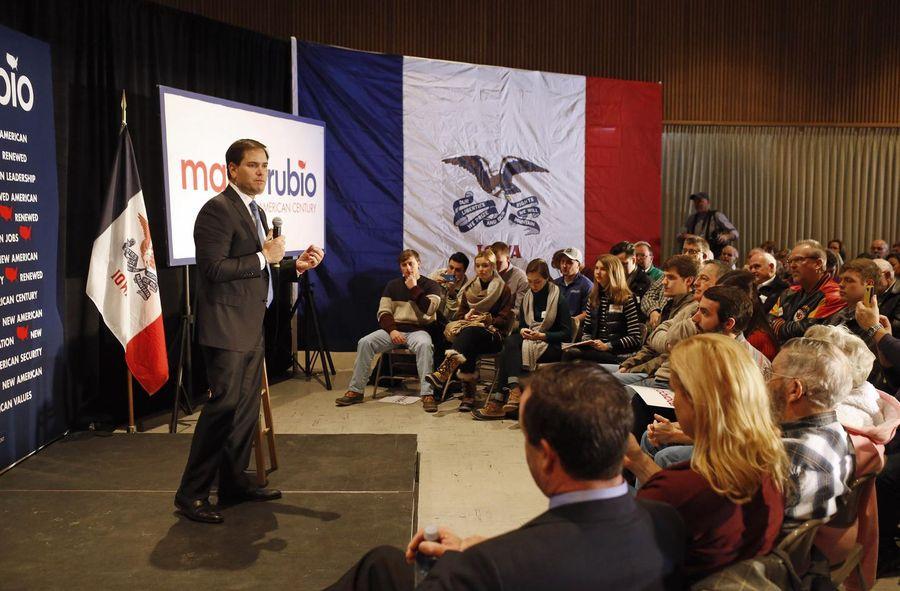
These well-worn byways lead to libraries at community colleges, speeches before the Iowa Pork Producers Association and town hall meetings in pubs, Holiday Inns, coffee houses and bowling alleys. It is in settings like these, and in larger venues such as Drake University in Des Moines and Iowa State University in Ames, where the Republican rebellion is being stoked or combated, and where the Democrats are struggling to win voters by debating who most ardently opposes powerful banks and business interests.
Late last week, for example, former Secretary of State Hillary Rodham Clinton stopped by the Berg Middle School in this central Iowa city, where, in a sign of the times, the onetime headquarters of the Maytag Washing Machine Co. has been transformed into a telecommunications complex. There the crowd lined up early for an education event and a “get-out-the-caucus” rally. For many of them, this was not the first time they had met Ms. Clinton, who campaigned here in 2008.
She and Sen. Bernie Sanders of Vermont are locked in an increasingly close and increasingly bitter battle to emerge unscathed from Iowa. Mr. Sanders criticized his rival for leaving Iowa Wednesday for a fund-raising event among bankers in Philadelphia, saying she had raised millions from Wall Street “and other special interests.” Nearly half of likely Democratic caucus goers describe themselves as anti-Wall Street, according to a Bloomberg/Des Moines Register poll this month.
Lies, Assault and Cover-ups Don't Stop Donald Trump
Trump Stands by His Man; Obama on a Health Scourge; Hayden Interview; Reagan's Courage
Analysis: For Trump, Few Limits to Win-At-Any-Cost Approach
What If Clinton Isn't Indicted?
Among Republicans, Iowa remains a struggle between Sen. Ted Cruz, who held a lead earlier this month but who had a tough debate night Thursday, and billionaire Donald Trump, who again dominates polls and the conversation even as he withdrew from the final Iowa debate. By stealing away during the debate, he may have stolen the show.
The biggest question in American politics is the staying power of Mr. Trump, who increasingly is taking on the manner of a character from Edith Wharton: “Formerly, when he was not sure of his ground, it had been his way to turn the difficulty by glib nonsense or easy irony; now he was actually dull, at times pompous.”
Mr. Cruz, too, is often portrayed as unlikeable, with some of his critics (among them fellow senators and other Republican grandees) insisting he is insufferable. In the past week he came under withering attack from two former Iowa caucus winners who again are in the hunt, former Sen. Rick Santorum of Pennsylvania (the 2012 winner) and former Gov. Mike Huckabee of Arkansas (the 2008 winner). Even GOP Gov. Terry Branstad, until now scrupulously neutral, urged Iowans to spurn Mr. Cruz because of his opposition to subsidies for corn ethanol, a favored local industry.
The consensus among political professionals is that Mr. Cruz doesn’t even qualify for William Allen White’s devastating critique of William McKinley as one who “shook hands with exactly the amount of cordiality and with precisely the lack of intimacy that deceived men into thinking well of him.” But winning favor among political professionals is not the goal of a man whose entire campaign is predicated on destroying the political establishment those professionals personify and represent.
This is the rare situation where as the cold deepens — the forecast calls for 28-degree temperatures at caucus time Monday night — the gloves have come off.
Mr. Trump and Mr. Cruz have fought for the past 10 days, but Mr. Trump is depending largely upon Iowans who have never caucused before. Mr. Cruz’s constituency, largely among religious conservatives, has been participating in caucuses for more than a quarter-century. “I believe [Mr. Cruz] is a once-in-a-generation movement conservative — that’s how excited I am about him,” says Bob Vander Plaats, an influential social conservative who helped Mr. Santorum prevail in the caucuses four years ago.
These disputes are playing out across a state that, as the 1938 Work Projects Administration Guide to Iowa pointed out, possesses “a shape somewhat similar to that of the United States.” Iowans will travel to caucus sites in a political climate where nine out of 10 Republicans believe the country is going in the wrong direction — and where three-fifths of Republican primary voters consider themselves conservatives, according to a Wall Street Journal/NBC News Poll this month. Some 58 percent of them back Mr. Cruz or Mr. Trump. And by a four-to-one margin they are drawn to candidates who present themselves as representing “change.”
But this campaign, in which all but a few of the Republican candidates have emphasized if not enhanced their conservative credentials, has not necessarily improved the party’s profile, even among its own members. The Journal/NBC survey indicated that more than two out of five GOP voters have a less favorable impression of the party.
In his classic 1974 history of Iowa, the former University of Northern Iowa historian Leland L. Sage counted among the instruments of change in the state “the advent of the power-driven tractor, the combine and the auto truck,” which, he wrote, opened the way to “the replacement of horse-drawn farm implements.” In more recent years, along with the increased emphasis on soybeans, the change in the nature of political campaigning and the emergence of Iowa at the front of the political calendar have transformed the state from a remote laboratory of agrarian science and governance to a prominent testing ground for presidential politics.
“We have learned that the activist base of the Republican Party is really fed up with business as usual,” says Dennis J. Goldford, a Drake University political scientist studying his eighth Iowa caucus. “Since last summer it has been clear that the more conventional business-oriented candidates have decided that Iowa is not a place to fight it up. This is now the fight to see who emerges as the religious, populist outsider candidate.”
Iowa is about to speak. Three years out of four it speaks in a whisper. But in election years, it shouts along the Main-Travelled Roads. Monday night, all America will be listening.

Newsom Defies Voters, Juries and Lawmakers To Spare Murderers While Defending Abortion
Curtis Hill • RealClearPolitics
The Algorithmic Tilt
Frank Filingeri • RealClearPolitics
A RealClear Thanksgiving: Investing in a Better Future
David DesRosiers • RealClearPolitics
Trump’s Newsom Problem: Antagonist-in-Chief
Carolina Lumetta • RealClearPolitics
America’s Free Spirit
John Maxwell Hamilton • RealClearPolitics
The GOP Majority Should Go Out in Glory
Daniel McCarthy • RealClearPolitics
RCP Today
Top stories on RealClearPolitics
The Takeaway
Polling intelligence and analysis delivered to your inbox
World News
Featuring the latest world news
Policy
Featuring the latest policy news
Support Our Mission
As part of RealClearPolitics, authors aim to provide balanced, non-partisan analysis by presenting top reporting and commentary from all sides of the political spectrum.
Trusted by policymakers and citizens alike since 2000