The Hatred More Powerful Than a Mother's Love
Published Dec. 7, 2015 • Read time: 13m
Spilt across their cluttered kitchen counter was the last meal enjoyed by Tashfeen Malik and her husband, Syed Farook. Along with orange juice and paratha bread were bottles of Adderall and Xanax pills prescribed to steady the nerves.
Unwashed dishes lay in the sink of the modest two-bedroom home at 53 North Center Street in Redlands, California.
There were boxes of Pampers nappies and tins of Nido and Cerelac powdered baby milk for their six-month-old daughter.
On the sitting room table was a Koran, one of many religious books including Common Mistakes Regarding Prayer and a slim volume called Islamic Manners. Two sets of prayer beads lay on a bed.
The drugs could have been much more than an aid to relieving the stress of young newlyweds — she was 29 and he 28 — coping with their first baby.
They might help to explain how the devout Muslim couple could walk into a Christmas event linked to Farook’s work in nearby San Bernardino and calmly spray his colleagues with bullets, killing 14 and injuring 21.
Most extraordinary of all was the fact it was Malik who took the lead, opening fire before her husband.
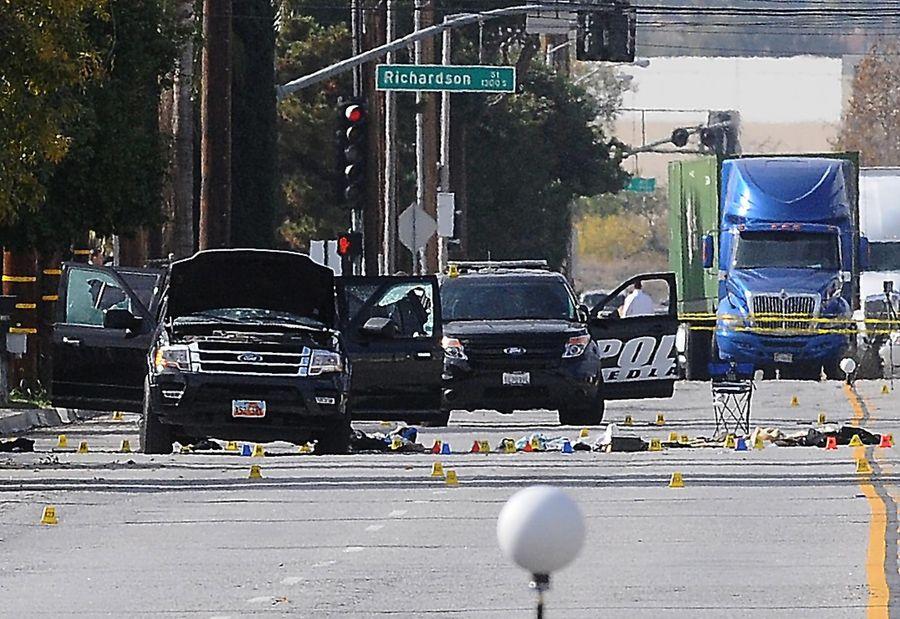
The couple’s murderous spree took less than four minutes. Afterwards they walked slowly and deliberately out of the building and climbed back into their rented black Ford Expedition 4x4.
Dressed in black and wearing tactical vests with magazines and more than 1,600 rounds of ammunition in their pockets, they were still each carrying an AR-15-style assault rifle and 9mm pistol.
Before they left, they tried to detonate a remote-controlled explosive device made of three pipe bombs in a bag. It failed to explode, probably because a stray bullet had activated the sprinkler system.
Is Trump Right About NATO?
Over Here: Competence Amid Repulsive Politics
We're Not a Poor Country, Donald
U.S. Officials Say 2 Americans Died in Brussels Attack
Around the time of the attack, Malik used a “war name” on Facebook to pledge her loyalty to Isis and its leader, Abu Bakr al-Baghdadi. The couple then avoided the police for some four hours before staging a last stand and dying together in a hail of bullets.
It was the worst terrorist atrocity on American soil since the September 11, 2001, attacks on New York and Washington.
So were the perpetrators “self-radicalised” Islamists or could they have been directed by Isis or another group? Does the San Bernardino massacre represent an ominous new phase in the war against radical Islam, a next step after Paris, or is it yet another isolated “lone wolf” attack?
And who were the apparently ordinary husband and wife who deserted their baby daughter — now being looked after by social services — before committing an act of such unspeakable evil?
Earlier in the day, at about 9.30am, Farook had been among 80 fellow local government workers in a conference room inside the Inland Regional Centre, a complex in San Bernardino, a desert city 60 miles east of Los Angeles.
Many had chipped in for baby presents for Farook, an environmental health inspector based at the centre for five years, and his wife. An online baby registry in Malik’s name listed a large box of Pampers, Johnson’s safety swabs, a car seat and baby wash.
Among those gathered was Farook. “Ready to be bored?” one colleague joked with him. The event was a training session followed by a party and lunch.
At about 10.30am Farook got up abruptly and left, leaving his jacket on the back of the chair and files on the table.
Some say he slipped out, others that there was a heated discussion with Nicholas Thalasinos, 52, who identified as a messianic Jew and was a fervent supporter of Israel. Either way, it is now clear Farook’s departure was the precursor to a carefully planned attack carried out with devastating efficiency.
Once Farook was back at the house, the couple left their daughter with his mother, Rafia Farook, 62, telling her they had a doctor’s appointment to go to.
They then went to the garage, which contained what the FBI described as a “bomb factory” and arsenal. More than 4,000 rounds of ammunition, a dozen pipe bombs and scores of weapons and explosives components were later discovered there.
At 11am, less than 30 minutes after Farook had left the centre, he was back. The couple walked through the doors and took what witnesses described as “a stance”: she stood on the right of the door to the conference room, he was on the left as they pointed their long rifles at his astonished co-workers.
Farook appeared to hesitate, perhaps momentarily losing his nerve or maybe to seek out a specific victim, such as Thalasinos, with whom he had argued over whether Islam could call itself a peaceful religion.
It was Malik who pulled the trigger first, aiming semi- automatic fire at people gathered around a Christmas tree, knocking it sideways. There was bedlam as people were shot and fell. Others screamed and cried as they sought cover.
Middle managers, who had been examining ways of helping autistic and other disabled children and their families, dived under tables covered with festive decorations. That is where many of them died.
The luckier ones ran out a back door as Farook strode forward, stepping over overturned tables and bleeding victims and dumped the bag containing the explosive device on the same table he had been sitting at earlier.
Rather than pursue the workers into a back hallway, Farook and Malik left swiftly.
The centre could well have been only their first intended target that day and the bomb part of an attempt to lure as many police and other services as possible to the location.
Police did indeed arrive within a minute or two of the couple’s departure. Lieutenant Mike Madden, the first officer on the scene, described the “sensory overload” and “pure panic” among survivors, as he was assailed by the sounds of moaning and the smell of gunpowder and blood. “It was unspeakable, the carnage we were seeing,” he said.
The fact the Expedition SUV had been rented meant it would take longer for the police to trace the vehicle to the couple. But Farook had been identified by a colleague and within minutes his name was being broadcast on police scanners.
Quite what Farook and Malik did for the next four hours is unknown. But shortly after 3pm police spotted the Expedition driving close to North Center Street. They were travelling at a careful 15mph when San Bernardino police cruisers lit up their sirens and began a pursuit.
A bystander recorded the moment when Farook, who was driving, accelerated sharply while Malik, crouching on the back seat with her rifle, opened fire at the police, shattering the back window.
The couple hurled a fake pipe bomb into the path of the police cruisers and minutes later ground to a halt, the Expedition already riddled with bullets. Farook got out and was cut down by police bullets. Malik died inside the vehicle. Together, they had fired 76 rounds, the police 380.
Thalasinos was among the dead at the centre. Also killed were Michael Wetzel, 37, a father of six, and Bennetta Betbadal, 46, the wife of a police officer and a Christian who fled to America from Iran when she was 18 to escape Islamic extremism. Aurora Godoy, 26, the youngest killed, had a baby son.
____________________
When Malik arrived at Chicago’s O’Hare airport on July 27 last year after a flight that originated in Jeddah, Saudi Arabia, the FBI and US Department of Homeland Security had already carried out extensive background checks on her.
She had submitted her Pakistani passport and been fingerprinted but no red flags had been raised, despite her family originating from the city of Karor Lal Esan in Punjab province.
Pakistan’s Inter-Services Intelligence agency views Karor Lal Esan as a hotbed of support for jihadist groups, including Lashkar-e-Taiba. Javed Rabbani, Malik’s uncle, said that her father had become considerably more conservative after moving to Saudi Arabia.
Wearing a hijab covering her face, Malik was accompanied at O’Hare by Farook, her betrothed, and her future mother-in-law, also clad in conservative Islamic dress.
En route to Saudi Arabia 10 days earlier Farook and his mother had passed through immigration at Heathrow on visas permitting a six-month stay. MI5 is understood to be investigating whether they left the airport before flying on.
Before arriving at Chicago, Malik had been granted a K-1, or fiancée’s visa, allowing her to immigrate provided she married within 90 days.
Although born in Pakistan, she had been raised in Jeddah. A friend from school there, Sabeen Ahmed, described her as an “average student” who “didn’t particularly like Saudi Arabia’s conservative culture”.
But she returned to Pakistan to study, graduating in 2012 from Bahauddin Zakariya University in Multan, Punjab, with a degree in pharmacology.
That period in Pakistan is key to the FBI’s investigation. It was about that time during Malik’s visits to family in Karachi that they noticed signs of her radicalisation.
“She turned religious four years back and starting praying five times a day,” said her cousin Shoiab Ahmed. “She was extremely critical of Pakistan’s policies towards fellow Muslims in Afghanistan and operations in Waziristan.”
One former CIA officer said Malik and Farook’s coolness under fire and ability to kill so many people so quickly indicated “at least some degree of training, possibly in Pakistan”.
Intelligence sources have also suggested Malik might have been linked to the infamous Lal Masjid, or Red Mosque, in Islamabad, northeast of Karor Lal Esan.
The mosque is revered among Pakistani extremists. It has named a library in honour of Osama bin Laden and in 2014 its female madrasah students published a video praising Isis leader Baghdadi.
According to a close friend of Malik, who did not want to be named, the couple had been influenced by the preachings of Anwar al-Awlaki, an extremist imam killed by a US drone strike in Yemen in 2011.
One theory being worked on by the FBI is that Malik was already radicalised by the time she arrived on US soil. Far from being a young graduate pursuing love and the American Dream, this theory goes, she was already intent on attacking the country from within.
In an echo of the proclivity of Isis to combine its medieval fundamentalism with the tools of the 21st century, Malik had first met Farook online.
He had a profile on the dating website iMilap.com using the moniker “farooksyed49”. It stated he enjoyed “working on vintage and modern cars, reads religious books” and “enjoys eating out” as well as “travelling and just hanging out in the backyard doing target practice”.
The FBI believes this may show Farook was the victim of a jihadist “honeytrap” set by Malik in which she identified him as a potential accomplice; he was religious and proficient with guns. Crucially, his US citizenship gave her a means of getting into the country. If the theory holds, it will signify a level of sophistication and pre-planning by Isis that should strike fear into the hearts of the US security establishment.
During most of the 17 months leading up to the attack, Malik lived with Farook and his mother at 53 North Center Street. She appears to have had no discernible online or social media presence. The only known photograph of her is the 2014 image taken by immigration officials.
This remarkably low public presence could have simply befitted a devout Muslim woman. It might also have been an operational tactic designed to keep her profile low and avoid interest from authorities.
Three weeks after her arrival, Malik and Farook married at the Islamic Centre mosque of Riverside, 20 miles southwest of Redlands. That qualified her for a green card, or permanent resident’s visa. She was in America to stay.
Aged 27 when she married, Malik was her husband’s senior and on the older side for a Pakistani bride and appears to have been the more dominant figure in their marriage
By contrast, Farook, born in Chicago and therefore an American citizen, was westernised. He graduated from California State University, Fullerton with a degree in environmental engineering.
For the past five years had Farook worked for the county health department, checking food surfaces at restaurants and chlorine levels in public swimming pools.
Farook earned about $70,000 (£46,000) a year. Thin and about 6ft tall, he was shy and rarely started a conversation but was liked by colleagues. He was very religious, sometimes attending prayers at the Islamic Centre mosque as early as 4.30am and again in the evening. At Friday services he wore traditional long robes.
Christian Nwadike, who worked with Farook for five years, noticed a change after his wedding. “I think he married a terrorist,” he said.
____________________
Before The Sunday Times was given access to 53 North Center Street the FBI removed computers, thumb drives, photographs and documents as well as all the weapons and explosives paraphernalia.
David Bowdich, the FBI assistant director leading the investigation, said he hoped the “electronic media” seized would provide the “golden nuggets” that would answer many of the questions over what happened in Redlands and San Bernardino.
Neither Malik nor Farook were being watched by the US authorities, but it has emerged that Farook had been in contact with five people linked to terrorist investigations. They included at least one connected to the Somalia-based al- Shabaab, and one allied with the al-Nusra Front, the Syrian branch of al-Qaeda.
Among items discovered in the house were “miniature Christmas tree lamps”. An issue of Inspire, an online al-Qaeda magazine, included an article “Designing a timed hand grenade” with instructions to make a delayed igniter with a Christmas tree lamp.
The FBI found evidence that in their final days the couple tried to erase their electronic footprints, destroying devices.
Two smashed mobile phones were discovered in a rubbish bin near the home; Malik had what appeared to be a “burner phone” — one meant to be used for a short time and discarded — on her body.
In an online radio bulletin yesterday Isis claimed credit for the attack, hailing Farook and Malik as “martrys”.
James Comey, the FBI director, said the couple had shown signs of “potential inspiration by foreign terrorist organisations”, but there was no indication they were part of a broader terror cell.
Nada Bakos, a former CIA analyst who specialised in tracking al-Qaeda in Iraq (AQI), the forerunner of Isis, said if it turned out that Malik had been the “operational leader” of the attack, it could be “a game changer” for the West.
“Radicalisation and violence is not gender specific,” said Bakos. “Women are entirely capable of it. She was in the perfect situation to be able to pull it off. She was here legally and not on anyone’s radar.”
At the start of this year, Isis sought the release of Sajida Mubarak Atrous al-Rishawi, a female AQI suicide bomber whose device failed to detonate during a 2005 attack in Amman. The Jordanians executed her after Isis burnt one of its pilots to death.
Back at North Center Street, Doyle Miller, 81, the couple’s landlord, pondered Malik’s role in the relationship as he surveyed the wreckage of his property after the FBI had smashed down the door and ripped holes in the walls.
“She did not like to be seen,” he said. “She did not seem to like people around here. He seemed ordinary, no worries for me at all. I’m only now thinking that maybe she wore the pants. It could be that she was behind it all.”
Additional reporting: Ali Chishti, Karachi, and Aoun Sahi, Islamabad
This article originally appeared in The Sunday Times. It is reprinted here with permission.

A RealClear Thanksgiving: Investing in a Better Future
David DesRosiers • RealClearPolitics
Trump’s Newsom Problem: Antagonist-in-Chief
Carolina Lumetta • RealClearPolitics
America’s Free Spirit
John Maxwell Hamilton • RealClearPolitics
The GOP Majority Should Go Out in Glory
Daniel McCarthy • RealClearPolitics
Republican Majorities Could Return Sooner Than Expected
J.T. Young • RealClearPolitics
The Danger Before the Attack
Leslie J. Sullivan • RealClearPolitics
RCP Today
Top stories on RealClearPolitics
The Takeaway
Polling intelligence and analysis delivered to your inbox
World News
Featuring the latest world news
Policy
Featuring the latest policy news
Support Our Mission
As part of RealClearPolitics, authors aim to provide balanced, non-partisan analysis by presenting top reporting and commentary from all sides of the political spectrum.
Trusted by policymakers and citizens alike since 2000