Undaunted Christie Hopes N.H. Rewards His Grit
Published Nov. 12, 2015 • Read time: 12m
Join the Conversation
0CONCORD, N.H. — As Chris Christie arrived Friday at the New Hampshire statehouse to file his paperwork for the state’s pivotal presidential primary, he and his underdog campaign seemed to have reached a major turning point.
Whether that moment marked a breakthrough or a breakdown, however, wasn’t altogether clear.
On the one hand, the New Jersey governor and his supporters who crowded the secretary of state’s office had ample reason to be buoyant. New polling showed Christie jumping into contention in the state, and a Huffington Post video of him talking about drug addiction had recently gone viral. Meanwhile, he was wowing local audiences and had performed well in televised debates.
But, just the prior evening, Christie had been dealt a stunning setback when Fox Business Channel announced he would not participate in its prime-time GOP debate, airing Tuesday from Milwaukee. Instead, he would be relegated to the undercard round, to that stage where presidential candidacies seemingly go to die.
When the two-term governor sat down to speak with reporters after filing his paperwork, however, he projected certainty that the setback would not be a death sentence. “I’ve never had difficulty making an impression,” he insisted.
And, indeed, Christie posted another steady debate performance Tuesday, avoiding unnecessary tiffs with his Republican rivals and instead projecting electability by measuring himself against Hillary Clinton, the likely Democratic nominee.
“I'll tell you what I'll bring to the table: the fact that I've won in a blue state ... that I won re-election after governing as a pro-life conservative and got 61 percent of the vote,” he said. “That's the person you want on the stage prosecuting the case against Hillary Clinton.”
Lies, Assault and Cover-ups Don't Stop Donald Trump
Trump Stands by His Man; Obama on a Health Scourge; Hayden Interview; Reagan's Courage
Analysis: For Trump, Few Limits to Win-At-Any-Cost Approach
What If Clinton Isn't Indicted?
But the odds of him making it onto a stage with Clinton seem remote. Once the toast of the party’s establishment wing for his straight-talking style and magnetic political charisma, Christie finds himself in the unusual position of being overlooked among the crowded Republican field.
At the statehouse, one reporter asked: How would he conjure a breakout moment in New Hampshire, the state at the center of his primary strategy?
“I think I’m having one,” Christie countered. But, he then suggested, maybe it’s not a breakout moment that matters. “I don’t think New Hampshire reacts necessarily to a breakout moment. My impression is it’s a cumulative effect.”
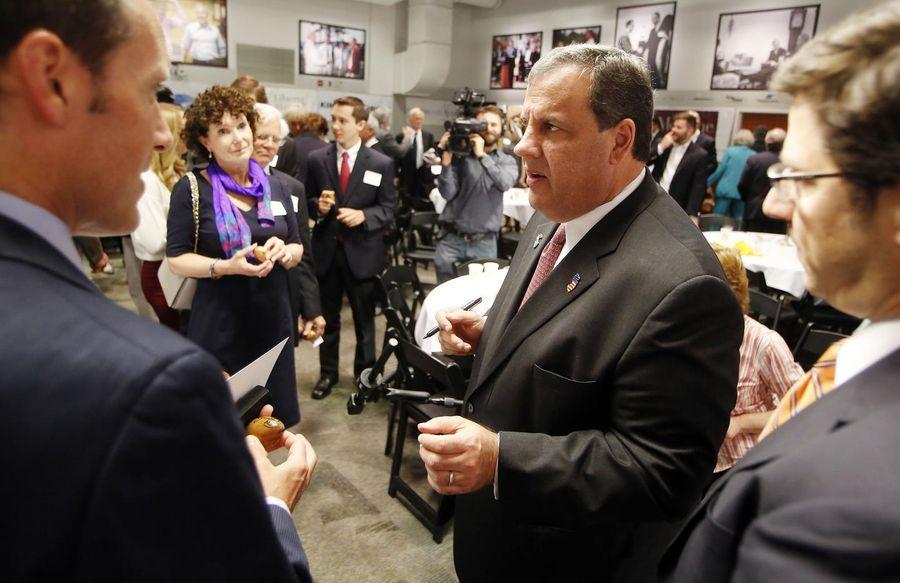
Christie’s campaign so far reflects that working hypothesis. He has spent more time in the state than any candidate except Sen. Lindsey Graham, seemingly taking a page from the John McCain playbook and its focus on freewheeling, long-winded town-hall events. The format suits Christie, playing up his sitcom-dad persona -- equal parts tough love and relatability -- while showcasing his knack for explaining policy issues. Both qualities set him apart from many of his GOP competitors.
“What I do best,” he told reporters, “is to stand in the center of a room and answer questions from people until they’ve got no questions left.”
This model has proven successful in New Hampshire. The conventional wisdom that emerged from McCain’s two presidential campaigns in the Granite State was that an underdog candidate without money or infrastructure could triumph through sheer grit alone.
But polling indicates voters here have not yet rewarded the same work ethic or earnestness in this election’s crop of Republican candidates. Christie, who marked his 30th state town-hall event Friday, is still stuck in single digits in New Hampshire; Donald Trump, who has only logged four, is comfortably in the lead.
If the new dynamic is unnerving to Christie, he hasn’t shown it. On the campaign trail last week, he reasoned that most voters will not make up their minds until a week or two before the Feb. 9 primary, although the polling does not reflect their lingering indecision.
“Feel the weather out there,” he said Friday — a bright, sunny day with temperatures in the 60s. “Doesn’t feel like voting weather to me, not in New Hampshire.”
Walt Havenstein, a former gubernatorial candidate who endorsed Christie at a stop in Nashua on Thursday, has seen first-hand how the state’s electorate can shift: In his own race, in 2014, he went from 20 points down in May to a five-point loss to incumbent Gov. Maggie Hassan on Election Day.
“With politics and campaigning in particular, I draw analysis with physics. And it is not a series of impulse functions, those moments, unless it’s a bad one. It is constant pressure moving the ball forward,” Havenstein said. “And I think Gov. Christie’s strategy in New Hampshire is absolutely perfect.”
And so, head down and blinders on, Christie has resolved to keep doing exactly what he has been, and more of it: On Friday, he marked his 45th day of campaigning in the state this year. But the campaign slog ahead remains daunting. Christie not only must out-maneuver a challenging primary field, but he faces growing skepticism. A scathing New York Times editorial recently advised him to “go home.”
“It’s that time in the ever-long presidential campaign when candidates lacking money and mojo are starting to go back to their plows,” the editorial board wrote. “Gov. Chris Christie of New Jersey should join them.”
But Christie continues to campaign, undaunted. If Jeb Bush’s recent tour of New Hampshire resembled a public therapy session, as characterized by the Washington Post, where he hemmed and hawed about his flaws as a candidate, Christie’s was a defiant show of force and confidence.
“I’m not one of these guys today campaigning up here in this state who complains about this ‘Oh, I wish it was different, I wish it was better, it’s not what I thought it would be, I’m concerned.’ Going through self-analysis, ‘I’m entitled to this,’” Christie said Friday morning at a town-hall gathering in Somersworth, N.H., seemingly alluding to Bush. “No, I want to be president of the United States. I want to take on these challenges. That’s why I’m here.”
Bush’s would-be comeback tour signaled a new phase of the campaign in New Hampshire, and possible complications for Christie. Suddenly, the Granite State is must-win turf for the former Florida governor — just as it is for Christie, Ohio Gov. John Kasich, and a herd of other candidates. Meanwhile, Donald Trump and Ben Carson still loom large in the polls. The small state is growing crowded.
And the campaigns are accelerating their efforts to win over other candidates’ supporters —including Paul Clark, a Nashua-based activist and member of Christie’s grassroots leadership team in the state. On Friday, as Clark stood in the secretary of state’s office wearing a Christie-for-president T-shirt, he described how Bush’s campaign was attempting to lure him to sign on with a meeting this week.
“But I’m not going to do it,” Clark chuckled. He still thinks Christie could win or finish second in New Hampshire.
As an undisputed underdog, Christie’s hope is that the unsettled landscape will favor a come-from-behind candidacy such as his. In conversations with donors, he makes the case that there is no longer a “safe bet” in the Republican race for president.
“What I say to donors is, either you believe in me or you don’t. If you’re betting on me because you think I’m a safe bet, I’m not a safe bet,” Christie told RealClearPolitics. “But in this race now, there are no safe bets.”
“They all bet on the ‘safe bet’ before,” he added, referring obliquely to early donor support for Bush. “Doesn’t look so safe anymore.”
Christie, of course, is not a safe bet in any sense. He finds himself far down in the polls in part because of political scars from the Bridgegate scandal, although he has not been shown to have been directly involved. And he is apart from and more moderate than many of his Republican challengers on key policy issues — in ways that could pay off, but are also risky.
For example, it has become fashionable among Republicans to name the federal department or agencies they would get rid of. Many point to the IRS. Marco Rubio recently suggested doing away with the Department of Education. In the Republican debate Tuesday, Ted Cruz named four.
But when Christie was asked in Nashua on Thursday what departments or agencies he would eliminate, he didn’t name a single one. Instead, he said he would prefer to make strategic budget cuts across the board.
In his interview with RCP, Christie explained that doing away with the Department of Education, for example, is “not a top priority of mine.”
“The Department of Education is a relatively small part of the federal budget compared to the 71 percent we’re spending on debt service and entitlements,” he said, nodding to an issue, entitlement reform, that he has put at the center of his campaign. “So my style of leadership is to deal with the biggest problems first.”
Nor did he echo another popular refrain on the Republican campaign trail: getting the federal government out of education entirely. Instead, he said, he believes it is the role of the federal government to “[encourage] excellence” with the power of the purse.
“I think if the federal government wants to be involved in education, it should be helping with funding,” Christie said, adding that funding nevertheless should have “few if any strings attached.”
And, at a time when Republican candidates are tripping over themselves to strip more money and powers from the federal government, Christie would wrest back from the states the authority to decide whether marijuana should be legal — enforcing the federal laws on the books and expending more federal resources in the process.
“Frankly, I do believe a national policy on the use of dangerous drugs is something that makes sense,” he explained. “From my perspective, there should be one uniform system of what is allowed to be consumed in this country and what isn’t, and I think the federal government’s the only place to do that.”
Christie has said the “war on drugs” was a failure because “we thought we could purely arrest our way out of the problem without doing other things.” Nevertheless, he believes the federal government would be equipped to lead the fight against drug abuse, marijuana included.
“You’ve got to curb the demand as well, and the way to curb demand is through treatment,” he said. Why include marijuana? “I’ve read lots of studies that make it clear it’s not good for you, that it’s addictive, that it’s a gateway to other drugs.”
On the campaign trail in New Hampshire, where heroin overdose deaths have spiked, drug abuse has become central to Christie’s stump speech — and, recently, his claim to fame in the GOP field. The Huffington Post video that captured a few minutes of him speaking about the stigma of drug addiction — in the same way he has when addressing small crowds for months — suddenly caught fire on the Internet.
Now, Christie has begun to update crowds on the video’s view count, which is nearing 7 million and climbing daily.
“I think that tells us something,” he said Thursday at a roundtable with local law enforcement and activists to discuss drug abuse and addiction. “It doesn’t tell us something about me, it tells us something about the nature and depth of this problem.”
Indeed, in an October poll conducted by WMUR, voters ranked drug abuse as the most serious problem in the state, ahead of jobs and the economy.
But the video’s success might say something about Christie, too. He and his supporters no doubt hope so. In a primary that has not yielded many tangible markers of success, for Christie, here was one.
Presidential campaigns often measure momentum by money raised, or polling, or high-profile endorsements. Christie has none of these metrics to tout. He told RCP he is not actively seeking endorsements from members of Congress.
“I don’t think that’s where this election is going to be won or lost,” he said.
Christie thinks and hopes the election will be won or lost in this small Northeastern state.
From the statehouse on Friday, he walked across the street to a corner bar and restaurant to meet a small group of supporters who had come to watch him file his paperwork. One day after the news that their candidate would not make the prime-time debate stage, it would not be easy to rally the troops.
But Christie pointed to one new poll, which showed his support in New Hampshire at 8 percent, edging out Bush at 7 percent.
“Our numbers in New Hampshire have quadrupled. We’re now ahead of Jeb Bush,” he said. “Let me guarantee you: Marco Rubio is next! And we’ll have some fun with my old friend The Donald.”
After 45 days in the Granite State, here was Christie’s sign of life. Here was the proof, thin as it was, that hard work and grit and retail politicking can still pay off.
“So what we need to do now is not let up. We need to double down,” Christie said. “That’s the way I always run campaigns: The minute you see an opening, the minute you see a little daylight — and the last two weeks, that’s what we’ve seen — you run twice as hard to that daylight.”
That evening, in our interview, he explained what that sliver of light had been for him.
“It was the [third] debate,” he said. “The reaction to the debate was really strong this time. And so, I felt like, OK, this is an opportunity for me now to double down and work even harder and to push the things that I think really need to be pushed.”
There is a hint of dramatic irony to this plot: that Christie’s breakthrough and breakdown moments would both come from debates, just weeks apart. As they give, they also take away.
In New Hampshire, Christie’s supporters were demoralized by the twist. At town-hall gatherings, they urged him to keep fighting, and he left little doubt that he would. But their evident frustration begged the question: Would they keep fighting for him?
It will be weeks before it is clear whether those backers will stick with Christie in light of his setback, or whether his steady performance in the undercard debate swayed anyone. In the meantime, the onus is on the Garden State governor to show supporters that he is, indeed, worth fighting for.
“What I tell them is, if you really believe that we’re on the right track and we’re doing the right things, then be patient,” Christie said. “We’ll get there.”

Newsom Defies Voters, Juries and Lawmakers To Spare Murderers While Defending Abortion
Curtis Hill • RealClearPolitics
The Algorithmic Tilt
Frank Filingeri • RealClearPolitics
A RealClear Thanksgiving: Investing in a Better Future
David DesRosiers • RealClearPolitics
Trump’s Newsom Problem: Antagonist-in-Chief
Carolina Lumetta • RealClearPolitics
America’s Free Spirit
John Maxwell Hamilton • RealClearPolitics
The GOP Majority Should Go Out in Glory
Daniel McCarthy • RealClearPolitics
RCP Today
Top stories on RealClearPolitics
The Takeaway
Polling intelligence and analysis delivered to your inbox
World News
Featuring the latest world news
Policy
Featuring the latest policy news
Support Our Mission
As part of RealClearPolitics, authors aim to provide balanced, non-partisan analysis by presenting top reporting and commentary from all sides of the political spectrum.
Trusted by policymakers and citizens alike since 2000